
基于MicroRNA的口腔舌鳞状细胞癌和颊鳞状细胞癌标志物:一种系统生物学方法
MicroRNA-Based Markers of Oral Tongue Squamous Cell Carcinoma and Buccal Squamous Cell Carcinoma: A Systems Biology Approach.
作者信息
Shojaei Setareh, Menbari Pouya, Jamshidi Shokoofeh, Taherkhani Amir
机构信息
Department of Oral and Maxillofacial Pathology, School of Dentistry, Hamadan University of Medical Sciences, Hamadan, Iran.
Department of Oral and Maxillofacial Pathology, School of Dentistry, Dental Research Center, Hamadan University of Medical Sciences, Hamadan, Iran.
出版信息
Biochem Res Int. 2023 Apr 24;2023:5512894. doi: 10.1155/2023/5512894. eCollection 2023.
OBJECTIVE
Oral tongue squamous cell carcinoma (OTSCC) and buccal squamous cell carcinoma (BSCC) are the first and second leading causes of oral cancer, respectively. OTSCC and BSCC are associated with poor prognosis in patients with oral cancer. Thus, we aimed to indicate signaling pathways, Gene Ontology terms, and prognostic markers mediating the malignant transformation of the normal oral tissue to OTSCC and BSCC.
METHODS
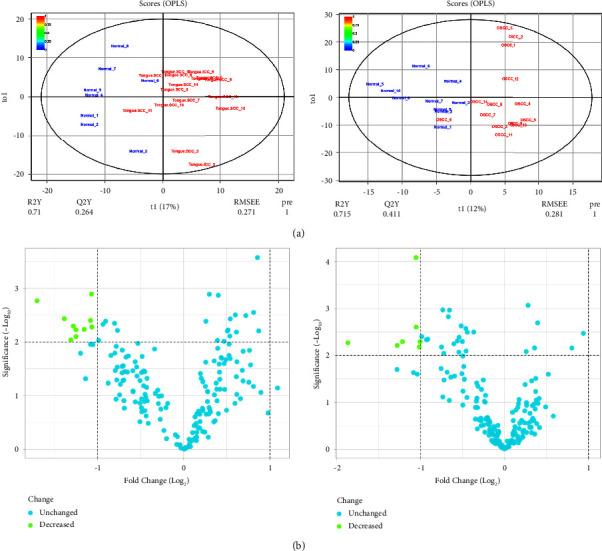
The dataset GSE168227 was downloaded and reanalyzed from the GEO database. Orthogonal partial least square (OPLS) analysis identified common differentially expressed miRNAs (DEMs) in OTSCC and BSCC compared to their adjacent normal mucosa. Next, validated targets of DEMs were identified using the TarBase web server. With the use of the STRING database, a protein interaction map (PIM) was created. Using the Cytoscape program, hub genes and clusters within the PIM were shown. Next, gene-set enrichment analysis was carried out using the g:Profiler tool. Using the GEPIA2 web tool, analyses of gene expression and survival analysis were also performed.
RESULTS
Two DEMs, including has-miR-136 and has-miR-377, were common in OTSCC and BSCC ( value <0.01; |Log2 FC| > 1). A total of 976 targets were indicated for common DEMs. PIM included 96 hubs, and the upregulation of EIF2S1, CAV1, RAN, ANXA5, CYCS, CFL1, MYC, HSP90AA1, PKM, and HSPA5 was significantly associated with a poor prognosis in the head and neck squamous cell carcinoma (HNSCC), while NTRK2, HNRNPH1, DDX17, and WDR82 overexpression was significantly linked to favorable prognosis in the patients with HNSCC. "Clathrin-mediated endocytosis" was considerably dysregulated in OTSCC and BSCC.
CONCLUSION
The present study suggests that has-miR-136 and has-miR-377 are underexpressed in OTSCC and BSCC than in normal oral mucosa. Moreover, EIF2S1, CAV1, RAN, ANXA5, CYCS, CFL1, MYC, HSP90AA1, PKM, HSPA5, NTRK2, HNRNPH1, DDX17, and WDR82 demonstrated prognostic markers in HNSCC. These findings may benefit the prognosis and management of individuals with OTSCC/BSCC. However, additional experimental verification is required.
目的
口腔舌鳞状细胞癌(OTSCC)和颊鳞状细胞癌(BSCC)分别是口腔癌的首要和第二大主要病因。OTSCC和BSCC与口腔癌患者的不良预后相关。因此,我们旨在指出介导正常口腔组织向OTSCC和BSCC恶性转化的信号通路、基因本体术语和预后标志物。
方法
从基因表达综合数据库(GEO数据库)下载数据集GSE168227并重新分析。正交偏最小二乘法(OPLS)分析确定了OTSCC和BSCC与其相邻正常黏膜相比共同的差异表达微小RNA(DEM)。接下来,使用TarBase网络服务器鉴定DEM的验证靶点。利用STRING数据库创建了蛋白质相互作用图谱(PIM)。使用Cytoscape程序展示了PIM中的枢纽基因和聚类。接下来,使用g:Profiler工具进行基因集富集分析。使用GEPIA2网络工具进行基因表达分析和生存分析。
结果
两个DEM,包括hsa-miR-136和hsa-miR-377,在OTSCC和BSCC中是共同的(P值<0.01;|Log2倍变化|>1)。共指出了976个共同DEM的靶点。PIM包括96个枢纽,真核翻译起始因子2亚基1(EIF2S1)、小窝蛋白1(CAV1)、RAN、膜联蛋白A5(ANXA5)、细胞色素c(CYCS)、肌动蛋白解聚因子1(CFL1)、原癌基因c-Myc(MYC)、热休克蛋白90α家族成员1(HSP90AA1)、丙酮酸激酶M2(PKM)和热休克蛋白A5(HSPA5)的上调与头颈部鳞状细胞癌(HNSCC)的不良预后显著相关,而神经营养酪氨酸激酶2(NTRK2)、不均一核糖核蛋白H1(HNRNPH1)\、解旋酶DDX17(DDX17)和WD重复结构域82(WDR82)的过表达与HNSCC患者的良好预后显著相关。“网格蛋白介导的内吞作用”在OTSCC和BSCC中明显失调。
结论
本研究表明,hsa-miR-136和hsa-miR-377在OTSCC和BSCC中比在正常口腔黏膜中表达下调。此外,EIF2S1、CAV1、RAN、ANXA5、CYCS、CFL1、MYC、HSP90AA1、PKM、HSPA5、NTRK2、HNRNPH1、DDX17和WDR82在HNSCC中显示为预后标志物。这些发现可能有助于OTSCC/BSCC患者的预后和管理。然而,还需要额外的实验验证。



 Zotero 插件