
一项结合生物信息学、网络药理学和实验方法的综合分析确定了鼻咽癌中表没食子儿茶素没食子酸酯(EGCG)靶点的关键基因。
An integrative analysis combining bioinformatics, network pharmacology and experimental methods identified key genes of EGCG targets in Nasopharyngeal Carcinoma.
作者信息
Yang Yuhang, Luo Wenqi, Feng Zhang, Chen Xiaoyu, Li Jinqing, Zuo Long, Duan Meijiao, He Xiaosong, Wang Wenhua, He Feng, Liu Fangxian
机构信息
Department of Otolaryngology Head and Neck Surgery, Affiliated Hospital of Guilin Medical University, Guilin, 541001, China.
Department of Pathology, Guangxi Medical University Cancer Hospital, Nanning, 530021, China.
出版信息
Discov Oncol. 2025 May 12;16(1):742. doi: 10.1007/s12672-025-02365-x.
BACKGROUND
Epigallocatechin gallate (EGCG), a frequently studied catechin in green tea, has been shown to be involved in the antiproliferation and apoptosis of human Nasopharyngeal carcinoma (NPC) cells. However, the pharmacological targets and mechanism by which EGCG can combat NPC patients remain to be studied in detail.
METHODS
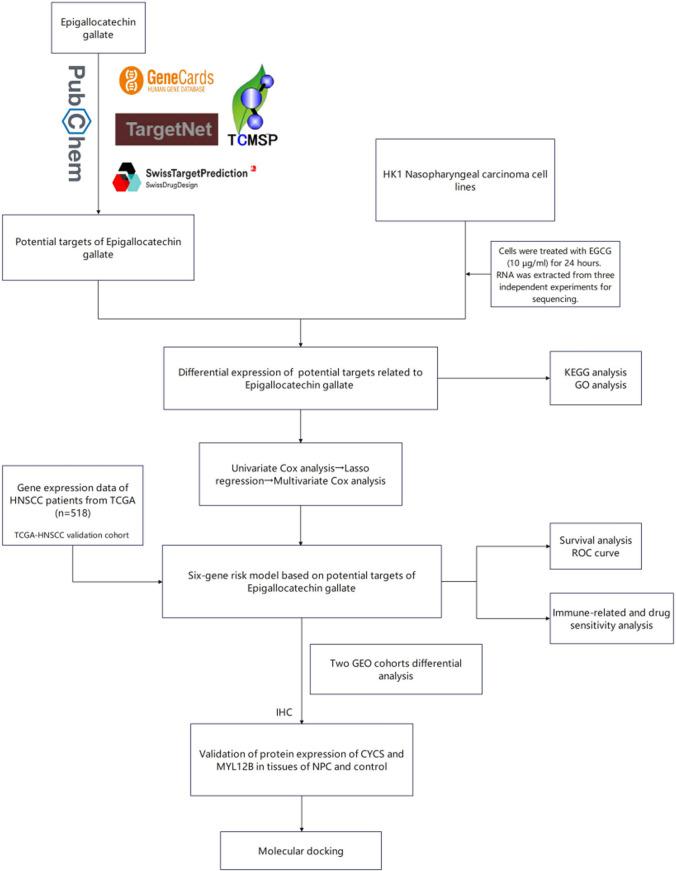
Network pharmacology and bioinformatics were employed to investigate the molecular mechanisms underlying EGCG's therapeutic effects on NPC, with an emphasis on developing a prognostic risk model and identifying potential therapeutic targets.
RESULTS
A novel prognostic risk model was developed using univariate Cox regression, LASSO regression and multivariable Cox regression analyses, incorporating six genes to stratify patients into low- and highrisk groups. Kaplan-Meier analysis demonstrated significantly shorter progression-free survival in the high-risk group. The model's accuracy was further validated using time-dependent Receiver Operating Characteristic (ROC) curves. ESTIMATE analysis revealed significantly higher immune, stromal and overall ESTIMATE scores in the low-risk group compared to the high-risk group. Immune profiling indicated significant differences in five immune cell subtypes (memory B cells, regulatory T cells (Tregs), gamma delta T cells, activated NK cells and activated dendritic cells) between the two risk groups. Additionally, the low-risk group showed greater sensitivity to conventional chemotherapeutic agents. Immunohistochemistry and molecular docking analyses identified CYCS and MYL12B as promising targets for EGCG treatment.
CONCLUSION
This study utilised network pharmacology and bioinformatics to identify shared genes between EGCG and NPC, aiming to elucidate the molecular mechanisms through which EGCG inhibits NPC and to develop a prognostic model for assessing patient outcomes. The findings provide potential insights for the development of anti-NPC therapies and their clinical applications.
背景
表没食子儿茶素没食子酸酯(EGCG)是绿茶中经常被研究的儿茶素,已被证明参与人类鼻咽癌(NPC)细胞的增殖抑制和凋亡过程。然而,EGCG对抗NPC患者的药理靶点和机制仍有待详细研究。
方法
采用网络药理学和生物信息学方法研究EGCG对NPC治疗作用的分子机制,重点是建立预后风险模型并确定潜在的治疗靶点。
结果
通过单变量Cox回归、LASSO回归和多变量Cox回归分析建立了一个新的预后风险模型,纳入六个基因将患者分为低风险和高风险组。Kaplan-Meier分析表明高风险组的无进展生存期明显缩短。使用时间依赖性受试者工作特征(ROC)曲线进一步验证了该模型的准确性。ESTIMATE分析显示,与高风险组相比,低风险组的免疫、基质和总体ESTIMATE评分显著更高。免疫图谱显示两个风险组之间在五种免疫细胞亚型(记忆B细胞、调节性T细胞(Tregs)、γδT细胞、活化的自然杀伤细胞和活化的树突状细胞)上存在显著差异。此外,低风险组对传统化疗药物表现出更高的敏感性。免疫组织化学和分子对接分析确定CYCS和MYL12B是EGCG治疗的有前景的靶点。
结论
本研究利用网络药理学和生物信息学方法确定EGCG和NPC之间的共享基因,旨在阐明EGCG抑制NPC的分子机制,并建立一个评估患者预后的预后模型。这些发现为抗NPC疗法的开发及其临床应用提供了潜在的见解。



 Zotero 插件