
内部串联重复(ITD)插入位点如何调控FLT3-ITD突变型急性髓系白血病的生物学特性及疾病发生
How ITD Insertion Sites Orchestrate the Biology and Disease of FLT3-ITD-Mutated Acute Myeloid Leukemia.
作者信息
Haage Tobias R, Schraven Burkhart, Mougiakakos Dimitrios, Fischer Thomas
机构信息
Department of Hematology and Oncology, Medical Center, Otto-von-Guericke University, 39120 Magdeburg, Germany.
Gesundheitscampus Immunology, Inflammation and Infectiology (GC-I3), Medical Center, Otto-von-Guericke University, 39120 Magdeburg, Germany.
出版信息
Cancers (Basel). 2023 May 30;15(11):2991. doi: 10.3390/cancers15112991.
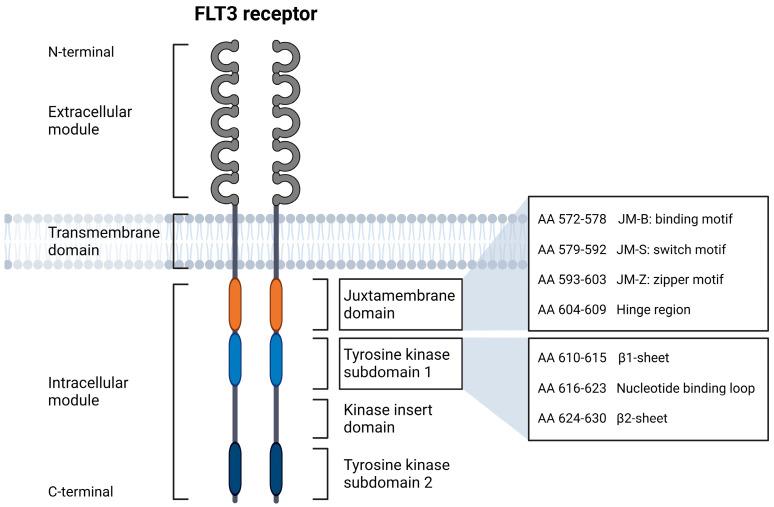
Mutations of the gene are among the most common genetic aberrations detected in AML and occur mainly as internal tandem duplications (FLT3-ITD). However, the specific sites of FLT3-ITD insertion within show marked heterogeneity regarding both biological and clinical features. In contrast to the common assumption that ITD insertion sites (IS) are restricted to the juxtamembrane domain (JMD) of FLT3, 30% of FLT3-ITD mutations insert at the non-JMD level, thereby integrating into various segments of the tyrosine kinase subdomain 1 (TKD1). ITDs inserted within TKD1 have been shown to be associated with inferior complete remission rates as well as shorter relapse-free and overall survival. Furthermore, resistance to chemotherapy and tyrosine kinase inhibition (TKI) is linked to non-JMD IS. Although FLT3-ITD mutations in general are already recognized as a negative prognostic marker in currently used risk stratification guidelines, the even worse prognostic impact of non-JMD-inserting FLT3-ITD has not yet been particularly considered. Recently, the molecular and biological assessment of TKI resistance highlighted the pivotal role of activated WEE1 kinase in non-JMD-inserting ITDs. Overcoming therapy resistance in non-JMD FLT3-ITD-mutated AML may lead to more effective genotype- and patient-specific treatment approaches.
该基因的突变是急性髓系白血病(AML)中最常见的基因畸变之一,主要表现为内部串联重复(FLT3-ITD)。然而,FLT3-ITD在该基因内的插入具体位点在生物学和临床特征方面均表现出显著的异质性。与常见观点认为ITD插入位点(IS)局限于FLT3的近膜结构域(JMD)不同,30%的FLT3-ITD突变插入在非JMD水平,从而整合到酪氨酸激酶亚结构域1(TKD1)的各个片段中。已表明插入TKD1内的ITD与较低的完全缓解率以及较短的无复发生存期和总生存期相关。此外,对化疗和酪氨酸激酶抑制(TKI)的耐药性与非JMD IS相关。尽管一般来说,FLT3-ITD突变在目前使用的风险分层指南中已被视为不良预后标志物,但尚未特别考虑非JMD插入型FLT3-ITD更差的预后影响。最近,对TKI耐药性的分子和生物学评估突出了活化的WEE1激酶在非JMD插入型ITD中的关键作用。克服非JMD FLT3-ITD突变型AML的治疗耐药性可能会带来更有效的基因型和患者特异性治疗方法。

 Zotero 插件