
用于准确鉴定细菌和真菌种类的阳性血培养液宏基因组测序:一项初步研究
Metagenomic Sequencing of Positive Blood Culture Fluid for Accurate Bacterial and Fungal Species Identification: A Pilot Study.
作者信息
Kamau Edwin, Yang Shangxin
机构信息
Department of Pathology and Laboratory Medicine, UCLA David Geffen School of Medicine, Los Angeles, CA 90095, USA.
出版信息
Microorganisms. 2023 May 10;11(5):1259. doi: 10.3390/microorganisms11051259.
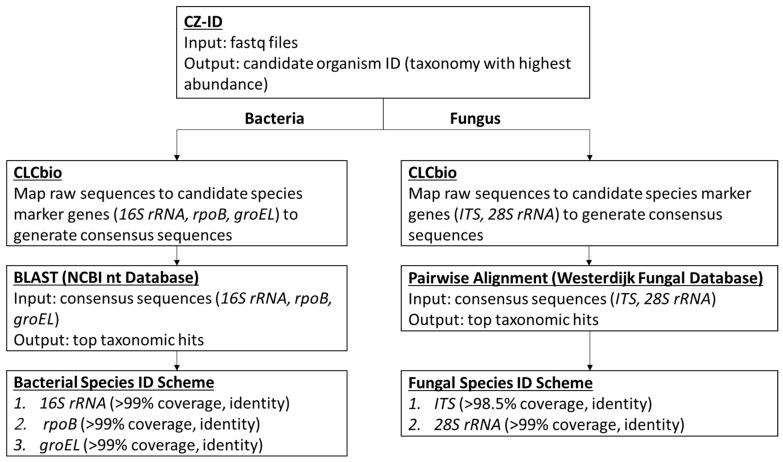
With blood stream infections (BSIs) representing a major cause of mortality and morbidity worldwide, blood cultures play a crucial role in diagnosis, but their clinical application is dampened by the long turn-around time and the detection of only culturable pathogens. In this study, we developed and validated a shotgun metagenomics next-generation sequencing (mNGS) test directly from positive blood culture fluid, allowing for the identification of fastidious or slow growing microorganisms more rapidly. The test was built based on previously validated next-generation sequencing tests, which rely on several key marker genes for bacterial and fungal identification. The new test utilizes an open-source metagenomics CZ-ID platform for the initial analysis to generate the most likely candidate species, which is then used as a reference genome for downstream, confirmatory analysis. This approach is innovative because it takes advantage of an open-source software's agnostic taxonomic calling capability while still relying on the more established and previously validated marker gene-based identification scheme, increasing the confidence in the final results. The test showed high accuracy (100%, 30/30) for both bacterial and fungal microorganisms. We further demonstrated its clinical utility especially for anaerobes and mycobacteria that are either fastidious, slow growing, or unusual. Although applicable in only limited settings, the Positive Blood Culture mNGS test provides an incremental improvement in solving the unmet clinical needs for the diagnosis of challenging BSIs.
血流感染(BSIs)是全球范围内导致死亡和发病的主要原因之一,血培养在诊断中起着关键作用,但其临床应用因周转时间长以及只能检测可培养病原体而受到影响。在本研究中,我们开发并验证了一种直接从阳性血培养液进行的鸟枪法宏基因组学下一代测序(mNGS)检测方法,能够更快地鉴定出苛求菌或生长缓慢的微生物。该检测方法基于先前经验证的下一代测序检测构建,后者依靠几个关键标记基因进行细菌和真菌鉴定。新检测方法利用开源宏基因组学CZ-ID平台进行初始分析,以生成最有可能的候选物种,然后将其用作下游验证性分析的参考基因组。这种方法具有创新性,因为它利用了开源软件的无偏见分类调用能力,同时仍依赖于更成熟且先前经验证的基于标记基因的鉴定方案,从而提高了对最终结果的信心。该检测方法对细菌和真菌微生物均显示出高准确性(100%,30/30)。我们进一步证明了其临床实用性,特别是对于苛求菌、生长缓慢的菌或不常见的厌氧菌和分枝杆菌。尽管仅适用于有限的情况,但阳性血培养mNGS检测方法在解决具有挑战性的血流感染诊断方面的未满足临床需求上提供了渐进式的改进。
 Zotero 插件