
木樨草素减轻大鼠肝星状细胞 HSC-T6 的肝纤维化:蛋白质组学分析。
Luteolin Alleviates Liver Fibrosis in Rat Hepatic Stellate Cell HSC-T6: A Proteomic Analysis.
机构信息
Institute of Clinical Pharmacology of Traditional Mongolian Medicine, Affiliated Hospital of Inner Mongolia Minzu University, Tongliao City, Inner Mongolia, People's Republic of China.
出版信息
Drug Des Devel Ther. 2023 Jun 17;17:1819-1829. doi: 10.2147/DDDT.S402864. eCollection 2023.
BACKGROUND
Traditional Chinese medicine (TCM) with single or compound materials is an effective cure for liver fibrosis. Hepatic stellate cells (HSCs) play a key role in liver fibrosis pathology and have become a novel drug target for this condition.
METHODS
CCK-8 assay was used to determine the cytotoxicity of four components, SYPA, HSYPA, Apigenin, and Luteolin, from Deduhonghua-7 powder on HSC-T6 cells. Transforming Growth Factor β 1 (TGFβ1)-induced fibrotic cell model and CCI-induced fibrotic rat model were constructed, the expression of fibrosis-related genes, the pathological changes and serum biochemical markers were evaluated. Proteomic analysis was performed to determine the mechanism by which luteolin attenuated liver fibrosis, which were further confirmed by Western blot.
RESULTS
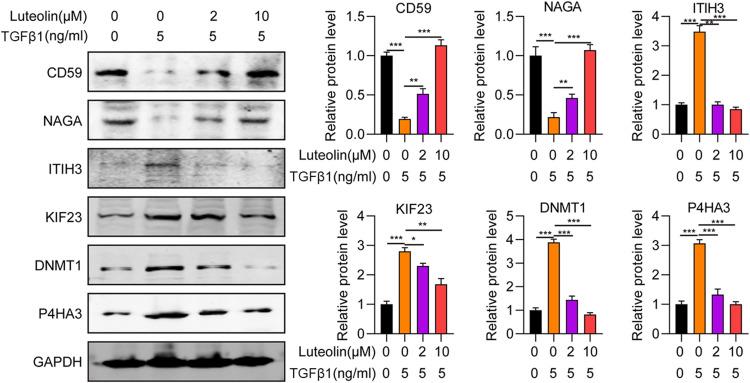
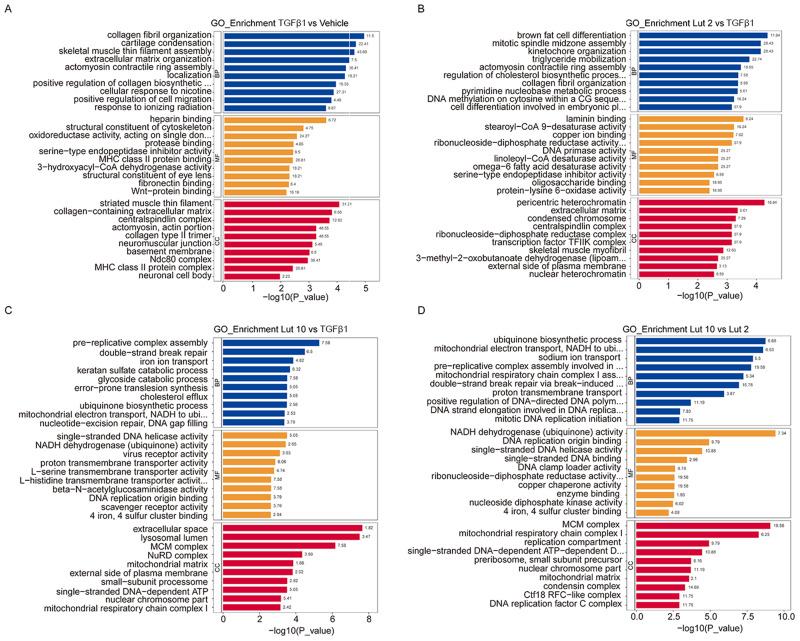
Luteolin attenuates liver fibrosis in HSC-T6 cells and luteolin decreases the liver fibrosis index level in vivo. A total of 5000 differentially expressed proteins (DEPs) were obtained using proteomic analysis. KEGG analysis found that DEPs were concentrated in various metabolic pathways, including DNA replication and repair and lysosomal signaling. GO analysis showed that molecular functions included the activity and binding of various enzymes, related cellular components included the extracellular space, lysosomal lumen, mitochondrial matrix, and nucleus, and biological processes included collagen organization and biosynthesis and the positive regulation of cell migration. Western blot results showed that CCR1, CD59, and NAGA were downregulated in TGFβ1 treatment, while upregulated both in Lut2 and Lut10 treatment. Meanwhile, eight proteins, ITIH3, MKI67, KIF23, DNMT1, P4HA3, CCDC80, APOB, FBLN2, that were upregulated in TGFβ1 treatment, while downregulated both in Lut2 and Lut10 treatment.
CONCLUSION
Luteolin was shown to have a strong protective effect on liver fibrosis. CCR1, CD59, and NAGA may promote liver fibrosis while ITIH3, MKI67, KIF23, DNMT1, P4HA3, CCDC80, APOB, and FBLN2 may facilitate protection against fibrosis.
背景
中药(TCM)单味或复方材料是治疗肝纤维化的有效方法。肝星状细胞(HSCs)在肝纤维化病理中起关键作用,已成为该疾病的新型药物靶点。
方法
采用 CCK-8 法测定 Deduhonghua-7 粉中四种成分 SYPA、HSYPA、芹菜素和木樨草素对 HSC-T6 细胞的细胞毒性。构建转化生长因子β1(TGFβ1)诱导的纤维化细胞模型和 CCI 诱导的纤维化大鼠模型,评价纤维化相关基因的表达、病理变化和血清生化标志物。采用蛋白质组学分析确定木樨草素减轻肝纤维化的机制,并用 Western blot 进一步验证。
结果
木樨草素可减轻 HSC-T6 细胞肝纤维化,体内可降低肝纤维化指数水平。蛋白质组学分析共获得 5000 个差异表达蛋白(DEPs)。KEGG 分析发现 DEPs 集中在各种代谢途径中,包括 DNA 复制和修复以及溶酶体信号转导。GO 分析表明分子功能包括各种酶的活性和结合,相关细胞成分包括细胞外空间、溶酶体腔、线粒体基质和核,生物过程包括胶原组织和生物合成以及细胞迁移的正调控。Western blot 结果显示,TGFβ1 处理时 CCR1、CD59 和 NAGA 下调,而 Lut2 和 Lut10 处理时均上调。同时,ITIH3、MKI67、KIF23、DNMT1、P4HA3、CCDC80、APOB、FBLN2 等 8 种蛋白在 TGFβ1 处理时上调,而 Lut2 和 Lut10 处理时均下调。
结论
木樨草素对肝纤维化具有较强的保护作用。CCR1、CD59 和 NAGA 可能促进肝纤维化,而 ITIH3、MKI67、KIF23、DNMT1、P4HA3、CCDC80、APOB 和 FBLN2 可能有助于抗纤维化保护。



 Zotero 插件