
肥胖对 15 种自身免疫性疾病风险的因果效应:一项孟德尔随机化研究。
The Causal Effect of Obesity on the Risk of 15 Autoimmune Diseases: A Mendelian Randomization Study.
机构信息
Department of Nephrology, The Second Affiliated Hospital of Anhui Medical University, Hefei, China,
Department of Infectious Disease, The Second Affiliated Hospital of Anhui Medical University, Hefei, China.
出版信息
Obes Facts. 2023;16(6):598-605. doi: 10.1159/000534468. Epub 2023 Oct 12.
INTRODUCTION
Observational studies have shown that obesity is a risk factor for various autoimmune diseases. However, the causal relationship between obesity and autoimmune diseases is unclear. Mendelian randomization (MR) was used to investigate the causal effects of obesity on 15 autoimmune diseases.
METHODS
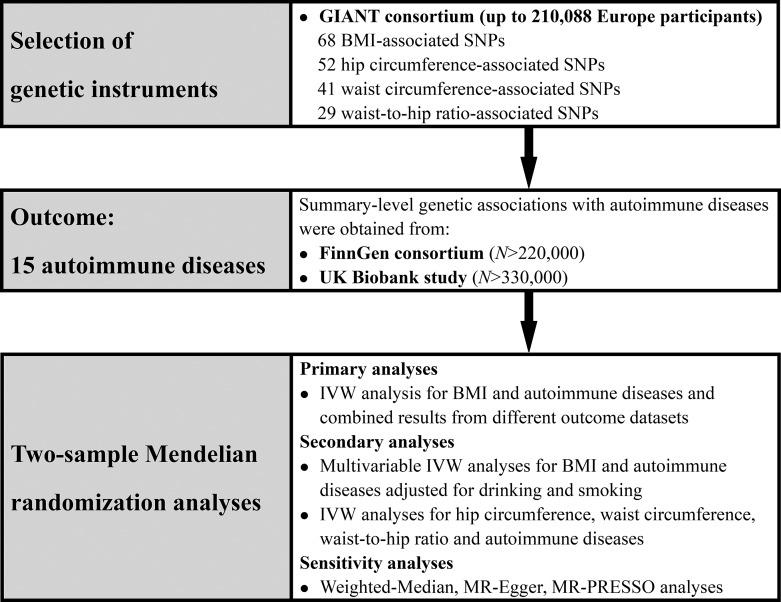
MR analysis employed instrumental variables, specifically single-nucleotide polymorphisms associated with obesity measures such as body mass index (BMI), waist circumference, hip circumference, and waist-to-hip ratio. The study utilized UK Biobank and FinnGen data to estimate the causal relationship between obesity and autoimmune diseases.
RESULTS
Genetically predicted BMI was associated with risk for five autoimmune diseases. The odds ratio per 1-SD increase in genetically predicted BMI, the OR was 1.28 (95% CI, 1.18-1.09; p < 0.001) for asthma, 1.37 (95% CI, 1.24-1.51; p < 0.001) for hypothyroidism, 1.52 (95% CI, 1.27-1.83; p < 0.001) for psoriasis, 1.22 (95% CI, 1.06-1.40; p = 0.005) for rheumatoid arthritis, and 1.55 (95% CI, 1.32-1.83; p < 0.001) for type 1 diabetes. However, after adjusting for genetic susceptibility to drinking and smoking, the correlation between BMI and rheumatoid arthritis was not statistically significant. Genetically predicted waist circumference, hip circumference, and waist and hip circumference were associated with 6, 6, and 1 autoimmune disease, respectively.
CONCLUSION
This study suggests that obesity may be associated with an increased risk of several autoimmune diseases, such as asthma, hypothyroidism, psoriasis, rheumatoid arthritis, and type 1 diabetes.
简介
观察性研究表明,肥胖是多种自身免疫性疾病的危险因素。然而,肥胖与自身免疫性疾病之间的因果关系尚不清楚。孟德尔随机化(MR)被用于研究肥胖对 15 种自身免疫性疾病的因果影响。
方法
MR 分析采用了工具变量,特别是与肥胖指标(如体重指数(BMI)、腰围、臀围和腰臀比)相关的单核苷酸多态性。该研究利用英国生物库和芬兰基因数据来估计肥胖与自身免疫性疾病之间的因果关系。
结果
遗传预测的 BMI 与五种自身免疫性疾病的风险相关。与遗传预测 BMI 每增加 1-SD 相比,OR 为 1.28(95%CI,1.18-1.09;p < 0.001),哮喘,1.37(95%CI,1.24-1.51;p < 0.001),甲状腺功能减退症,1.52(95%CI,1.27-1.83;p < 0.001),银屑病,1.22(95%CI,1.06-1.40;p = 0.005),类风湿关节炎,和 1.55(95%CI,1.32-1.83;p < 0.001),1 型糖尿病。然而,在调整了对饮酒和吸烟的遗传易感性后,BMI 与类风湿关节炎之间的相关性不再具有统计学意义。遗传预测的腰围、臀围和腰围与臀围之比与 6、6 和 1 种自身免疫性疾病相关。
结论
本研究表明,肥胖可能与多种自身免疫性疾病(如哮喘、甲状腺功能减退症、银屑病、类风湿关节炎和 1 型糖尿病)的风险增加有关。


 Zotero 插件