
基于人工智能的肿瘤浸润淋巴细胞空间分析用于预测结肠癌切除术后的预后
Artificial intelligence-powered spatial analysis of tumor-infiltrating lymphocytes for prediction of prognosis in resected colon cancer.
作者信息
Lim Yoojoo, Choi Songji, Oh Hyeon Jeong, Kim Chanyoung, Song Sanghoon, Kim Sukjun, Song Heon, Park Seonwook, Kim Ji-Won, Kim Jin Won, Kim Jee Hyun, Kang Minsu, Kang Sung-Bum, Kim Duck-Woo, Oh Heung-Kwon, Lee Hye Seung, Lee Keun-Wook
机构信息
Lunit, Seoul, Republic of Korea.
Department of Internal Medicine, Seoul National University Bundang Hospital, Seoul National University College of Medicine, Seongnam, Republic of Korea.
出版信息
NPJ Precis Oncol. 2023 Nov 20;7(1):124. doi: 10.1038/s41698-023-00470-0.
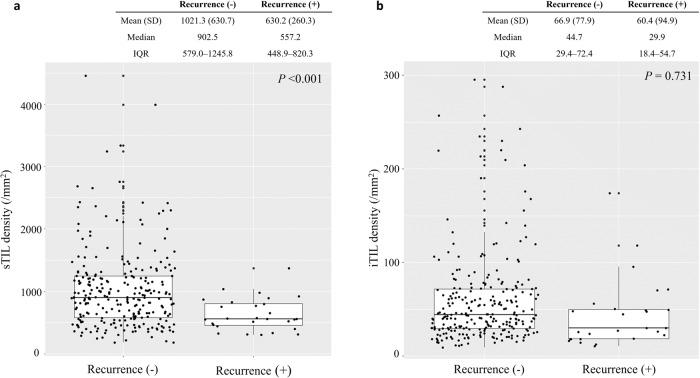
Tumor-infiltrating lymphocytes (TIL) have been suggested as an important prognostic marker in colorectal cancer, but assessment usually requires additional tissue processing and interpretational efforts. The aim of this study is to assess the clinical significance of artificial intelligence (AI)-powered spatial TIL analysis using only a hematoxylin and eosin (H&E)-stained whole-slide image (WSI) for the prediction of prognosis in stage II-III colon cancer treated with surgery and adjuvant therapy. In this retrospective study, we used Lunit SCOPE IO, an AI-powered H&E WSI analyzer, to assess intratumoral TIL (iTIL) and tumor-related stromal TIL (sTIL) densities from WSIs of 289 patients. The patients with confirmed recurrences had significantly lower sTIL densities (mean sTIL density 630.2/mm in cases with confirmed recurrence vs. 1021.3/mm in no recurrence, p < 0.001). Additionally, significantly higher recurrence rates were observed in patients having sTIL or iTIL in the lower quartile groups. Risk groups defined as high-risk (both iTIL and sTIL in the lowest quartile groups), low-risk (sTIL higher than the median), or intermediate-risk (not high- or low-risk) were predictive of recurrence and were independently associated with clinical outcomes after adjusting for other clinical factors. AI-powered TIL analysis can provide prognostic information in stage II/III colon cancer in a practical manner.
肿瘤浸润淋巴细胞(TIL)被认为是结直肠癌的一个重要预后标志物,但评估通常需要额外的组织处理和解读工作。本研究的目的是评估仅使用苏木精和伊红(H&E)染色的全切片图像(WSI)进行人工智能(AI)驱动的空间TIL分析对接受手术和辅助治疗的II-III期结肠癌预后预测的临床意义。在这项回顾性研究中,我们使用了AI驱动的H&E WSI分析仪Lunit SCOPE IO,从289例患者的WSI中评估肿瘤内TIL(iTIL)和肿瘤相关基质TIL(sTIL)密度。确诊复发的患者sTIL密度显著更低(确诊复发患者的平均sTIL密度为630.2/mm²,无复发患者为1021.3/mm²,p<0.001)。此外,sTIL或iTIL处于下四分位数组的患者复发率显著更高。定义为高风险(iTIL和sTIL均处于最低四分位数组)、低风险(sTIL高于中位数)或中风险(非高风险或低风险)的风险组可预测复发,并且在调整其他临床因素后与临床结局独立相关。AI驱动的TIL分析能够以实用的方式为II/III期结肠癌提供预后信息。



 Zotero 插件