
肌动蛋白细胞骨架重构破坏了感染的物理屏障,并使呼吸道合胞病毒呈现进入受体。
Actin cytoskeleton remodeling disrupts physical barriers to infection and presents entry receptors to respiratory syncytial virus.
机构信息
Department of Medical Microbiology and Immunology, University of Alberta, Edmonton, T6G-2E1, Canada.
Department of Biomedical Engineering, University of Virginia, Charlottesville, VA 22908,, USA.
出版信息
J Gen Virol. 2023 Nov;104(11). doi: 10.1099/jgv.0.001923.
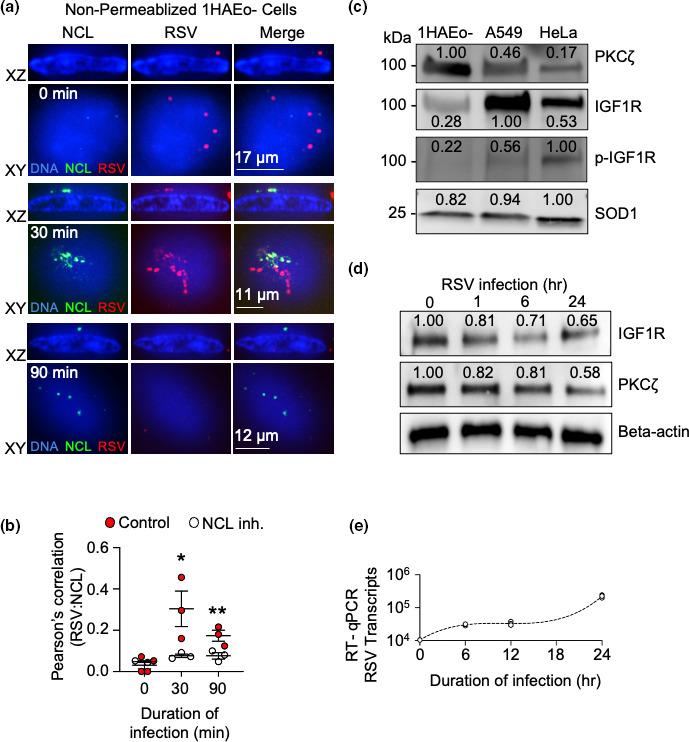
RSV is the leading cause of infant hospitalizations and a significant cause of paediatric and geriatric morbidity worldwide. Recently, we reported that insulin-like growth factor 1 receptor (IGF1R) was a receptor for respiratory syncytial virus (RSV) in airway epithelial cells and that activation of IGF1R recruited the coreceptor, nucleolin (NCL), to the cell surface. Cilia and mucus that line the airways pose a significant barrier to viral and bacterial infection. The cortical actin cytoskeleton has been shown by others to mediate RSV entry, so we studied the roles of the RSV receptors and actin remodelling during virus entry. We found that IGF1R expression and phosphorylation were associated with the ability of RSV to infect cells. Confocal immunofluorescence imaging showed that actin projections, a hallmark of macropinocytosis, formed around viral particles 30 min after infection. Consistent with prior reports we also found that virus particles were internalized into early endosome antigen-1 positive endosomes within 90 min. Inhibiting actin polymerization significantly reduced viral titre by approximately ten-fold. Inhibiting PI3 kinase and PKCζ in stratified air-liquid interface (ALI) models of the airway epithelium had similar effects on reducing the actin remodelling observed during infection and attenuating viral entry. Actin projections were associated with NCL interacting with RSV particles resting on apical cilia of the ALIs. We conclude that macropinocytosis-like actin projections protrude through normally protective cilia and mucus layers of stratified airway epithelium that helps present the IGF1R receptor and the NCL coreceptor to RSV particles waiting at the surface.
RSV 是导致婴儿住院的主要原因,也是全球儿科和老年科发病率的重要原因。最近,我们报道称胰岛素样生长因子 1 受体(IGF1R)是气道上皮细胞中呼吸道合胞病毒(RSV)的受体,IGF1R 的激活将共受体核仁素(NCL)募集到细胞表面。气道中的纤毛和黏液对病毒和细菌感染构成了重大障碍。其他人已经表明皮质肌动蛋白细胞骨架介导 RSV 的进入,因此我们研究了 RSV 受体和肌动蛋白重塑在病毒进入过程中的作用。我们发现 IGF1R 的表达和磷酸化与 RSV 感染细胞的能力有关。共聚焦免疫荧光成像显示,肌动蛋白突起,即巨胞饮的标志,在感染后 30 分钟形成于病毒颗粒周围。与之前的报道一致,我们还发现病毒颗粒在 90 分钟内被内化到早期内体抗原-1 阳性内体中。抑制肌动蛋白聚合可使病毒滴度降低约十倍。在气道上皮的分层气液界面(ALI)模型中抑制 PI3 激酶和 PKCζ 对减少感染过程中观察到的肌动蛋白重塑和减弱病毒进入具有类似的作用。肌动蛋白突起与 NCL 相互作用,与停留在 ALI 顶纤毛上的 RSV 颗粒相互作用。我们得出结论,类似巨胞饮的肌动蛋白突起通过正常保护的纤毛和黏液层突出,有助于将 IGF1R 受体和 NCL 共受体呈现给等待在表面的 RSV 颗粒。



 Zotero 插件