
敲除抑制性受体 TIGIT 可增强体外扩增 NK 细胞的抗肿瘤反应,并防止与治疗性 Fc 活性 TIGIT 抗体发生自相残杀。
Knockout of the inhibitory receptor TIGIT enhances the antitumor response of ex vivo expanded NK cells and prevents fratricide with therapeutic Fc-active TIGIT antibodies.
机构信息
Burnett School of Biomedical Sciences, University of Central Florida, Orlando, Florida, USA.
Abigail Wexner Research Institute at Nationwide Children's Hospital, Columbus, Ohio, USA.
出版信息
J Immunother Cancer. 2023 Dec 11;11(12):e007502. doi: 10.1136/jitc-2023-007502.
BACKGROUND
Inhibitory receptor T-cell Immunoreceptor with Ig and ITIM domains (TIGIT) expressed by Natural Killer (NK) and T cells regulates cancer immunity and has been touted as the next frontier in the development of cancer immunotherapeutics. Although early results of anti-TIGIT and its combinations with antiprogrammed death-ligand 1 were highly exciting, results from an interim analysis of phase III trials are disappointing. With mixed results, there is a need to understand the effects of therapeutic anti-TIGIT on the TIGIT immune cells to support its clinical use. Most of the TIGIT antibodies in development have an Fc-active domain, which binds to Fc receptors on effector cells. In mouse models, Fc-active anti-TIGIT induced superior immunity, while Fc receptor engagement was required for its efficacy. NK-cell depletion compromised the antitumor immunity of anti-TIGIT indicating the essential role of NK cells in the efficacy of anti-TIGIT. Since NK cells express TIGIT and Fc-receptor CD16, Fc-active anti-TIGIT may deplete NK cells via fratricide, which has not been studied.
METHODS
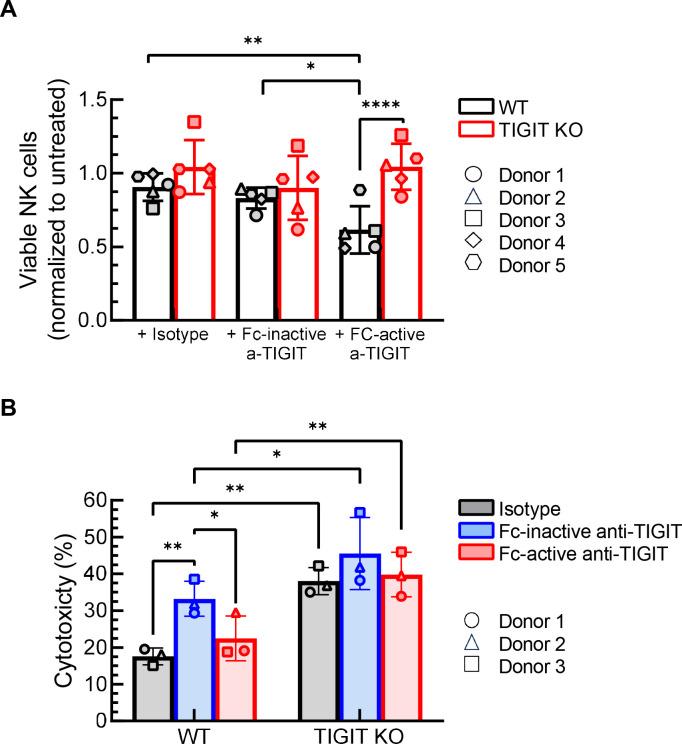
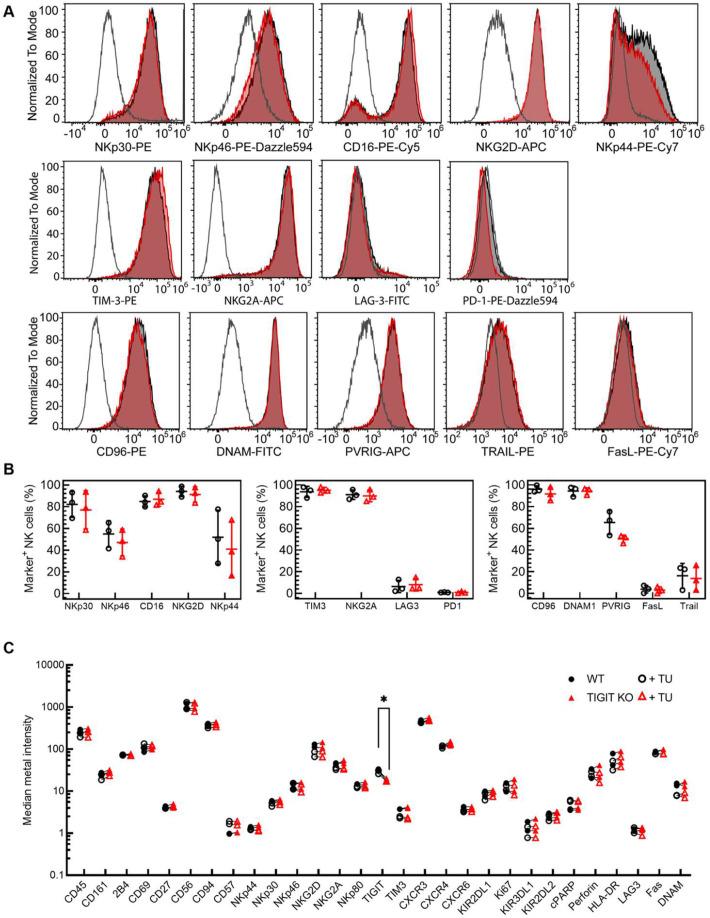
CRISPR-Cas9-based TIGIT knockout (KO) was performed in expanded NK cells. Phenotypic and transcriptomic properties of TIGIT KO and wild-type (WT) NK cells were compared with flow cytometry, CyTOF, and RNA sequencing. The effect of TIGIT KO on NK-cell cytotoxicity was determined by calcein-AM release and live cell imaging-based cytotoxicity assays. The metabolic properties of TIGIT KO and WT NK cells were compared with a Seahorse analyzer. The effect of the Fc-component of anti-TIGIT on NK-cell fratricide was determined by co-culturing WT and TIGIT KO NK cells with Fc-active and Fc-inactive anti-TIGIT.
RESULTS
TIGIT KO increased the cytotoxicity of NK cells against multiple cancer cell lines including spheroids. TIGIT KO NK cells upregulated mTOR complex 1 (mTORC1) signaling and had better metabolic fitness with an increased basal glycolytic rate when co-cultured with cancer cells compared with WT NK cells. Importantly, TIGIT KO prevented NK-cell fratricide when combined with Fc-active anti-TIGIT.
CONCLUSIONS
TIGIT KO in ex vivo expanded NK cells increased their cytotoxicity and metabolic fitness and prevented NK-cell fratricide when combined with Fc-active anti-TIGIT antibodies. These fratricide-resistant TIGIT KO NK cells have therapeutic potential alone or in combination with Fc-active anti-TIGIT antibodies to enhance their efficacy.
背景
表达于自然杀伤 (NK) 和 T 细胞的抑制性受体 T 细胞免疫受体 Ig 和 ITIM 结构域 (TIGIT) 调节癌症免疫,被誉为癌症免疫治疗的下一个前沿领域。尽管抗 TIGIT 及其与抗程序性死亡配体 1 的组合的早期结果令人兴奋,但 III 期试验中期分析的结果令人失望。结果喜忧参半,因此需要了解治疗性抗 TIGIT 对 TIGIT 免疫细胞的影响,以支持其临床应用。大多数正在开发的 TIGIT 抗体具有 Fc 活性结构域,可与效应细胞上的 Fc 受体结合。在小鼠模型中,Fc 活性抗 TIGIT 诱导了更强的免疫,而 Fc 受体结合是其疗效所必需的。NK 细胞耗竭损害了抗 TIGIT 的抗肿瘤免疫,表明 NK 细胞在抗 TIGIT 疗效中起着至关重要的作用。由于 NK 细胞表达 TIGIT 和 Fc 受体 CD16,Fc 活性抗 TIGIT 可能通过细胞间杀伤作用耗竭 NK 细胞,而这尚未得到研究。
方法
在扩增的 NK 细胞中使用基于 CRISPR-Cas9 的 TIGIT 敲除 (KO)。通过流式细胞术、CyTOF 和 RNA 测序比较 TIGIT KO 和野生型 (WT) NK 细胞的表型和转录组特性。通过 calcein-AM 释放和基于活细胞成像的细胞毒性测定确定 TIGIT KO 对 NK 细胞细胞毒性的影响。通过 Seahorse 分析仪比较 TIGIT KO 和 WT NK 细胞的代谢特性。通过将 WT 和 TIGIT KO NK 细胞与 Fc 活性和 Fc 失活的抗 TIGIT 共培养,确定抗 TIGIT 的 Fc 成分对 NK 细胞细胞间杀伤作用的影响。
结果
TIGIT KO 增加了 NK 细胞对多种癌细胞系(包括球体)的细胞毒性。与 WT NK 细胞相比,TIGIT KO NK 细胞在与癌细胞共培养时上调了 mTOR 复合物 1 (mTORC1) 信号,并具有更好的代谢适应性,基础糖酵解率增加。重要的是,当与 Fc 活性抗 TIGIT 联合使用时,TIGIT KO 可防止 NK 细胞间杀伤作用。
结论
在体外扩增的 NK 细胞中敲除 TIGIT 可增加其细胞毒性和代谢适应性,并防止与 Fc 活性抗 TIGIT 抗体联合使用时的 NK 细胞间杀伤作用。这些抗细胞间杀伤作用的 TIGIT KO NK 细胞具有单独或与 Fc 活性抗 TIGIT 抗体联合使用的治疗潜力,以增强其疗效。



 Zotero 插件