
针对不适合进行支气管肺泡灌洗的患者进行肺部感染诊断的靶向新一代测序。
Targeted next-generation sequencing for pulmonary infection diagnosis in patients unsuitable for bronchoalveolar lavage.
作者信息
Deng Zhenfeng, Li Chunhong, Wang Yingjin, Wu Fengwen, Liang Chunfang, Deng Wei, Wang Yuanli
机构信息
Clinical Genome Center, Guangxi KingMed Diagnostics, Nanning, China.
Precision Medicine Laboratory, The First People's Hospital of Qinzhou, The Tenth Affiliated Hospital of Guangxi Medical University, Qinzhou, China.
出版信息
Front Med (Lausanne). 2023 Dec 21;10:1321515. doi: 10.3389/fmed.2023.1321515. eCollection 2023.
BACKGROUND
Targeted next-generation sequencing (tNGS) has emerged as a rapid diagnostic technology for identifying a wide spectrum of pathogens responsible for pulmonary infections.
METHODS
Sputum samples were collected from patients unable or unwilling to undergo bronchoalveolar lavage. These samples underwent tNGS analysis to diagnose pulmonary infections. Retrospective analysis was performed on clinical data, and the clinical efficacy of tNGS was compared to conventional microbiological tests (CMTs).
RESULTS
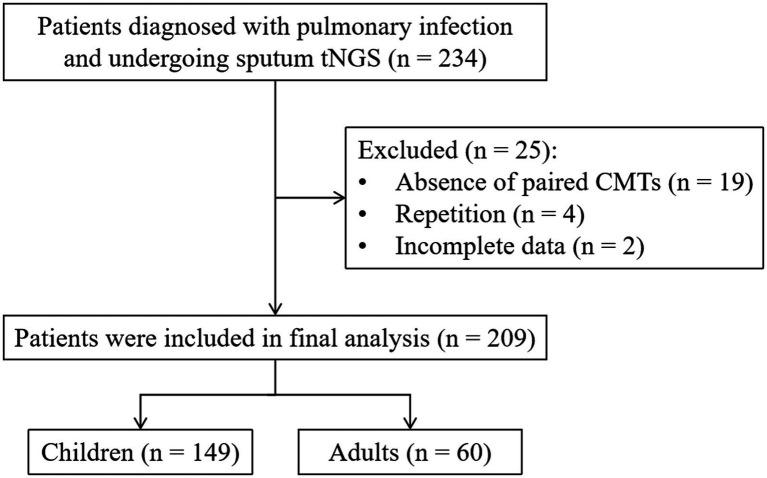
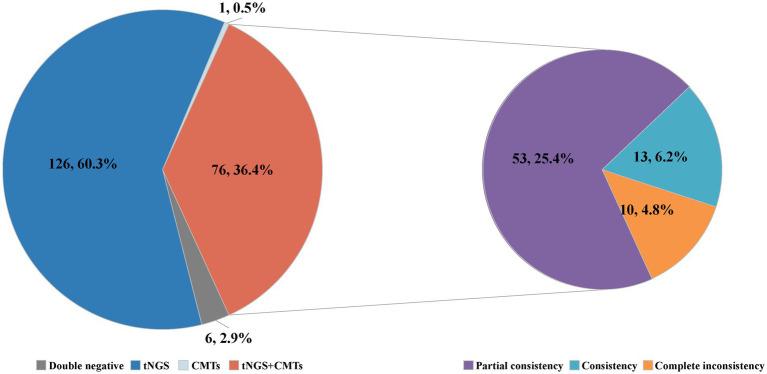
This study included 209 pediatric and adult patients with confirmed pulmonary infections. tNGS detected 45 potential pathogens, whereas CMTs identified 23 pathogens. The overall microbial detection rate significantly differed between tNGS and CMTs (96.7% vs. 36.8%, < 0.001). Among the 76 patients with concordant positive results from tNGS and CMTs, 86.8% (66/76) exhibited full or partial agreement. For highly pathogenic and rare/noncolonized microorganisms, tNGS, combined with comprehensive clinical review, directly guided pathogenic diagnosis and antibiotic treatment in 21 patients. This included infections caused by complex, certain atypical pathogens, Aspergillus, and nontuberculous Mycobacteria. Among the enrolled population, 38.8% (81/209) of patients adjusted their treatment based on tNGS results. Furthermore, tNGS findings unveiled age-specific heterogeneity in pathogen distribution between children and adults.
CONCLUSION
CMTs often fall short in meeting the diagnostic needs of pulmonary infections. This study highlights how tNGS of sputum samples from patients who cannot or will not undergo bronchoalveolar lavage yield valuable insights into potential pathogens, thereby enhancing the diagnosis of pulmonary infections in specific cases.
背景
靶向新一代测序(tNGS)已成为一种快速诊断技术,用于识别导致肺部感染的多种病原体。
方法
从无法或不愿接受支气管肺泡灌洗的患者中收集痰液样本。对这些样本进行tNGS分析以诊断肺部感染。对临床数据进行回顾性分析,并将tNGS的临床疗效与传统微生物检测(CMT)进行比较。
结果
本研究纳入了209例确诊为肺部感染的儿科和成人患者。tNGS检测到45种潜在病原体,而CMT鉴定出23种病原体。tNGS和CMT的总体微生物检测率有显著差异(96.7%对36.8%,<0.001)。在tNGS和CMT结果一致为阳性的76例患者中,86.8%(66/76)表现出完全或部分一致。对于高致病性和罕见/非定植微生物,tNGS结合全面的临床评估,直接指导了21例患者的病原学诊断和抗生素治疗。这包括由复杂的、某些非典型病原体、曲霉菌和非结核分枝杆菌引起的感染。在纳入人群中,38.8%(81/209)的患者根据tNGS结果调整了治疗方案。此外,tNGS结果揭示了儿童和成人之间病原体分布的年龄特异性异质性。
结论
CMT往往无法满足肺部感染的诊断需求。本研究强调了对无法或不愿接受支气管肺泡灌洗的患者的痰液样本进行tNGS,可对潜在病原体提供有价值的见解,从而在特定病例中加强肺部感染的诊断。


 Zotero 插件