
线粒体应激:神经炎症在中风中的关键作用。
Mitochondrial stress: a key role of neuroinflammation in stroke.
机构信息
Department of Neurosurgery, Xiangya School of Medicine, Affiliated Haikou Hospital, Central South University, Haikou, 570208, China.
Department of Physiology and Pharmacology, School of Medicine, Loma Linda University, Loma Linda, CA, 92354, USA.
出版信息
J Neuroinflammation. 2024 Feb 6;21(1):44. doi: 10.1186/s12974-024-03033-7.
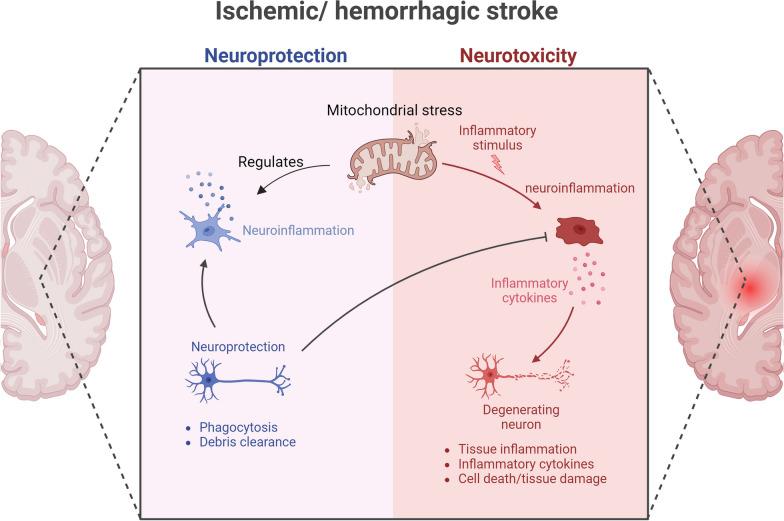
Stroke is a clinical syndrome characterized by an acute, focal neurological deficit, primarily caused by the occlusion or rupture of cerebral blood vessels. In stroke, neuroinflammation emerges as a pivotal event contributing to neuronal cell death. The occurrence and progression of neuroinflammation entail intricate processes, prominently featuring mitochondrial dysfunction and adaptive responses. Mitochondria, a double membrane-bound organelle are recognized as the "energy workshop" of the body. Brain is particularly vulnerable to mitochondrial disturbances due to its high energy demands from mitochondria-related energy production. The interplay between mitochondria and neuroinflammation plays a significant role in the pathogenesis of stroke. The biological and pathological consequences resulting from mitochondrial stress have substantial implications for cerebral function. Mitochondrial stress serves as an adaptive mechanism aimed at mitigating the stress induced by the import of misfolded proteins, which occurs in response to stroke. This adaptive response involves a reduction in misfolded protein accumulation and overall protein synthesis. The influence of mitochondrial stress on the pathological state of stroke is underscored by its capacity to interact with neuroinflammation. The impact of mitochondrial stress on neuroinflammation varies according to its severity. Moderate mitochondrial stress can bolster cellular adaptive defenses, enabling cells to better withstand detrimental stressors. In contrast, sustained and excessive mitochondrial stress detrimentally affects cellular and tissue integrity. The relationship between neuroinflammation and mitochondrial stress depends on the degree of mitochondrial stress present. Understanding its role in stroke pathogenesis is instrumental in excavating the novel treatment of stroke. This review aims to provide the evaluation of the cross-talk between mitochondrial stress and neuroinflammation within the context of stroke. We aim to reveal how mitochondrial stress affects neuroinflammation environment in stroke.
中风是一种以急性、局灶性神经功能缺损为特征的临床综合征,主要由脑血管阻塞或破裂引起。在中风中,神经炎症作为导致神经元细胞死亡的关键事件出现。神经炎症的发生和进展涉及复杂的过程,突出表现为线粒体功能障碍和适应性反应。线粒体是一种双层膜结合的细胞器,被认为是身体的“能量工厂”。由于大脑对线粒体相关能量产生的高能量需求,它特别容易受到线粒体紊乱的影响。线粒体与神经炎症之间的相互作用在中风的发病机制中起着重要作用。线粒体应激产生的生物学和病理后果对大脑功能有重大影响。线粒体应激是一种适应性机制,旨在减轻由于中风引起的错误折叠蛋白的输入所诱导的应激。这种适应性反应涉及减少错误折叠蛋白的积累和整体蛋白质合成。线粒体应激对中风病理状态的影响因其与神经炎症的相互作用而突显出来。线粒体应激对神经炎症的影响因其严重程度而异。适度的线粒体应激可以增强细胞的适应性防御能力,使细胞能够更好地抵抗有害应激源。相比之下,持续和过度的线粒体应激会对细胞和组织完整性造成不利影响。神经炎症和线粒体应激之间的关系取决于存在的线粒体应激程度。了解其在中风发病机制中的作用对于挖掘中风的新治疗方法至关重要。本综述旨在提供在中风背景下线粒体应激和神经炎症之间相互作用的评估。我们旨在揭示线粒体应激如何影响中风中的神经炎症环境。

 Zotero 插件