
有丝分裂间期转录抑制:机制与功能。
Transcriptional repression across mitosis: mechanisms and functions.
机构信息
Centro de Biología Molecular Severo Ochoa (CBMSO-CSIC), C/Nicolas Cabrera 1, 28049 Madrid, Spain.
出版信息
Biochem Soc Trans. 2024 Feb 28;52(1):455-464. doi: 10.1042/BST20231071.
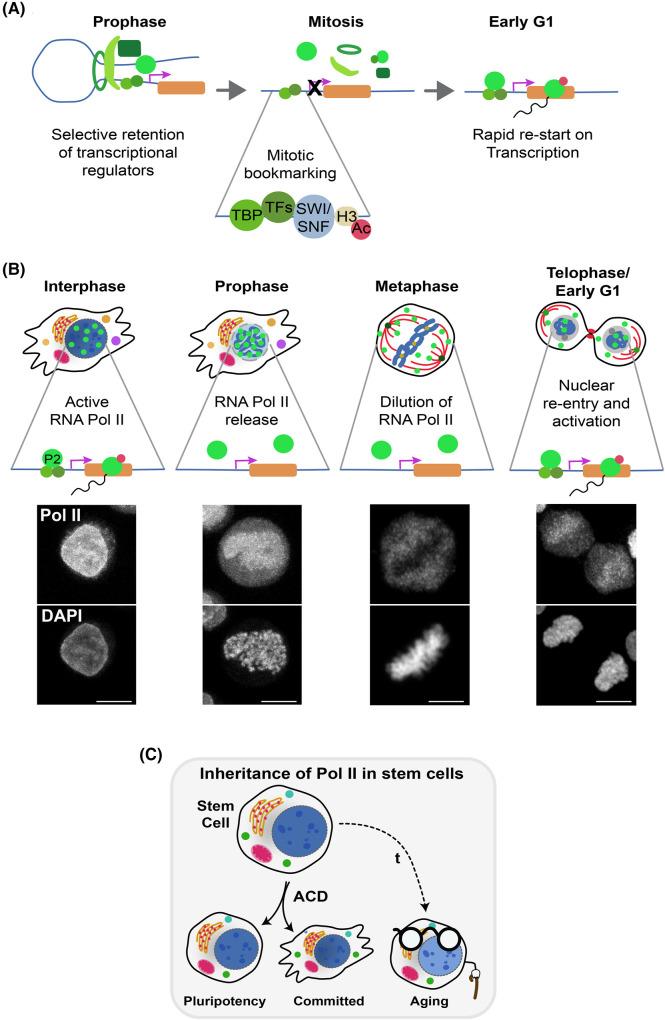
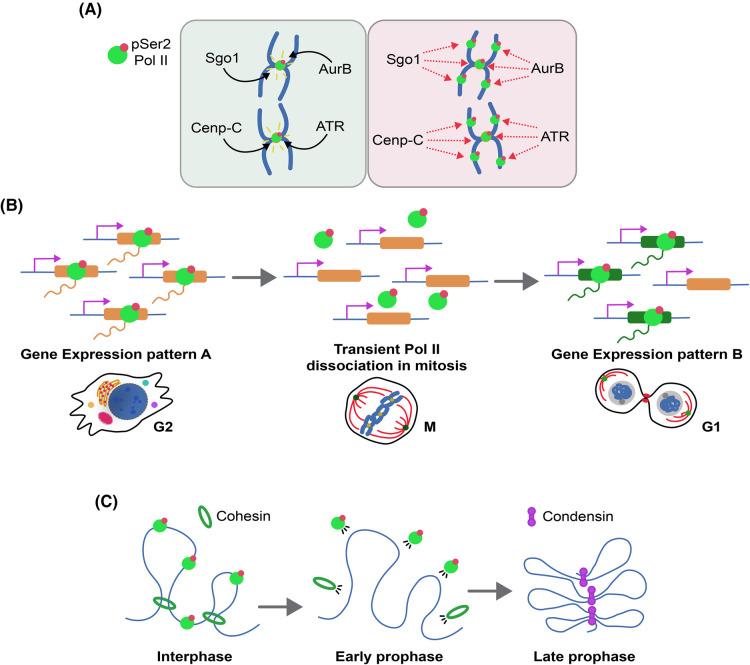
Transcription represents a central aspect of gene expression with RNA polymerase machineries (RNA Pol) driving the synthesis of RNA from DNA template molecules. In eukaryotes, a total of three RNA Pol enzymes generate the plethora of RNA species and RNA Pol II is the one transcribing all protein-coding genes. A high number of cis- and trans-acting factors orchestrates RNA Pol II-mediated transcription by influencing the chromatin recruitment, activation, elongation, and/or termination steps. The levels of DNA accessibility, defining open-euchromatin versus close-heterochromatin, delimits RNA Pol II activity as well as the encounter with other factors acting on chromatin such as the DNA replication or DNA repair machineries. The stage of the cell cycle highly influences RNA Pol II activity with mitosis representing the major challenge. In fact, there is a massive inhibition of transcription during the mitotic entry coupled with chromatin dissociation of most of the components of the transcriptional machinery. Mitosis, as a consequence, highly compromises the transcriptional memory and the perpetuation of cellular identity. Once mitosis ends, transcription levels immediately recover to define the cell fate and to safeguard the proper progression of daughter cells through the cell cycle. In this review, we evaluate our current understanding of the transcriptional repression associated with mitosis with a special focus on the molecular mechanisms involved, on the potential function behind the general repression, and on the transmission of the transcriptional machinery into the daughter cells. We finally discuss the contribution that errors in the inheritance of the transcriptional machinery across mitosis might play in stem cell aging.
转录是基因表达的核心方面之一,RNA 聚合酶机器(RNA Pol)从 DNA 模板分子驱动 RNA 的合成。在真核生物中,总共三种 RNA Pol 酶生成大量的 RNA 种类,而 RNA Pol II 是转录所有编码蛋白基因的酶。大量的顺式和反式作用因子通过影响染色质募集、激活、延伸和/或终止步骤来协调 RNA Pol II 介导的转录。DNA 可及性的水平,定义开放常染色质与关闭异染色质,限定了 RNA Pol II 的活性以及与作用于染色质的其他因子(如 DNA 复制或 DNA 修复机器)的相遇。细胞周期的阶段高度影响 RNA Pol II 的活性,有丝分裂是主要的挑战。事实上,在有丝分裂进入时,转录会发生大规模抑制,伴随着转录机器的大多数成分与染色质解离。因此,有丝分裂严重影响转录记忆和细胞身份的延续。一旦有丝分裂结束,转录水平立即恢复,以定义细胞命运,并通过细胞周期保障子细胞的正常进程。在这篇综述中,我们评估了我们对与有丝分裂相关的转录抑制的现有理解,特别关注所涉及的分子机制、普遍抑制背后的潜在功能以及转录机器向子细胞的传递。我们最后讨论了在有丝分裂过程中,转录机器的遗传错误可能在干细胞衰老中所起的作用。

 Zotero 插件