
六种人类ABC转运蛋白及其AlphaFold2预测的水溶性QTY变体的结构生物信息学研究
Structural bioinformatics studies of six human ABC transporters and their AlphaFold2-predicted water-soluble QTY variants.
作者信息
Pan Emily, Tao Fei, Smorodina Eva, Zhang Shuguang
机构信息
The Lawrenceville School, Lawrenceville, NJ, USA.
Laboratory of Food Microbial Technology, State Key Laboratory of Microbial Metabolism, School of Life Sciences and Biotechnology, Shanghai Jiao Tong University, Shanghai, China.
出版信息
QRB Discov. 2024 Jan 19;5:e1. doi: 10.1017/qrd.2024.2. eCollection 2024.
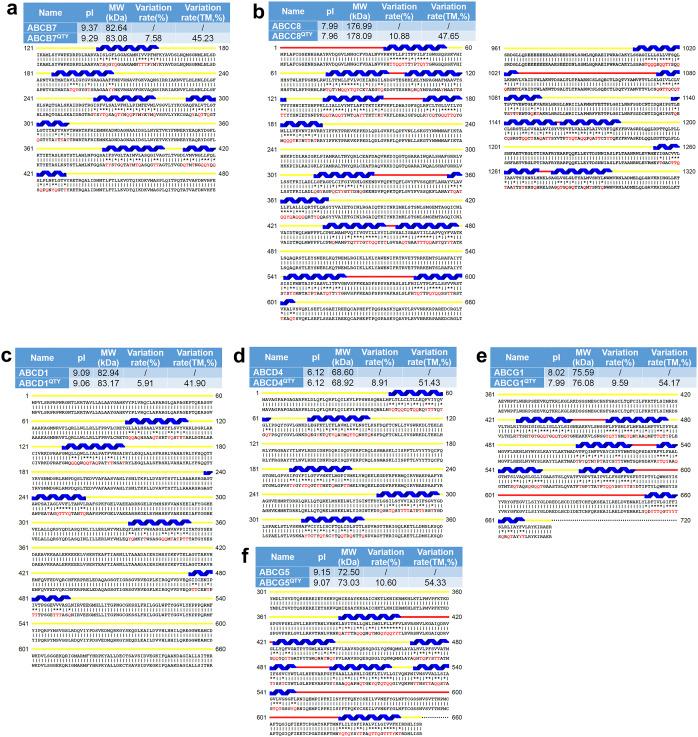
Human ATP-binding cassette (ABC) transporters are one of the largest families of membrane proteins and perform diverse functions. Many of them are associated with multidrug resistance that often results in cancer treatment with poor outcomes. Here, we present the structural bioinformatics study of six human ABC membrane transporters with experimentally determined cryo-electron microscopy (CryoEM) structures including ABCB7, ABCC8, ABCD1, ABCD4, ABCG1, ABCG5, and their AlphaFold2-predicted water-soluble QTY variants. In the native structures, there are hydrophobic amino acids such as leucine (L), isoleucine (I), valine (V), and phenylalanine (F) in the transmembrane alpha helices. These hydrophobic amino acids are systematically replaced by hydrophilic amino acids glutamine (Q), threonine (T), and tyrosine (Y). Therefore, these QTY variants become water soluble. We also present the superposed structures of native ABC transporters and their water-soluble QTY variants. The superposed structures show remarkable similarity with root mean square deviations between 1.064 and 3.413 Å despite significant (41.90-54.33%) changes to the protein sequence of the transmembrane domains. We also show the differences in hydrophobicity patches between the native ABC transporters and their QTY variants. We explain the rationale behind why the QTY membrane protein variants become water soluble. Our structural bioinformatics studies provide insight into the differences between the hydrophobic helices and hydrophilic helices and will likely further stimulate designs of water-soluble multispan transmembrane proteins and other aggregated proteins. The water-soluble ABC transporters may be useful as soluble antigens to generate therapeutic monoclonal antibodies for combating multidrug resistance in clinics.
人类ATP结合盒(ABC)转运蛋白是最大的膜蛋白家族之一,具有多种功能。其中许多与多药耐药性相关,这常常导致癌症治疗效果不佳。在此,我们展示了对六种具有实验测定的冷冻电子显微镜(CryoEM)结构的人类ABC膜转运蛋白的结构生物信息学研究,这些转运蛋白包括ABCB7、ABCC8、ABCD1、ABCD4、ABCG1、ABCG5以及它们通过AlphaFold2预测的水溶性QTY变体。在天然结构中,跨膜α螺旋中有疏水性氨基酸,如亮氨酸(L)、异亮氨酸(I)、缬氨酸(V)和苯丙氨酸(F)。这些疏水性氨基酸被亲水性氨基酸谷氨酰胺(Q)、苏氨酸(T)和酪氨酸(Y)系统地取代。因此,这些QTY变体变得可溶于水。我们还展示了天然ABC转运蛋白及其水溶性QTY变体的叠加结构。尽管跨膜结构域的蛋白质序列发生了显著(41.90 - 54.33%)变化,但叠加结构显示出显著的相似性,均方根偏差在1.064至3.413 Å之间。我们还展示了天然ABC转运蛋白与其QTY变体之间疏水性斑块的差异。我们解释了QTY膜蛋白变体变得可溶于水背后的原理。我们的结构生物信息学研究深入了解了疏水螺旋和亲水螺旋之间的差异,可能会进一步刺激水溶性多跨膜蛋白和其他聚集蛋白的设计。水溶性ABC转运蛋白可用作可溶性抗原,以产生治疗性单克隆抗体,用于临床对抗多药耐药性。



 Zotero 插件