
石墨烯、银和锌基纳米材料的抗菌性能及细胞毒性的合成、表征与比较评估
Synthesis, characterization, and comparative assessment of antimicrobial properties and cytotoxicity of graphene-, silver-, and zinc-based nanomaterials.
作者信息
Hossain Oindrila, Rahman Ehsanur, Roy Hridoy, Azam Md Shafiul, Ahmed Shoeb
机构信息
Department of Chemical Engineering Bangladesh University of Engineering and Technology Dhaka Bangladesh.
Department of Chemistry Bangladesh University of Engineering and Technology Dhaka Bangladesh.
出版信息
Anal Sci Adv. 2021 Dec 1;3(1-2):54-63. doi: 10.1002/ansa.202100041. eCollection 2022 Feb.
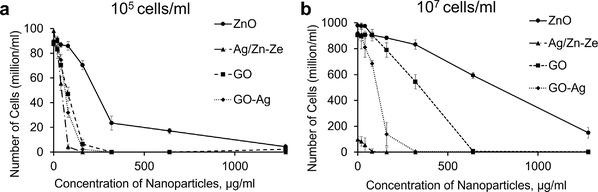
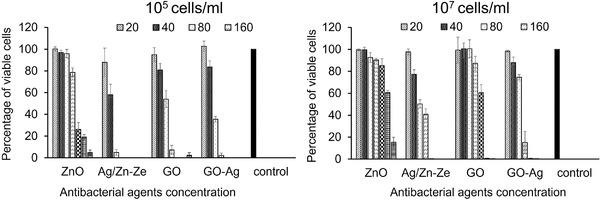
Zinc oxide (ZnO) and graphene oxide (GO) nanoparticles, silver/zinc zeolite (Ag/Zn-Ze), and graphene oxide-silver (GO-Ag) nanocomposites were synthesized and characterized with X-ray powder Diffraction, Field Emission Scanning Electron Microscope and Fourier Transform-Infrared Spectroscopy. The antibacterial efficacy of these nanoparticles was evaluated against . by shake flask method and plate culture method for different concentrations. For 10 cells/mL initial bacterial concentration, minimum inhibitory concentration (MIC) were <160, <320, <320, and >1280 μg/mL, and antibacterial concentration at which 50% cells are inhibited (IC) were 47, 90, 78, and 250 μg/mL for Ag/Zn-Ze, GO, GO-Ag, and ZnO, respectively. Therefore, the shake flask method showed that for all nanoparticle concentrations, Ag/Zn-Ze, and GO-Ag exhibited greater inhibition efficacy, which was also highly dependent on initial bacterial concentration. However, in case of the plate culture method, similar range of inhibition capacity was found for Ag/Zn-Ze, GO-Ag, and ZnO, whereas GO showed lower potency to inhibit . In addition, GO-Ag nanocomposite exhibited more efficacy than Ag/Zn-Ze when the antibacterial surface was prepared with those. However, Ag/Zn-Ze showed no toxicity on Vero cells, whereas GO-Ag exhibited severe toxicity at higher concentrations. This study establishes GO-Ag and Ag/Zn-Ze as potent antimicrobial agents; however, their application dosage should carefully be chosen based on cytotoxic effects of GO-Ag in case of any possible physiological interaction.
合成了氧化锌(ZnO)和氧化石墨烯(GO)纳米颗粒、银/锌沸石(Ag/Zn-Ze)以及氧化石墨烯-银(GO-Ag)纳米复合材料,并通过X射线粉末衍射、场发射扫描电子显微镜和傅里叶变换红外光谱对其进行了表征。采用摇瓶法和平板培养法,对不同浓度的这些纳米颗粒针对……的抗菌效果进行了评估。对于初始细菌浓度为10个细胞/mL的情况,最小抑菌浓度(MIC)分别为<160、<320、<320和>1280μg/mL,而抑制50%细胞生长的抗菌浓度(IC)对于Ag/Zn-Ze、GO、GO-Ag和ZnO分别为47、90、78和250μg/mL。因此,摇瓶法表明,对于所有纳米颗粒浓度,Ag/Zn-Ze和GO-Ag表现出更大的抑制效果,这也高度依赖于初始细菌浓度。然而,在平板培养法中,Ag/Zn-Ze、GO-Ag和ZnO的抑制能力范围相似,而GO显示出较低的抑制……的能力。此外,当用这些材料制备抗菌表面时,GO-Ag纳米复合材料比Ag/Zn-Ze表现出更高的功效。然而,Ag/Zn-Ze对Vero细胞无毒性,而GO-Ag在较高浓度下表现出严重毒性。本研究确定GO-Ag和Ag/Zn-Ze为有效的抗菌剂;然而,在任何可能的生理相互作用情况下,应根据GO-Ag的细胞毒性效应谨慎选择它们的应用剂量。




 Zotero 插件