
gMCSpy:在 Python 中高效、准确地计算遗传最小割集。
gMCSpy: efficient and accurate computation of genetic minimal cut sets in Python.
机构信息
Tecnun School of Engineering, Biomedical Engineering and Sciences Department, University of Navarra, San Sebastián 20018, Spain.
Biomedical Engineering Center, University of Navarra, Pamplona, Navarra 31009, Spain.
出版信息
Bioinformatics. 2024 Jun 3;40(6). doi: 10.1093/bioinformatics/btae318.
MOTIVATION
The identification of minimal genetic interventions that modulate metabolic processes constitutes one of the most relevant applications of genome-scale metabolic models (GEMs). The concept of Minimal Cut Sets (MCSs) and its extension at the gene level, genetic Minimal Cut Sets (gMCSs), have attracted increasing interest in the field of Systems Biology to address this task. Different computational tools have been developed to calculate MCSs and gMCSs using both commercial and open-source software.
RESULTS
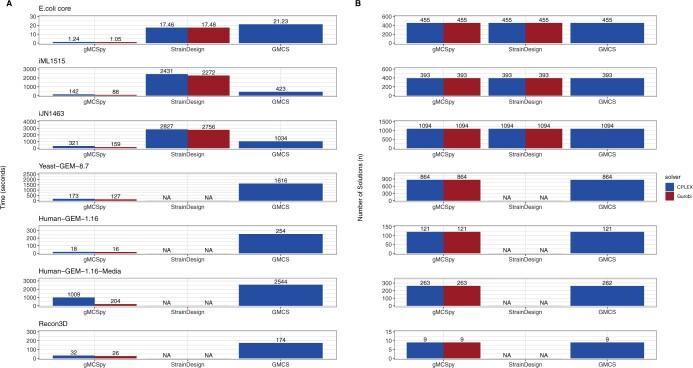
Here, we present gMCSpy, an efficient Python package to calculate gMCSs in GEMs using both commercial and non-commercial optimization solvers. We show that gMCSpy substantially overperforms our previous computational tool GMCS, which exclusively relied on commercial software. Moreover, we compared gMCSpy with recently published competing algorithms in the literature, finding significant improvements in both accuracy and computation time. All these advances make gMCSpy an attractive tool for researchers in the field of Systems Biology for different applications in health and biotechnology.
AVAILABILITY AND IMPLEMENTATION
The Python package gMCSpy and the data underlying this manuscript can be accessed at: https://github.com/PlanesLab/gMCSpy.
动机
鉴定调控代谢过程的最小遗传干预措施是基因组规模代谢模型(GEM)的最相关应用之一。最小割集(MCS)的概念及其在基因水平上的扩展,即遗传最小割集(gMCS),在系统生物学领域引起了越来越多的关注,以解决这一任务。已经开发了不同的计算工具,使用商业和开源软件来计算 MCS 和 gMCS。
结果
在这里,我们介绍了 gMCSpy,这是一个高效的 Python 包,用于使用商业和非商业优化求解器在 GEM 中计算 gMCS。我们表明,gMCSpy 大大优于我们之前仅依赖商业软件的计算工具 GMCS。此外,我们还将 gMCSpy 与文献中最近发表的竞争算法进行了比较,发现准确性和计算时间都有显著提高。所有这些进展使得 gMCSpy 成为系统生物学领域研究人员在健康和生物技术的不同应用中的一个有吸引力的工具。
可用性和实现
Python 包 gMCSpy 和本文所依据的数据可在以下网址获得:https://github.com/PlanesLab/gMCSpy。
 Zotero 插件