
用于调节脊髓损伤功能失调病理微环境的功能性生物材料。
Functional biomaterials for modulating the dysfunctional pathological microenvironment of spinal cord injury.
作者信息
Ma Dezun, Fu Changlong, Li Fenglu, Ruan Renjie, Lin Yanming, Li Xihai, Li Min, Zhang Jin
机构信息
Academy of Integrative Medicine, Fujian University of Traditional Chinese Medicine, 1 Qiuyang Road, Fuzhou, Fujian, 350122, PR China.
Fujian Key Laboratory of Integrative Medicine on Geriatrics, Fujian University of Traditional Chinese Medicine, Fuzhou, Fujian, 350122, PR China.
出版信息
Bioact Mater. 2024 May 30;39:521-543. doi: 10.1016/j.bioactmat.2024.04.015. eCollection 2024 Sep.
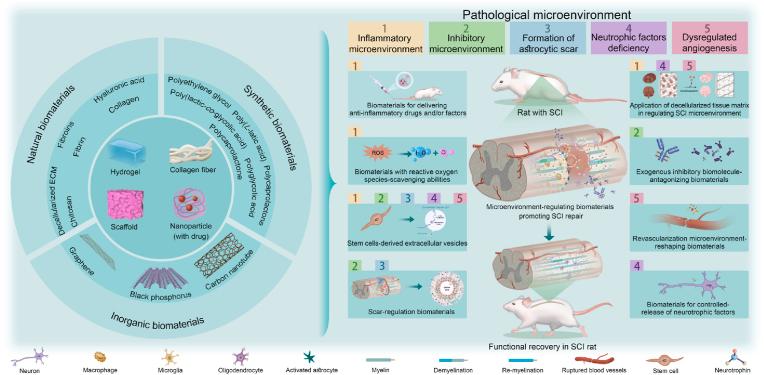
Spinal cord injury (SCI) often results in irreversible loss of sensory and motor functions, and most SCIs are incurable with current medical practice. One of the hardest challenges in treating SCI is the development of a dysfunctional pathological microenvironment, which mainly comprises excessive inflammation, deposition of inhibitory molecules, neurotrophic factor deprivation, glial scar formation, and imbalance of vascular function. To overcome this challenge, implantation of functional biomaterials at the injury site has been regarded as a potential treatment for modulating the dysfunctional microenvironment to support axon regeneration, remyelination at injury site, and functional recovery after SCI. This review summarizes characteristics of dysfunctional pathological microenvironment and recent advances in biomaterials as well as the technologies used to modulate inflammatory microenvironment, regulate inhibitory microenvironment, and reshape revascularization microenvironment. Moreover, technological limitations, challenges, and future prospects of functional biomaterials to promote efficient repair of SCI are also discussed. This review will aid further understanding and development of functional biomaterials to regulate pathological SCI microenvironment.
脊髓损伤(SCI)常导致感觉和运动功能不可逆转的丧失,并且目前的医学实践中大多数脊髓损伤无法治愈。治疗脊髓损伤最艰巨的挑战之一是功能失调的病理微环境的形成,其主要包括过度炎症、抑制性分子沉积、神经营养因子缺乏、胶质瘢痕形成以及血管功能失衡。为了克服这一挑战,在损伤部位植入功能性生物材料被视为一种潜在的治疗方法,可调节功能失调的微环境以支持轴突再生、损伤部位的髓鞘再生以及脊髓损伤后的功能恢复。本综述总结了功能失调的病理微环境的特征、生物材料的最新进展以及用于调节炎症微环境、抑制性微环境和重塑血管再生微环境的技术。此外,还讨论了功能性生物材料促进脊髓损伤有效修复的技术局限性、挑战和未来前景。本综述将有助于进一步理解和开发用于调节脊髓损伤病理微环境的功能性生物材料。




 Zotero 插件