
雄蜂射出精液的微生物群分析及采精方法对细菌载量的影响
Microbiota Analysis of Ejaculated Honey Bee Drone Semen and the Effect of Semen Collection Method on Bacterial Loads.
作者信息
Yániz Jesús, Toquet Marion, Santolaria Pilar, Silvestre Miguel Angel, Toledo-Perona Raquel, Gómez-Martín Ángel
机构信息
BIOFITER Research Group, Environmental Sciences Institute (IUCA), Department of Animal Production and Food Sciences, University of Zaragoza, 22071 Huesca, Spain.
Microbiological Agents Associated with Animal Reproduction (ProVaginBIO) Research Group, Departamento Producción y Sanidad Animal, Salud Pública Veterinaria y Ciencia y Tecnología de los Alimentos, Facultad de Veterinaria, Universidad Cardenal Herrera-CEU, CEU Universities, Carrer Tirant lo Blanc, 7, Alfara del Patriarca, 46115 Valencia, Spain.
出版信息
Insects. 2024 May 22;15(6):377. doi: 10.3390/insects15060377.
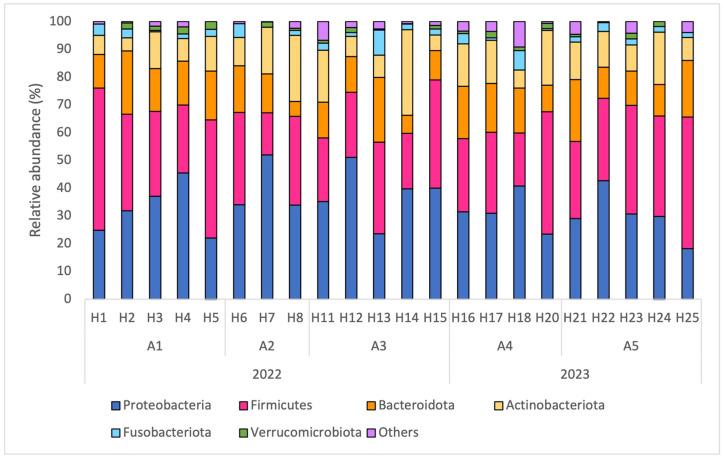
Artificial insemination in queen honey bees is the only tool that provides complete control over mating for research and breeding purposes, making it essential in genetic improvement and conservation programs in this species. The aims of this study were to characterize drone semen bacterial loads by culture-dependent and independent methods and to describe their variation depending on the method of semen collection, the colony and the apiary. In the first experiment, the bacterial loads of semen collected from the seminal vesicles or from ejaculates was studied using culture-dependent methods. The collection method had a significant influence on the overall bacterial count in semen. Out of the 42 semen samples analyzed, 26 (61.9%) tested positive for bacterial isolation. This encompassed the entirety of samples obtained from the seminal vesicles (21 of 21), whereas only 23.8% of those derived from ejaculates (5 out of 21) showed bacterial isolation. In the second experiment, next-generation sequencing techniques were used to describe the microbiome of ejaculated drone semen for the first time. The most abundant phyla were Proteobacteria, Firmicutes, Bacteroidota and Actinobacteriota, while the most abundant genera were , , and . The results showed that the apiary had a significant effect on the community structure composition and abundance of the seminal microbiota, and significative differences in abundance were observed for the genera , , and . Significant differences were also observed in the richness of the microbiota between apiaries and colonies.
蜂王人工授精是唯一一种能完全控制交配过程以用于研究和育种目的的工具,这使其在该物种的遗传改良和保护计划中至关重要。本研究的目的是通过依赖培养和不依赖培养的方法来表征雄蜂精液的细菌载量,并描述其因精液采集方法、蜂群和养蜂场的不同而产生的变化。在第一个实验中,使用依赖培养的方法研究了从精囊或射精中采集的精液的细菌载量。采集方法对精液中的总细菌计数有显著影响。在分析的42份精液样本中,26份(61.9%)细菌分离检测呈阳性。这涵盖了从精囊中获得的所有样本(21份中的21份),而从射精中获得的样本中只有23.8%(21份中的5份)显示有细菌分离。在第二个实验中,首次使用下一代测序技术来描述射精雄蜂精液的微生物群。最丰富的门是变形菌门、厚壁菌门、拟杆菌门和放线菌门,而最丰富的属是 、 、 和 。结果表明,养蜂场对精液微生物群的群落结构组成和丰度有显著影响,并且在 、 、 和 属的丰度上观察到显著差异。在不同养蜂场和蜂群之间的微生物群丰富度上也观察到显著差异。


 Zotero 插件