
新型冠状病毒感染小鼠大脑中神经炎症相关基因的上调
Upregulation of Neuroinflammation-Associated Genes in the Brain of SARS-CoV-2-Infected Mice.
作者信息
Oh Soo-Jin, Kumari Pratima, Auroni Tabassum Tasnim, Stone Shannon, Pathak Heather, Elsharkawy Amany, Natekar Janhavi Prasad, Shin Ok Sarah, Kumar Mukesh
机构信息
BK21 Graduate Program, Department of Biomedical Sciences, College of Medicine, Korea University Guro Hospital, Seoul 08308, Republic of Korea.
Department of Biology, College of Arts and Sciences, Georgia State University, Atlanta, GA 30303, USA.
出版信息
Pathogens. 2024 Jun 22;13(7):528. doi: 10.3390/pathogens13070528.
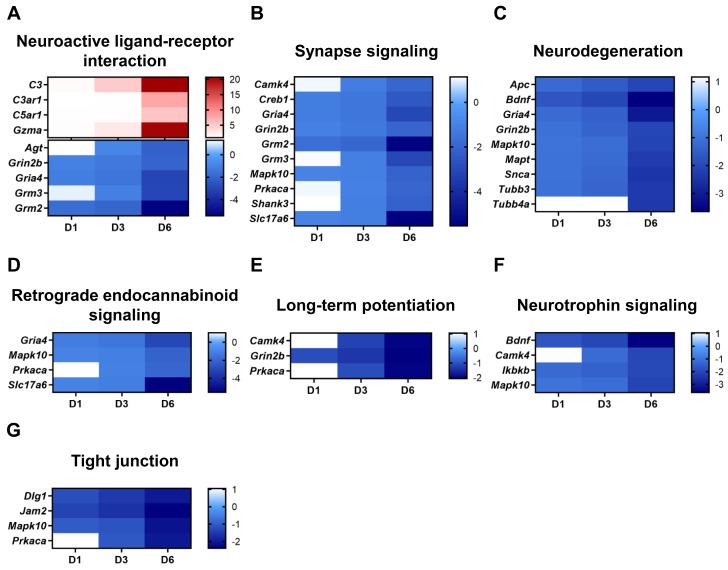
Neurological manifestations are a significant complication of coronavirus disease 2019 (COVID-19), but the underlying mechanisms are yet to be understood. Recently, severe acute respiratory syndrome coronavirus 2 (SARS-CoV-2)-induced neuroinvasion and encephalitis were observed in K18-hACE2 mice, leading to mortality. Our goal in this study was to gain insights into the molecular pathogenesis of neurological manifestations in this mouse model. To analyze differentially expressed genes (DEGs) in the brains of mice following SARS-CoV-2 infection, we performed NanoString gene expression analysis using three individual animal samples at 1, 3, and 6 days post-infection. We identified the DEGs by comparing them to animals that were not infected with the virus. We found that genes upregulated at day 6 post-infection were mainly associated with Toll-like receptor (TLR) signaling, RIG-I-like receptor (RLR) signaling, and cell death pathways. However, downregulated genes were associated with neurodegeneration and synaptic signaling pathways. In correlation with gene expression profiles, a multiplexed immunoassay showed the upregulation of multiple cytokines and chemokines involved in inflammation and cell death in SARS-CoV-2-infected brains. Furthermore, the pathway analysis of DEGs indicated a possible link between TLR2-mediated signaling pathways and neuroinflammation, as well as pyroptosis and necroptosis in the brain. In conclusion, our work demonstrates neuroinflammation-associated gene expression profiles, which can provide key insight into the severe disease observed in COVID-19 patients.
神经学表现是2019冠状病毒病(COVID-19)的一种重要并发症,但其潜在机制尚不清楚。最近,在K18-hACE2小鼠中观察到严重急性呼吸综合征冠状病毒2(SARS-CoV-2)诱导的神经侵袭和脑炎,导致死亡。我们在本研究中的目标是深入了解该小鼠模型中神经学表现的分子发病机制。为了分析SARS-CoV-2感染后小鼠大脑中差异表达基因(DEG),我们在感染后1天、3天和6天使用三个单独的动物样本进行了NanoString基因表达分析。我们通过将它们与未感染病毒的动物进行比较来鉴定DEG。我们发现感染后第6天上调的基因主要与Toll样受体(TLR)信号传导、视黄酸诱导基因I样受体(RLR)信号传导和细胞死亡途径相关。然而,下调的基因与神经退行性变和突触信号通路相关。与基因表达谱相关,多重免疫测定显示SARS-CoV-2感染的大脑中参与炎症和细胞死亡的多种细胞因子和趋化因子上调。此外,DEG的通路分析表明TLR2介导的信号通路与神经炎症以及大脑中的细胞焦亡和坏死性凋亡之间可能存在联系。总之,我们的工作展示了与神经炎症相关的基因表达谱,这可以为COVID-19患者中观察到的严重疾病提供关键见解。




 Zotero 插件