
不可切除胆道癌患者接受放射治疗的临床结果和风险分层。
Clinical outcomes and risk stratification in unresectable biliary tract cancers undergoing radiation therapy.
机构信息
Department of Radiation Oncology, Perelman School of Medicine, University of Pennsylvania, Philadelphia, PA, USA.
Department of Radiation Oncology, Tel Aviv Medical Center, Tel Aviv, Israel.
出版信息
Radiat Oncol. 2024 Aug 1;19(1):102. doi: 10.1186/s13014-024-02481-y.
BACKGROUND
Biliary tract cancers (BTC) are rare and aggressive malignancies originating from intrahepatic and extrahepatic bile ducts and the gallbladder. Surgery is the only curative option, but due to late-stage diagnosis, is frequently not feasible, leaving chemotherapy as the primary treatment. Radiotherapy (RT) can be an effective alternative for patients with unresectable, non-metastatic BTC despite the generally poor prognosis and significant variability. To help manage patients with unresectable BTC who receive RT, we aimed to identify prognostic markers that could aid in predicting overall survival (OS).
METHODS
A retrospective cohort study was conducted at the University of Pennsylvania, involving seventy-eight patients with unresectable BTC treated with definitive intent RT. Comprehensive demographic, clinical, and treatment-related data were extracted from the electronic medical records. Univariate and multivariate Cox regressions were employed to identify predictors of OS after RT. A biomarker model was developed for refined survival prediction.
RESULTS
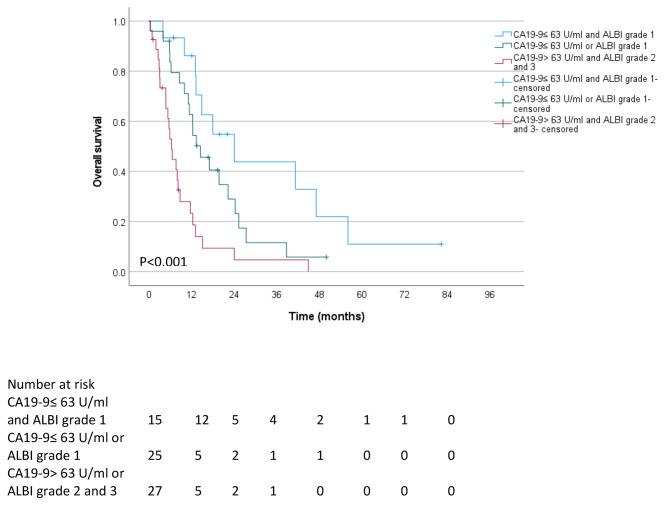
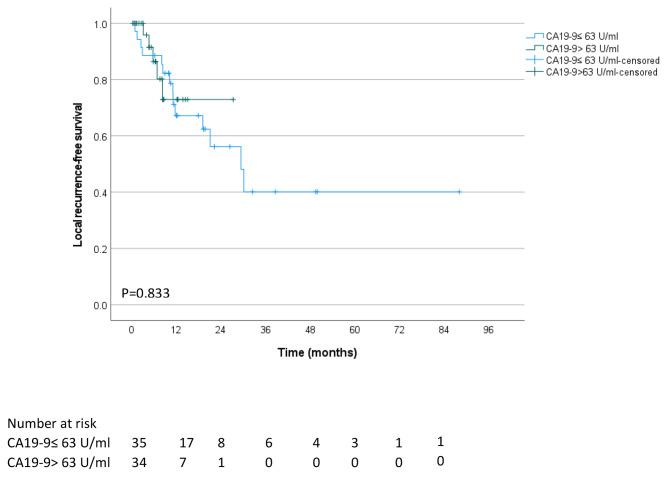
The cohort primarily comprised patients with good performance status without significant hepatic dysfunction at presentation. The predominant treatment approach involved hypofractionated RT or concurrent 5FU-based chemoRT. Median OS after RT was 12.3 months, and 20 patients (15.6%) experienced local progression with a median time of 30.1 months. Univariate and multivariate analyses identified CA19-9 (above median) and higher albumin-bilirubin (ALBI) grades at presentation as significant predictors of poor OS. Median OS after RT was 24 months for patients with no risk factors and 6.3 months for those with both.
CONCLUSIONS
Our study demonstrates generally poor but significantly heterogeneous OS in patients with unresectable BTC treated with RT. We have developed a biomarker model based on CA19-9 and ALBI grade at presentation that can distinguish sub-populations with markedly diverse prognoses. This model can aid the clinical management of this challenging disease.
背景
胆道癌(BTC)是一种罕见且侵袭性强的恶性肿瘤,起源于肝内和肝外胆管以及胆囊。手术是唯一的治愈方法,但由于诊断较晚,通常不可行,因此化疗成为主要治疗方法。尽管总体预后较差且存在显著差异,但放射治疗(RT)对于不可切除、非转移性 BTC 患者是一种有效的替代治疗方法。为了帮助管理接受 RT 的不可切除 BTC 患者,我们旨在确定有助于预测总生存期(OS)的预后标志物。
方法
这项回顾性队列研究在宾夕法尼亚大学进行,涉及 78 例接受确定性 RT 治疗的不可切除 BTC 患者。从电子病历中提取全面的人口统计学、临床和治疗相关数据。使用单变量和多变量 Cox 回归来确定 RT 后 OS 的预测因素。开发了一个生物标志物模型,用于精细的生存预测。
结果
该队列主要由表现状态良好且无明显肝功能障碍的患者组成。主要的治疗方法包括低分割 RT 或同期 5FU 为基础的化疗 RT。RT 后中位 OS 为 12.3 个月,20 例(15.6%)患者出现局部进展,中位时间为 30.1 个月。单变量和多变量分析确定 CA19-9(高于中位数)和更高的白蛋白-胆红素(ALBI)分级在初诊时是 OS 不良的显著预测因素。无风险因素的患者 RT 后中位 OS 为 24 个月,而有两个风险因素的患者为 6.3 个月。
结论
我们的研究表明,接受 RT 治疗的不可切除 BTC 患者的总体生存情况较差,但具有显著的异质性。我们已经基于初诊时的 CA19-9 和 ALBI 分级开发了一个生物标志物模型,可以区分具有明显不同预后的亚人群。该模型可以辅助对这种具有挑战性的疾病进行临床管理。


 Zotero 插件