
蛋白质组学衰老时钟可预测不同人群的死亡率和常见与年龄相关疾病的风险。
Proteomic aging clock predicts mortality and risk of common age-related diseases in diverse populations.
机构信息
Nuffield Department of Population Health, University of Oxford, Oxford, UK.
Analytic and Translational Genetics Unit, Massachusetts General Hospital, Boston, MA, USA.
出版信息
Nat Med. 2024 Sep;30(9):2450-2460. doi: 10.1038/s41591-024-03164-7. Epub 2024 Aug 8.
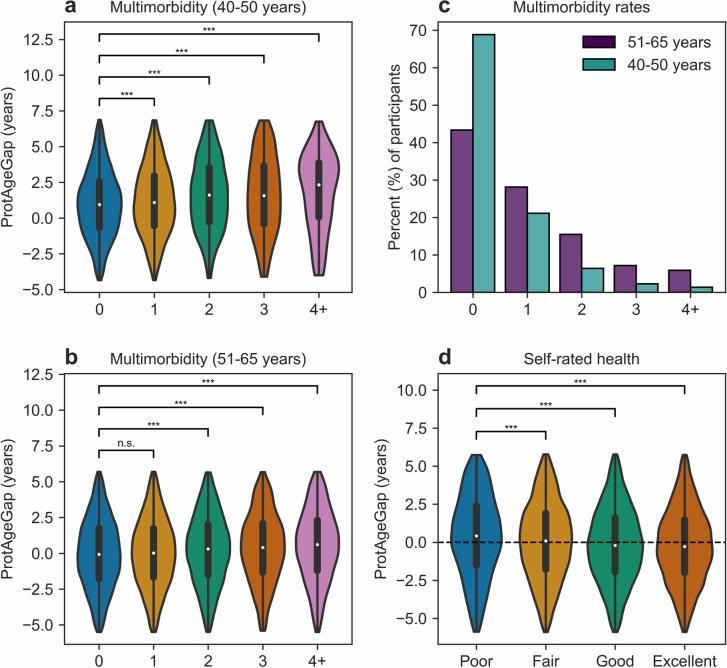
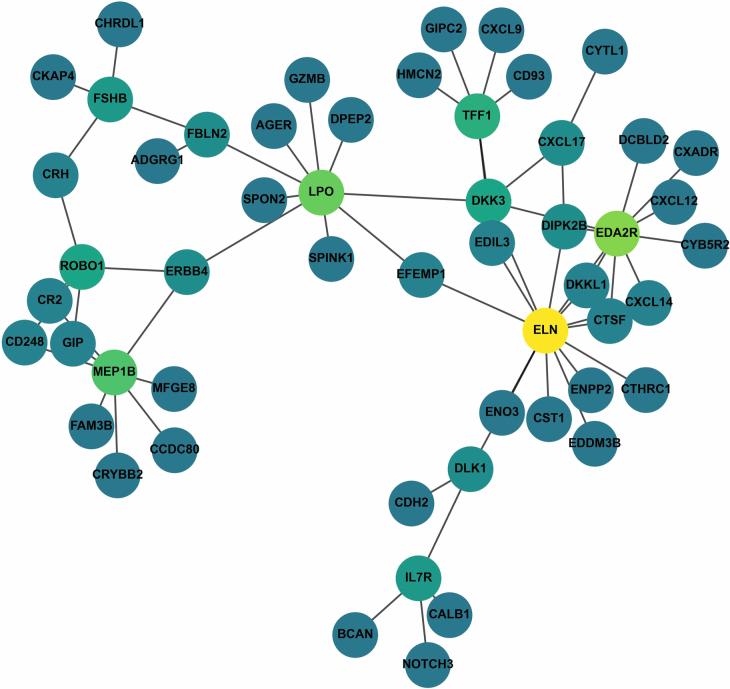
Circulating plasma proteins play key roles in human health and can potentially be used to measure biological age, allowing risk prediction for age-related diseases, multimorbidity and mortality. Here we developed a proteomic age clock in the UK Biobank (n = 45,441) using a proteomic platform comprising 2,897 plasma proteins and explored its utility to predict major disease morbidity and mortality in diverse populations. We identified 204 proteins that accurately predict chronological age (Pearson r = 0.94) and found that proteomic aging was associated with the incidence of 18 major chronic diseases (including diseases of the heart, liver, kidney and lung, diabetes, neurodegeneration and cancer), as well as with multimorbidity and all-cause mortality risk. Proteomic aging was also associated with age-related measures of biological, physical and cognitive function, including telomere length, frailty index and reaction time. Proteins contributing most substantially to the proteomic age clock are involved in numerous biological functions, including extracellular matrix interactions, immune response and inflammation, hormone regulation and reproduction, neuronal structure and function and development and differentiation. In a validation study involving biobanks in China (n = 3,977) and Finland (n = 1,990), the proteomic age clock showed similar age prediction accuracy (Pearson r = 0.92 and r = 0.94, respectively) compared to its performance in the UK Biobank. Our results demonstrate that proteomic aging involves proteins spanning multiple functional categories and can be used to predict age-related functional status, multimorbidity and mortality risk across geographically and genetically diverse populations.
循环血浆蛋白在人类健康中发挥着关键作用,并且有可能被用于测量生物年龄,从而预测与年龄相关的疾病、多种疾病和死亡率的风险。在这里,我们使用包含 2897 种血浆蛋白的蛋白质组学平台,在英国生物库(n=45441)中开发了一种蛋白质组学年龄时钟,并探索了其在预测不同人群主要疾病发病率和死亡率方面的效用。我们鉴定出 204 种能够准确预测实际年龄(皮尔逊相关系数 r=0.94)的蛋白质,并发现蛋白质组学年龄与 18 种主要慢性疾病(包括心脏、肝脏、肾脏和肺部疾病、糖尿病、神经退行性疾病和癌症)的发病有关,还与多种疾病和全因死亡率风险相关。蛋白质组学年龄与与年龄相关的生物学、身体和认知功能指标也相关,包括端粒长度、虚弱指数和反应时间。对蛋白质组学年龄时钟贡献最大的蛋白质涉及许多生物学功能,包括细胞外基质相互作用、免疫反应和炎症、激素调节和生殖、神经元结构和功能以及发育和分化。在一项涉及中国生物库(n=3977)和芬兰生物库(n=1990)的验证研究中,蛋白质组学年龄时钟与在英国生物库中的表现相比,具有相似的年龄预测准确性(皮尔逊相关系数 r=0.92 和 r=0.94)。我们的研究结果表明,蛋白质组学年龄涉及跨越多个功能类别的蛋白质,可用于预测不同地理和遗传背景人群的与年龄相关的功能状态、多种疾病和死亡率风险。





 Zotero 插件