
多因素吸气肌训练能否改善巴基斯坦糖尿病患者的姿势稳定性和生活质量?一项随机对照试验。
Does multifactorial inspiratory muscle training improve postural stability and quality of life of patients with diabetes in Pakistan? A randomised controlled trial.
作者信息
Sheraz Suman, Malik Arshad Nawaz, Ferraro Francesco Vincenzo, Siddiqi Furqan Ahmed
机构信息
Faculty of Rehabilitation And Allied Health Sciences, Riphah International University, Islamabad, Pakistan
Faculty of Rehabilitation And Allied Health Sciences, Riphah International University, Islamabad, Pakistan.
出版信息
BMJ Open. 2024 Sep 16;14(9):e080718. doi: 10.1136/bmjopen-2023-080718.
OBJECTIVE
To determine the effects of multifactorial inspiratory muscle training (IMT) combined with Otago Exercise Programme (OEP) on balance and quality of life (QoL) in patients with diabetes.
METHODS
Pretest-post-test randomised controlled trial.
SETTING
Rehabilitation Department of Pakistan Railway General Hospital.
PARTICIPANTS
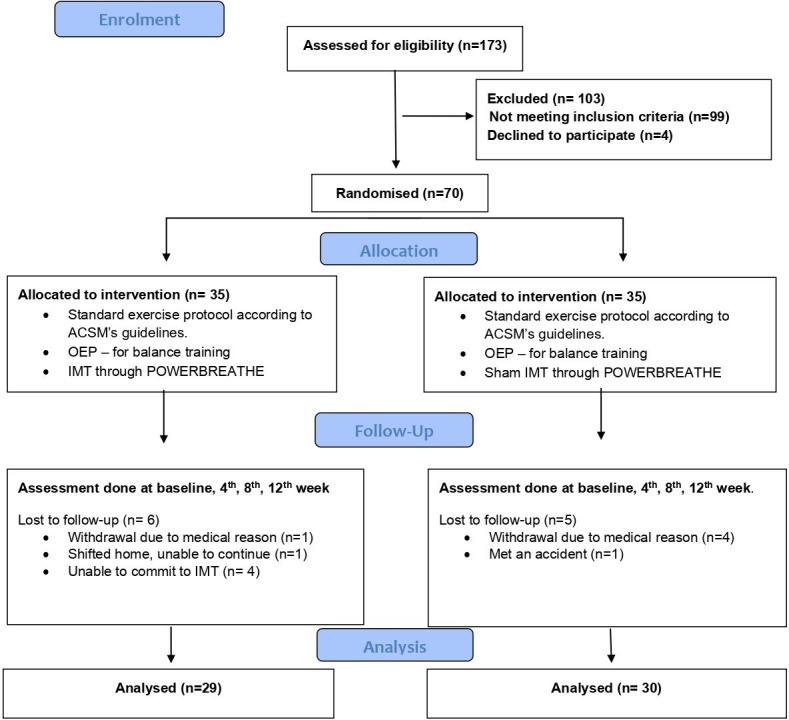
70 patients with diabetes were randomly assigned to experimental or placebo groups, out of which 59 patients completed the intervention.
INTERVENTION
Patients in the experimental group performed OEP+IMT (at 50% of baseline maximum inspiratory pressure (MIP)) whereas the placebo group performed OEP+sham IMT (at 15% of MIP). Both groups exercised for 12 consecutive weeks.
OUTCOME MEASURES
Outcome measures included nine variables: the Berg Balance Scale (BBS), the Biodex Postural Stability System (including postural stability test (Overall Stability Index, Anterior-Posterior Index and Mediolateral Index), fall risk test (FRT), Limits of Stability (LOS) test (time to complete test and direction control), Clinical Test of Sensory Interaction and Balance (CTSIB)) and the Audit of Diabetes Dependent Quality of Life questionnaire.
RESULTS
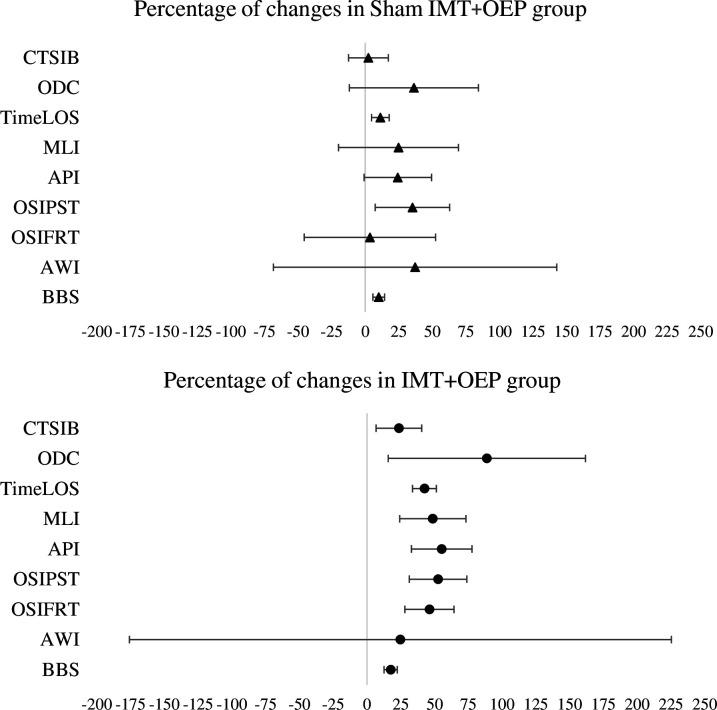
Out of 59 patients who completed treatment, 37.1% were men and 62.9% were women with a mean age of 58.37±5.91 years. Results show significant interaction effects on BBS scores with the mean score improving from 41.87±2.61 to 49.16±2.50 in IMT versus sham IMT group with scores improving from 41.58±2.51 to 45.74±2.30. The IMT group significantly improved in dynamic balance tested through BBS (p=0.003), anticipatory balance through LOS test (p=0.003), reactive balance tested through FRT (p=0.04), direction control (p=0.03) and sensory integration through CTSIB test (p=0.04) when compared with the sham IMT group. While no significant changes (p>0.05) between groups were observed in QoL and static balance; significant changes (p<0.05) within group were observed in both groups in QoL and static balance.
CONCLUSION
Additional research is necessary to understand the association between inspiratory muscle strength and balance, however, we demonstrated that a multifactorial IMT intervention should be used with patients with diabetes to improve balance, postural control and reduce fall risks.
TRIAL REGISTRATION NUMBER
ClinicalTrials.gov, NCT#04947163.
目的
确定多因素吸气肌训练(IMT)联合奥塔哥运动计划(OEP)对糖尿病患者平衡能力和生活质量(QoL)的影响。
方法
前后测随机对照试验。
地点
巴基斯坦铁路总医院康复科。
参与者
70例糖尿病患者被随机分配至实验组或安慰剂组,其中59例患者完成了干预。
干预措施
实验组患者进行OEP+IMT(吸气肌最大压力(MIP)基线值的50%),而安慰剂组进行OEP+假IMT(MIP的15%)。两组均连续锻炼12周。
观察指标
观察指标包括9个变量:伯格平衡量表(BBS)、Biodex姿势稳定系统(包括姿势稳定性测试(总体稳定性指数、前后指数和内外侧指数)、跌倒风险测试(FRT)、稳定性极限(LOS)测试(完成测试时间和方向控制)、感觉整合与平衡临床测试(CTSIB))以及糖尿病相关生活质量问卷。
结果
在完成治疗的59例患者中,男性占37.1%,女性占62.9%,平均年龄为58.37±5.91岁。结果显示,与假IMT组相比,IMT组BBS评分有显著交互作用,平均得分从41.87±2.61提高到49.16±2.50,假IMT组得分从41.58±2.51提高到45.74±2.30。与假IMT组相比,IMT组通过BBS测试的动态平衡(p=0.003)、通过LOS测试的预期平衡(p=0.003)、通过FRT测试的反应性平衡(p=0.04)、方向控制(p=0.03)以及通过CTSIB测试的感觉整合(p=0.04)均有显著改善。虽然两组在生活质量和静态平衡方面未观察到显著变化(p>0.05);但两组在生活质量和静态平衡方面组内均观察到显著变化(p<0.05)。
结论
有必要进行更多研究以了解吸气肌力量与平衡之间的关联,然而,我们证明多因素IMT干预应用于糖尿病患者可改善平衡、姿势控制并降低跌倒风险。
试验注册号
ClinicalTrials.gov,NCT#04947163。
 Zotero 插件