
SMARCA4在肺腺癌中的突变与表达:预后意义及对免疫治疗反应的影响
SMARCA4 mutations and expression in lung adenocarcinoma: prognostic significance and impact on the immunotherapy response.
作者信息
Zhang Yuming, Sun Dantong, Han Weizhong, Yang Zhen, Lu Yongzhi, Zhang Xuchen, Wang Yongjie, Zhang Chuantao, Liu Ning, Hou Helei
机构信息
Precision Medicine Center of Oncology, The Affiliated Hospital of Qingdao University, Qingdao University, China.
Department of Medical Oncology, National Cancer Center/National Clinical Research Center for Cancer/Cancer Hospital, Chinese Academy of Medical Sciences and Peking Union Medical College, Beijing, China.
出版信息
FEBS Open Bio. 2024 Dec;14(12):2086-2103. doi: 10.1002/2211-5463.13899. Epub 2024 Sep 25.
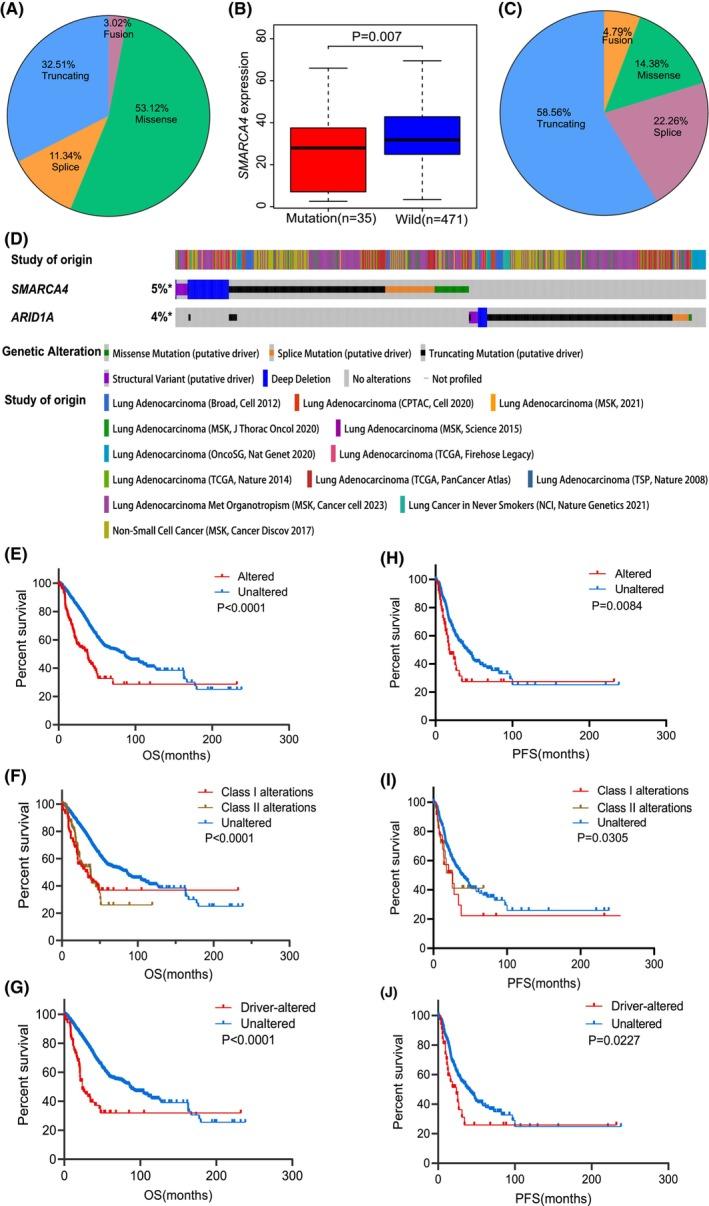
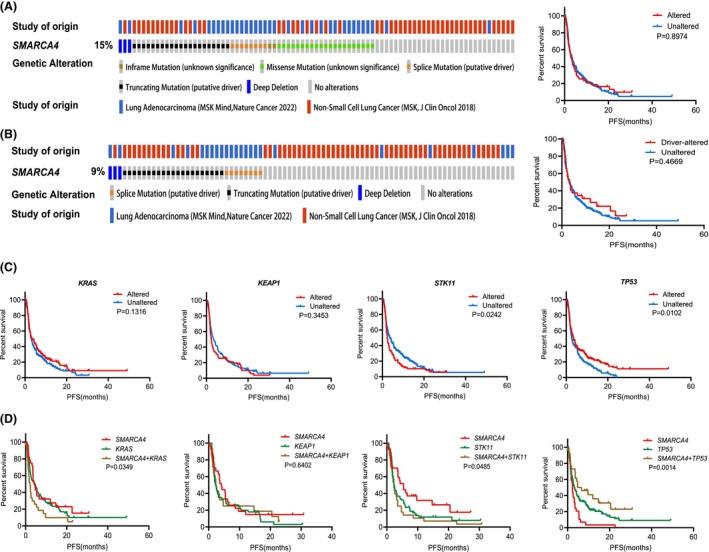
The switch/sucrose non-fermenting (SWI/SNF) complex family includes important chromatin-remodeling factors that are frequently mutated in lung adenocarcinoma (LUAD). However, the role of one family member, SMARCA4, in LUAD prognosis and immunotherapy sensitivity remains unclear. In the present study, 6745 LUAD samples from the cBioPortal database were used to analyze the relationships between SMARCA4 mutations and patient prognoses and clinical characteristics. Additionally, we examined the correlation between SMARCA4 mutations and prognosis in patients treated with immunotherapy using two immune-related datasets. SMARCA4 mutations and low expression were associated with shorter survival, and mutations were associated with a high tumor mutational burden and high microsatellite instability. SMARCA4 mutations were accompanied by KRAS, KEAP1, TP53 and STK11 mutations. No significant difference was observed in the immunotherapy response between patients with and without SMARCA4 mutations. When KRAS or STK11 mutations were present, immunotherapy effectiveness was poorer; however, when both SMARCA4 and TP53 mutations were present, immunotherapy was more effective. Furthermore, low SMARCA4 expression predicted a higher immunophenoscore, and SMARCA4 expression was correlated with certain immune microenvironment features. Taken together, our results suggest that SMARCA4 mutations and low expression might be associated with poor LUAD prognosis. Additionally, immunotherapy efficacy in patients with SMARCA4 mutations depended on the co-mutant genes. Thus, SMARCA4 could be an important factor to be considered for LUAD diagnosis and treatment.
开关/蔗糖非发酵(SWI/SNF)复合体家族包含重要的染色质重塑因子,这些因子在肺腺癌(LUAD)中经常发生突变。然而,该家族成员之一SMARCA4在LUAD预后和免疫治疗敏感性中的作用仍不清楚。在本研究中,我们使用来自cBioPortal数据库的6745个LUAD样本分析了SMARCA4突变与患者预后及临床特征之间的关系。此外,我们使用两个免疫相关数据集研究了接受免疫治疗患者中SMARCA4突变与预后的相关性。SMARCA4突变和低表达与较短生存期相关,且突变与高肿瘤突变负担和高微卫星不稳定性相关。SMARCA4突变伴有KRAS、KEAP1、TP53和STK11突变。有无SMARCA4突变的患者在免疫治疗反应方面未观察到显著差异。当存在KRAS或STK11突变时,免疫治疗效果较差;然而,当同时存在SMARCA4和TP53突变时,免疫治疗更有效。此外,SMARCA4低表达预示着更高的免疫表型评分,且SMARCA4表达与某些免疫微环境特征相关。综上所述,我们的结果表明,SMARCA4突变和低表达可能与LUAD预后不良有关。此外,SMARCA4突变患者的免疫治疗疗效取决于共突变基因。因此,SMARCA4可能是LUAD诊断和治疗中需要考虑的一个重要因素。





 Zotero 插件