
聚乳酸(PLA)基共混物的发展及改性策略:改善面向技术应用的关键性能的方法——综述
The Development of Poly(lactic acid) (PLA)-Based Blends and Modification Strategies: Methods of Improving Key Properties towards Technical Applications-Review.
作者信息
Andrzejewski Jacek, Das Subhasis, Lipik Vitali, Mohanty Amar K, Misra Manjusri, You Xiangyu, Tan Lay Poh, Chang Boon Peng
机构信息
Institute of Materials Technology, Poznan University of Technology, Piotrowo 3 Str., 61-138 Poznan, Poland.
School of Materials Science & Engineering, Nanyang Technological University, 50 Nanyang Avenue, Singapore 639798, Singapore.
出版信息
Materials (Basel). 2024 Sep 17;17(18):4556. doi: 10.3390/ma17184556.
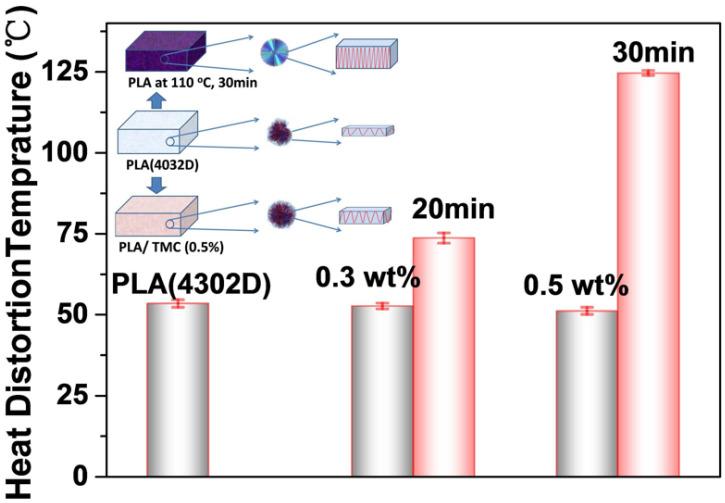
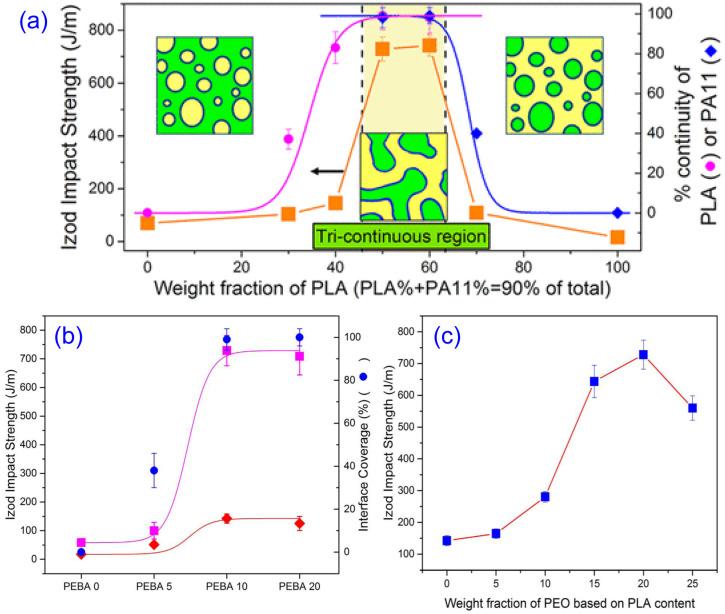
The widespread use of poly(lactic acid) (PLA) from packaging to engineering applications seems to follow the current global trend. The development of high-performance PLA-based blends has led to the commercial introduction of various PLA-based resins with excellent thermomechanical properties. The reason for this is the progress in the field of major PLA limitations such as low thermal resistance and poor impact strength. The main purpose of using biobased polymers in polymer blends is to increase the share of renewable raw materials in the final product rather than its possible biodegradation. However, in the case of engineering applications, the focus is on achieving the required properties rather than maximizing the percentage of biopolymer. The presented review article discusses the current strategies to optimize the balance of the key features such as stiffness, toughness, and heat resistance of PLA-based blends. Improving of these properties requires molecular structural changes, which together with morphology, crystallinity, and the influence of the processing conditions are the main subjects of this article. The latest research in this field clearly indicates the high potential of using PLA-based materials in highly demanding applications. In the case of impact strength modification, it is possible to obtain values close to 800 J/m, which is a value comparable to polycarbonate. Significant improvement can also be confirmed for thermal resistance results, where heat deflection temperatures for selected types of PLA blends can reach even 130 °C after modification. The modification strategies discussed in this article confirm that a properly conducted process of selecting the blend components and the conditions of the processing technique allows for revealing the potential of PLA as an engineering plastic.
从包装到工程应用,聚乳酸(PLA)的广泛使用似乎顺应了当前的全球趋势。高性能PLA基共混物的发展促使各种具有优异热机械性能的PLA基树脂商业化推出。原因在于在PLA的主要局限性领域取得了进展,如耐热性低和冲击强度差。在聚合物共混物中使用生物基聚合物的主要目的是增加最终产品中可再生原料的比例,而非其可能的生物降解性。然而,在工程应用中,重点在于实现所需性能而非最大化生物聚合物的百分比。本文献综述讨论了优化PLA基共混物关键特性(如刚度、韧性和耐热性)平衡的当前策略。改善这些性能需要分子结构变化,分子结构变化连同形态、结晶度以及加工条件的影响是本文的主要主题。该领域的最新研究清楚地表明了在高要求应用中使用PLA基材料的巨大潜力。在冲击强度改性方面,可以获得接近800 J/m的值,这一数值与聚碳酸酯相当。对于耐热性结果也能证实有显著改善,经过改性后,某些类型的PLA共混物的热变形温度甚至可达到130℃。本文讨论的改性策略证实,正确进行共混物组分选择和加工技术条件的过程能够挖掘PLA作为工程塑料的潜力。












 Zotero 插件