
通过与蛋白毒性应激反应抑制剂联合治疗,银纳米颗粒增强三阴性乳腺癌特异性细胞死亡诱导作用。
Enhancement of Triple-Negative Breast Cancer-Specific Induction of Cell Death by Silver Nanoparticles by Combined Treatment with Proteotoxic Stress Response Inhibitors.
作者信息
Snyder Christina M, Mateo Beatriz, Patel Khushbu, Fahrenholtz Cale D, Rohde Monica M, Carpenter Richard, Singh Ravi N
机构信息
Department of Cancer Biology, Wake Forest University School of Medicine, Winston-Salem, NC 27157, USA.
Fred Wilson School of Pharmacy, High Point University, High Point, NC 27268, USA.
出版信息
Nanomaterials (Basel). 2024 Sep 27;14(19):1564. doi: 10.3390/nano14191564.
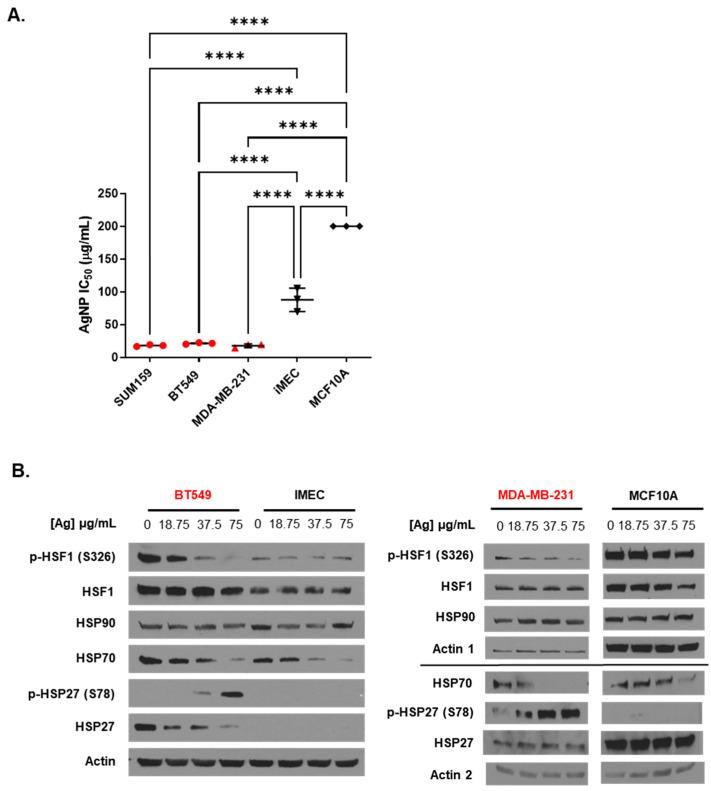
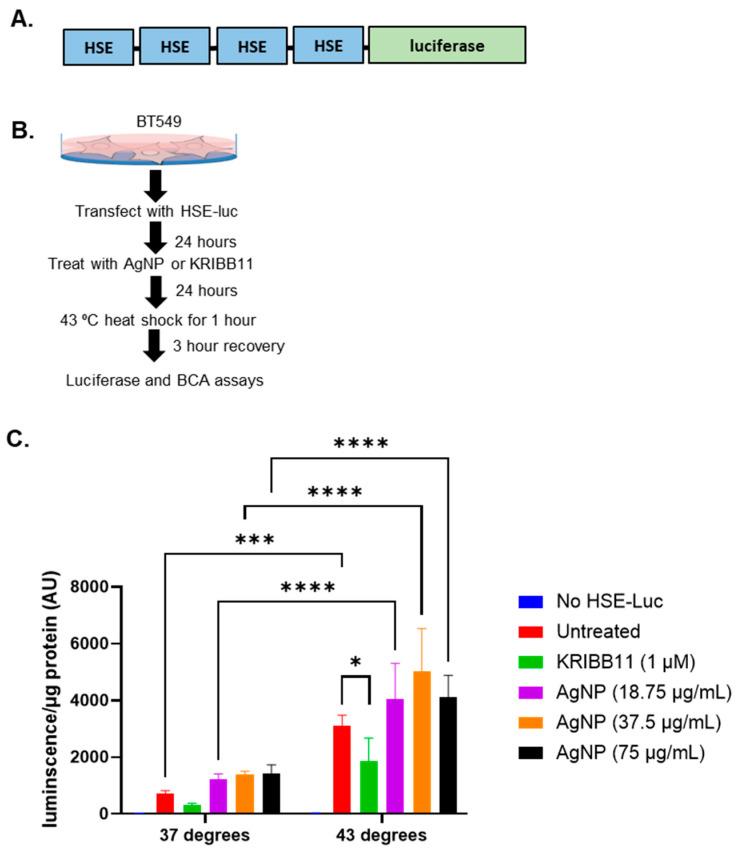
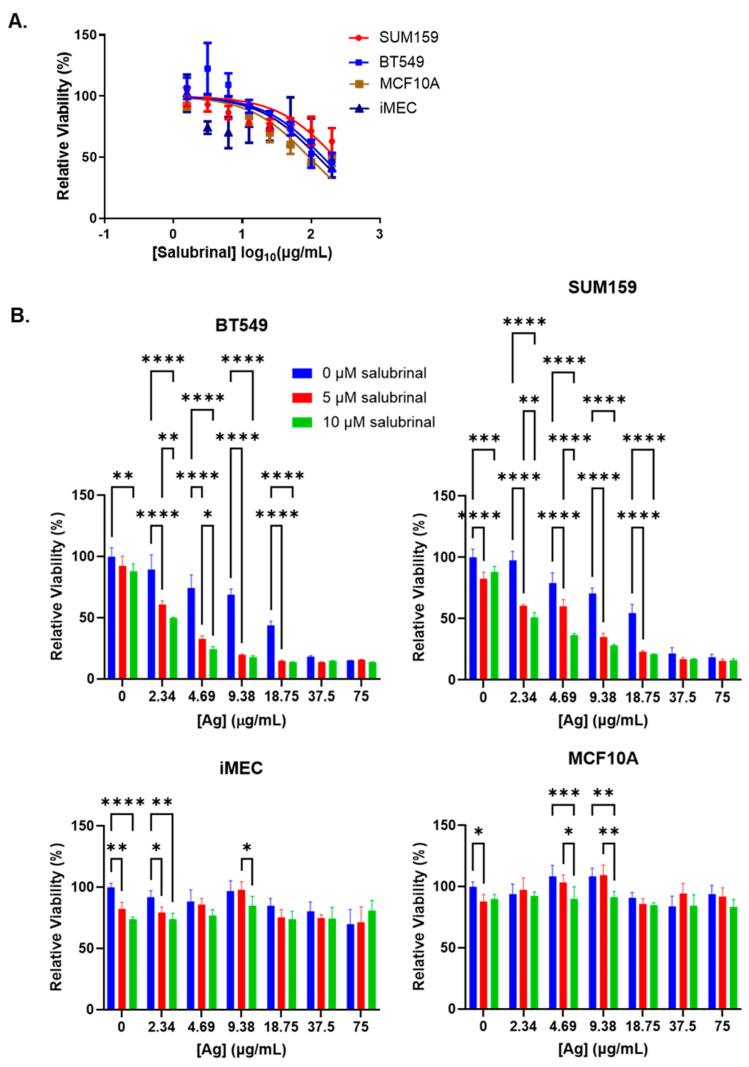
Metal nanoparticles have been tested for therapeutic and imaging applications in pre-clinical models of cancer, but fears of toxicity have limited their translation. An emerging concept in nanomedicine is to exploit the inherent drug-like properties of unmodified nanomaterials for cancer therapy. To be useful clinically, there must be a window between the toxicity of the nanomaterial to cancer and toxicity to normal cells. This necessitates identification of specific vulnerabilities in cancers that can be targeted using nanomaterials without inducing off-target toxicity. Previous studies point to proteotoxic stress as a driver of silver nanoparticle (AgNPs) toxicity. Two key cell stress responses involved in mitigating proteotoxicity are the heat shock response (HSR) and the integrated stress response (ISR). Here, we examine the role that these stress responses play in AgNP-induced cytotoxicity in triple-negative breast cancer (TNBC) and immortalized mammary epithelial cells. Furthermore, we investigate HSR and ISR inhibitors as potential drug partners to increase the anti-cancer efficacy of AgNPs without increasing off-target toxicity. We showed that AgNPs did not strongly induce the HSR at a transcriptional level, but instead decreased expression of heat shock proteins (HSPs) at the protein level, possibly due to degradation in AgNP-treated TNBC cells. We further showed that the HSR inhibitor, KRIBB11, synergized with AgNPs in TNBC cells, but also increased off-target toxicity in immortalized mammary epithelial cells. In contrast, we found that salubrinal, a drug that can sustain pro-death ISR signaling, enhanced AgNP-induced cell death in TNBC cells without increasing toxicity in immortalized mammary epithelial cells. Subsequent co-culture studies demonstrated that AgNPs in combination with salubrinal selectively eliminated TNBCs without affecting immortalized mammary epithelial cells grown in the same well. Our findings provide additional support for proteotoxic stress as a mechanism by which AgNPs selectively kill TNBCs and will help guide future efforts to identify drug partners that would be beneficial for use with AgNPs for cancer therapy.
金属纳米颗粒已在癌症临床前模型中进行了治疗和成像应用测试,但对毒性的担忧限制了它们的转化应用。纳米医学中一个新兴的概念是利用未修饰纳米材料固有的类药物特性进行癌症治疗。要在临床上有用,纳米材料对癌症的毒性与对正常细胞的毒性之间必须有一个窗口。这就需要识别癌症中可以使用纳米材料靶向的特定脆弱性,而不会引起脱靶毒性。先前的研究指出蛋白毒性应激是银纳米颗粒(AgNP)毒性的驱动因素。参与减轻蛋白毒性的两个关键细胞应激反应是热休克反应(HSR)和综合应激反应(ISR)。在这里,我们研究了这些应激反应在三阴性乳腺癌(TNBC)和永生化乳腺上皮细胞中AgNP诱导的细胞毒性中所起的作用。此外,我们研究了HSR和ISR抑制剂作为潜在的药物伙伴,以提高AgNP的抗癌疗效而不增加脱靶毒性。我们发现,AgNP在转录水平上并未强烈诱导HSR,而是在蛋白质水平上降低了热休克蛋白(HSP)的表达,这可能是由于经AgNP处理的TNBC细胞中的降解所致。我们进一步表明,HSR抑制剂KRIBB11在TNBC细胞中与AgNP协同作用,但也增加了永生化乳腺上皮细胞中的脱靶毒性。相比之下,我们发现salubrinal,一种可以维持促死亡ISR信号的药物,增强了AgNP在TNBC细胞中诱导的细胞死亡,而不会增加永生化乳腺上皮细胞中的毒性。随后的共培养研究表明,AgNP与salubrinal联合使用可选择性消除TNBC,而不会影响在同一孔中生长的永生化乳腺上皮细胞。我们的研究结果为蛋白毒性应激作为AgNP选择性杀死TNBC的机制提供了额外支持,并将有助于指导未来寻找与AgNP联合用于癌症治疗有益的药物伙伴的努力。



 Zotero 插件