
基层医疗护士在电话护理中对伴有不宁腿综合征相关症状患者的症状及治疗需求的体验——基于“四习惯”沟通模型的溯因分析
Primary healthcare nurses' experiences of symptoms and treatment needs of patients with RLS-associated symptoms at telephone nursing - an abductive analysis based on the Four Habits communication model.
作者信息
Säwén Alexandra, Odzakovic Elzana, Ulander Martin, Lind Jonas, Broström Anders
机构信息
School of Health and Welfare, Jönköping University, Jönköping, Sweden.
Department of Clinical Neurophysiology, Linköping University Hospital, Linköping, Sweden.
出版信息
Int J Qual Stud Health Well-being. 2025 Dec;20(1):2478687. doi: 10.1080/17482631.2025.2478687. Epub 2025 Mar 17.
BACKGROUND
Restless legs syndrome (RLS) is a common, neurological disease. Primary healthcare (PHC) nurses are often the patient's first contact, but studies regarding their experience assessing RLS-associated symptoms and treatment needs in telephone nursing (TN) are lacking.
PURPOSE
To describe how PHC nurses experience symptoms and treatment needs of patients with RLS-associated symptoms during TN.
METHODS
A descriptive abductive design, including semi-structured interviews with 18 PHC nurses from six Swedish regions. Data was deductively analyzed using the Four Habits communication model. Facilitators and barriers were inductively identified.
RESULTS
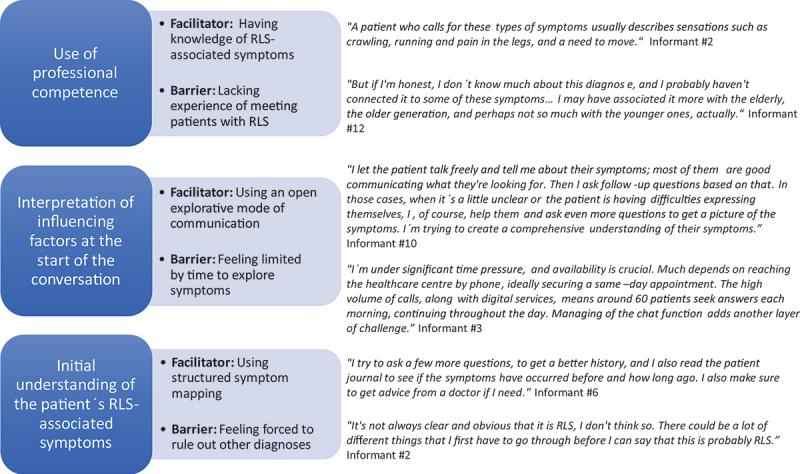
Invest in the beginning included the use of professional competence, interpretation of influencing factors at the start of the conversation and initial understanding of the patient's RLS symptoms. Elicit the patient's perspective involved originate from the patient's perception of the symptoms and comprehending the symptoms' impact on the patient's life situation. Relate to the patient's situation and the importance of trust in the patient meeting described demonstrating empathy. Invest in the end involved triaging patients with RLS-associated symptoms, providing self-care advice to patients with RLS-associated symptoms and achieving consensus at the end of the conversation.
CONCLUSION
Using the Four Habits communication model could enrich communication regarding RLS-associated symptoms and treatment needs during TN.
背景
不宁腿综合征(RLS)是一种常见的神经系统疾病。初级医疗保健(PHC)护士通常是患者的首个接触对象,但缺乏关于她们在电话护理(TN)中评估RLS相关症状及治疗需求经验的研究。
目的
描述初级医疗保健护士在电话护理期间对有RLS相关症状患者的症状及治疗需求的体验。
方法
采用描述性溯因设计,包括对来自瑞典六个地区的18名初级医疗保健护士进行半结构化访谈。使用四习惯沟通模型对数据进行演绎分析。归纳确定促进因素和障碍。
结果
开始时投入包括运用专业能力、在对话开始时解读影响因素以及初步了解患者的RLS症状。引出患者观点涉及源自患者对症状的感知并理解症状对患者生活状况的影响。关联患者情况及在患者会面中信任的重要性描述为表现出同理心。结束时投入包括对有RLS相关症状的患者进行分诊、为有RLS相关症状的患者提供自我护理建议以及在对话结束时达成共识。
结论
使用四习惯沟通模型可丰富电话护理期间关于RLS相关症状及治疗需求的沟通。



 Zotero 插件