
β2-微球蛋白与认知衰退:揭示达尼丁衰老速度甲基化的中介作用
β2-microglobulin and cognitive decline: unraveling the mediating role of the Dunedin Pace of Aging methylation.
作者信息
Ke Yujun, Chen Ping, Wu Chunlan, Wang Qinqin, Zeng Kai, Liang Min
机构信息
Department of Anesthesiology, The First Affiliated Hospital, Fujian Medical University, Fuzhou, China.
Department of Anesthesiology, National Regional Medical Center, Binhai Campus of the First Affiliated Hospital, Fujian Medical University, Fuzhou, China.
出版信息
Front Aging Neurosci. 2025 Mar 25;17:1505185. doi: 10.3389/fnagi.2025.1505185. eCollection 2025.
BACKGROUND
Progressive cognitive decline is inevitable with aging. Growing evidence links β2-microglobulin (B2M) to aging and cognitive decline. However, the current evidence is inadequate to establish a definitive association. This study aims to investigate the relationship between B2M levels and cognitive performance, together with the mediating effect of the pace of biological aging.
METHODS
Utilizing the 1999-2002 National Health and Nutrition Examination Survey (NHANES) database, cognitive performance was measured via the Digit Symbol Substitution Test (DSST), while the pace of biological aging was quantified using a new generation DNA methylation algorithm, Dunedin Pace of Aging methylation (DunedinPoAm). Weighted multivariable linear regression was used to explore the relationship between B2M levels and cognitive performance. Furthermore, subgroup analysis and interaction tests were performed to assess the relationship's stability. Mediation analysis was conducted to investigate the mediating effect of DunedinPoAm on the association between B2M levels and cognitive performance.
RESULTS
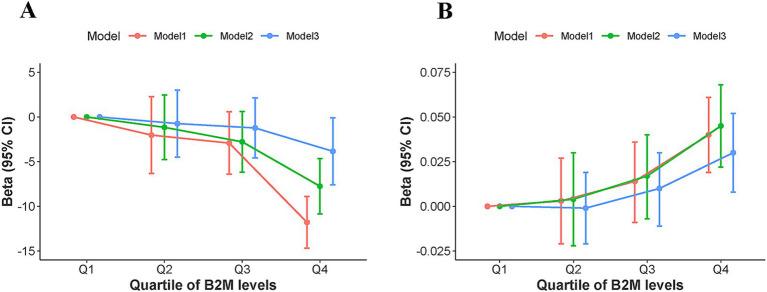
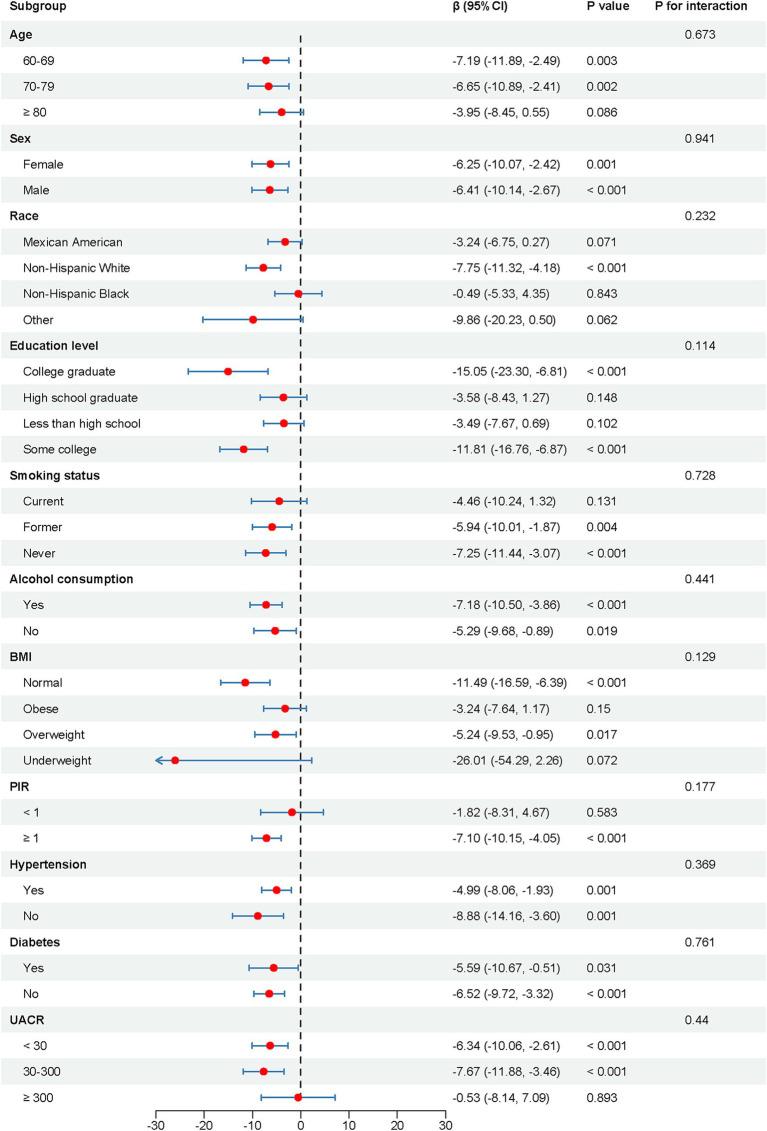
The study included 1,267 participants aged 60 and over. After correcting for all confounders, for each one-unit increment in log-transformed B2M levels, the DSST score fell by 5.13 points (95%CI -9.03 to -1.24), while the level of DunedinPoAm increased by 0.04 (95%CI 0.01-0.07). The analysis of the trend test yielded identical results ( for trend <0.05). Additionally, across every subgroup analyzed, the correlation between B2M levels and cognitive performance was stable ( for interaction >0.05). Further mediation analysis showed that DunedinPoAm mediated 9.0% (95%CI 0.1-43.2%) of the association between B2M and cognitive performance.
CONCLUSION
These findings suggested a substantial link between elevated B2M levels and cognitive decline among U.S. older adults, partly mediated through the faster pace of aging. This correlation highlights the potential of B2M as a biomarker for early detection and therapeutic intervention of aging-related cognitive decline.
背景
随着年龄增长,认知功能逐渐衰退是不可避免的。越来越多的证据表明β2-微球蛋白(B2M)与衰老和认知衰退有关。然而,目前的证据不足以确定两者之间的明确关联。本研究旨在探讨B2M水平与认知表现之间的关系,以及生物衰老速度的中介作用。
方法
利用1999 - 2002年美国国家健康与营养检查调查(NHANES)数据库,通过数字符号替换测验(DSST)测量认知表现,同时使用新一代DNA甲基化算法——达尼丁衰老甲基化速度(DunedinPoAm)对生物衰老速度进行量化。采用加权多变量线性回归来探讨B2M水平与认知表现之间的关系。此外,进行亚组分析和交互作用检验以评估该关系的稳定性。进行中介分析以研究DunedinPoAm对B2M水平与认知表现之间关联的中介作用。
结果
该研究纳入了1267名60岁及以上的参与者。校正所有混杂因素后,对数转换后的B2M水平每增加一个单位,DSST得分下降5.13分(95%CI -9.03至-1.24),而DunedinPoAm水平增加0.04(95%CI 0.01 - 0.07)。趋势检验分析得出了相同的结果(趋势P<0.05)。此外,在分析的每个亚组中,B2M水平与认知表现之间的相关性是稳定的(交互作用P>0.05)。进一步的中介分析表明,DunedinPoAm介导了B2M与认知表现之间9.0%(95%CI 0.1 - 43.2%)的关联。
结论
这些发现表明,美国老年人中B2M水平升高与认知衰退之间存在显著关联,部分是通过更快的衰老速度介导的。这种相关性凸显了B2M作为衰老相关认知衰退早期检测和治疗干预生物标志物的潜力。


 Zotero 插件