
表观遗传年龄与血栓栓塞之间的因果关联:一项双向两样本孟德尔随机化研究。
Causal associations between epigenetic age and thromboembolism: a bi-directional two-sample Mendelian randomization study.
作者信息
Jin Bowen, Li Yunyan, Li Dingyang, Jing Chi, Sheng Qunshan
机构信息
Department of Cardiovascular Surgery, Wuhan Asia Heart Hospital, Wuhan City, 430000, Hubei Province, China.
出版信息
Clin Epigenetics. 2025 May 5;17(1):75. doi: 10.1186/s13148-025-01875-3.
BACKGROUND
Thromboembolism is one of the most prevalent cardiovascular conditions affecting the elder population. The associations between epigenetic aging and thromboembolism risks remain incompletely elucidated. Through Mendelian randomization (MR), this research seeks to assess the causal links between genetically determined epigenetic aging factors and thromboembolism.
RESULTS
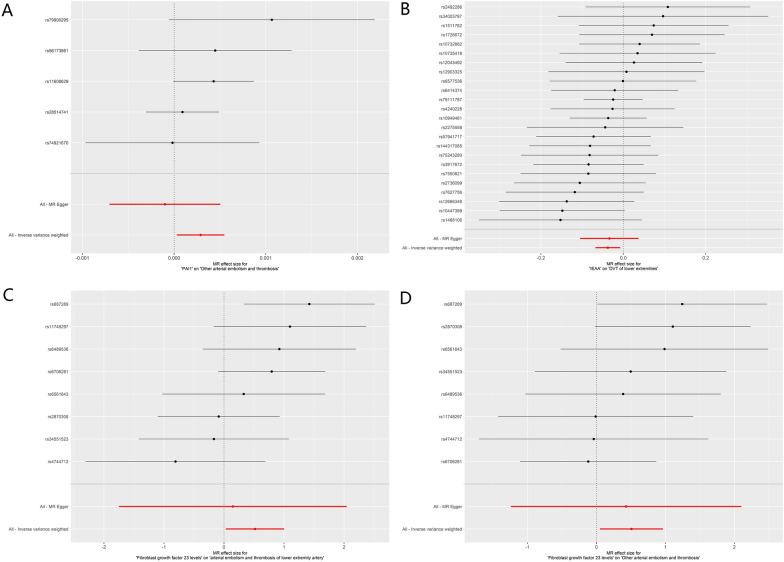
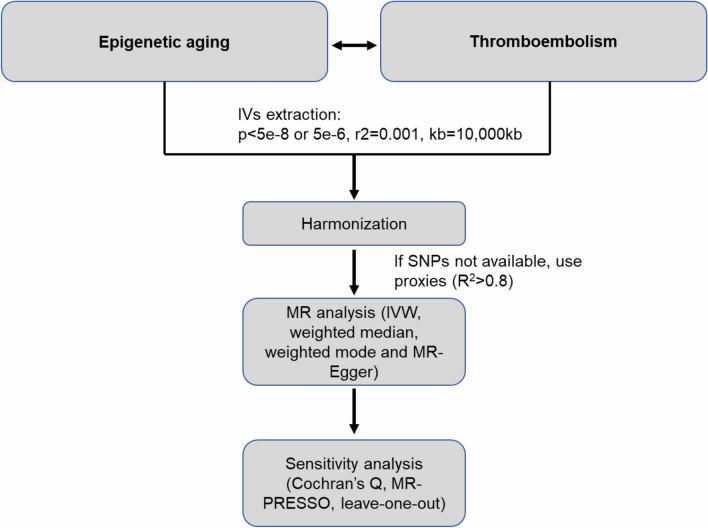
Genetic variants were extracted from genome-wide association studies (GWAS) under stringent threshold as instrumental variables (IVs). Bi-directional two-sample MR analyses were conducted to determine the direction of causal associations. We employed the inverse variance weighted (IVW), weighted median, weighted mode and MR Egger to estimate the causal effect, with sensitivity analyses such as Cochran's Q tests, MR-PRESSO and leave-one-out performed to avoid potential heterogeneity and pleiotropy. Our MR analysis revealed a causal association between intrinsic epigenetic age acceleration and deep vein thrombosis of lower extremities (IVW: OR 0.963, 95% CI 0.934-0.992, P = 0.014), and between the genetically determined levels of plasminogen activator inhibitor-1 and other arterial embolism and thrombosis (IVW: OR 1.000, 95% CI 1.000-1.0005, P = 0.029). Causality was also identified between the genetically predicted levels of FGF23 and other arterial embolism and thrombosis (IVW: OR: 1.661, 95% CI 1.051-2.624, P = 0.029) and arterial embolism and thrombosis of lower extremity artery (IVW: OR 1.68, 95% CI 1.031-2.725, P = 0.037). Moreover, bi-directional MR showed reverse effects between portal vein thrombosis and PhenoAge (IVW: OR 0.871, 95% CI 0.765-0.992, P = 0.037) and between venous thromboembolism and GrimAge (IVW: OR 1.186, 95% CI 1.048-1.341, P = 0.007). Sensitivity analysis using Cochran's Q tests, MR-PRESSO and leave-one-out excluded the influence of heterogeneity, horizontal pleiotropy, and outliers.
CONCLUSION
Our results identified a causal association between genetically predicted epigenetic aging factors and thromboembolism. The findings highlight the necessity for further exploration into the underlying etiology of thromboembolism.
背景
血栓栓塞是影响老年人群的最常见心血管疾病之一。表观遗传衰老与血栓栓塞风险之间的关联尚未完全阐明。通过孟德尔随机化(MR),本研究旨在评估基因决定的表观遗传衰老因素与血栓栓塞之间的因果关系。
结果
从全基因组关联研究(GWAS)中在严格阈值下提取基因变异作为工具变量(IVs)。进行双向双样本MR分析以确定因果关联的方向。我们采用逆方差加权(IVW)、加权中位数、加权模式和MR Egger来估计因果效应,并进行了敏感性分析,如Cochran's Q检验、MR-PRESSO和留一法分析,以避免潜在的异质性和多效性。我们的MR分析揭示了内在表观遗传年龄加速与下肢深静脉血栓形成之间的因果关联(IVW:OR 0.963,95%CI 0.934-0.992,P = 0.014),以及基因决定的纤溶酶原激活物抑制剂-1水平与其他动脉栓塞和血栓形成之间的因果关联(IVW:OR 1.000,95%CI 1.000-1.0005,P = 0.029)。在基因预测的成纤维细胞生长因子23水平与其他动脉栓塞和血栓形成(IVW:OR:1.661,95%CI 1.051-2.624,P = 0.029)以及下肢动脉栓塞和血栓形成(IVW:OR 1.68,95%CI 1.031-2.725,P = 0.037)之间也确定了因果关系。此外,双向MR显示门静脉血栓形成与PhenoAge之间(IVW:OR 0.871,95%CI 0.765-0.992,P = 0.037)以及静脉血栓栓塞与GrimAge之间(IVW:OR 1.186,95%CI 1.048-1.341,P = 0.007)存在反向效应。使用Cochran's Q检验、MR-PRESSO和留一法分析进行的敏感性分析排除了异质性、水平多效性和异常值的影响。
结论
我们的结果确定了基因预测的表观遗传衰老因素与血栓栓塞之间的因果关联。这些发现突出了进一步探索血栓栓塞潜在病因的必要性。

 Zotero 插件