
整合多组学技术揭示PSMD12作为促进肺腺癌脑转移的关键基因。
Integrating multi-omics to unveil PSMD12 as a critical gene in promoting brain metastases of lung adenocarcinoma.
作者信息
Li Xin, Zhang Juxuan, Zhang Meng, Jiang Wenbin, Jia Dexin, Wang Ruxiong, Li Hao, Wang Zhihui, Liu Yixin, Tang Lefan, Deng Jiaxing, Zhao Wenyuan, Yu Yan, Liu Shilong, Qi Lishuang
机构信息
College of Bioinformatics Science and Technology, Harbin Medical University, Harbin, 150086, China.
Department of Medical Oncology, Harbin Medical University Cancer Hospital, Harbin, 150040, China.
出版信息
J Transl Med. 2025 Jun 17;23(1):668. doi: 10.1186/s12967-025-06680-3.
BACKGROUND
Brain metastases (BM) remain the leading cause of death in patients with lung adenocarcinoma (LUAD) despite the availability of comprehensive therapeutics. This study aimed to systematically identify crucial genes associated with BM in patients with LUAD, and develop a heuristic search algorithm combining information filtering and multiple stepwise regression to construct a multi-layered transcription factor regulatory network.
METHODS
We used the mRNA expression profiles of primary tumours derived from LUAD patients with different organ metastasis and adjacent normal tissue samples to identify differentially expressed genes specific to BM, and validated it in bulk, spatial and single-cell RNA-sequencing data. Furthermore, we collected 110 stage I-III LUAD specimens to validate the correlation of high PSMD12 (proteasome 26 S subunit, non-ATPase 12) protein expression with BM incidence and patient prognosis. We also developed an in vitro blood-brain barrier (BBB) model to investigate the disruption of PSMD12 on the barrier. Mechanistically, we developed an algorithm to construct an upstream regulator network of PSMD12 overexpression.
RESULTS
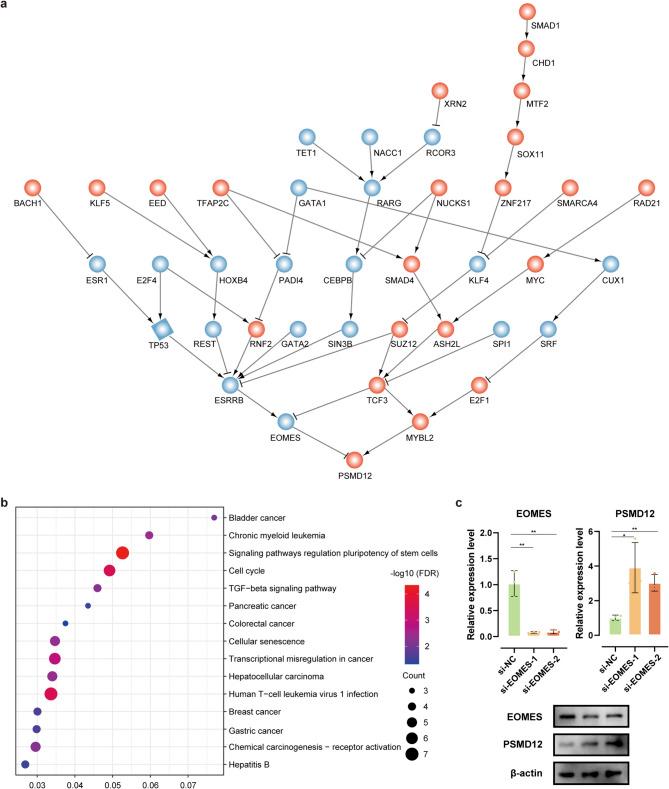
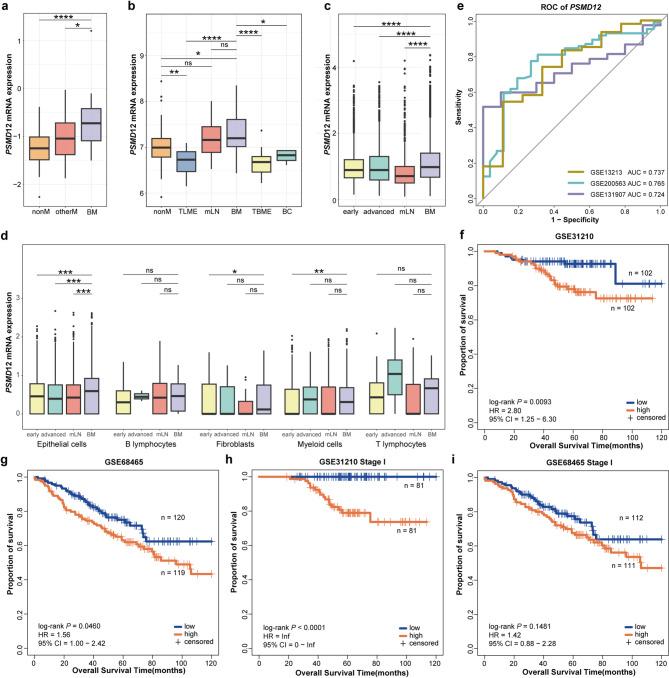
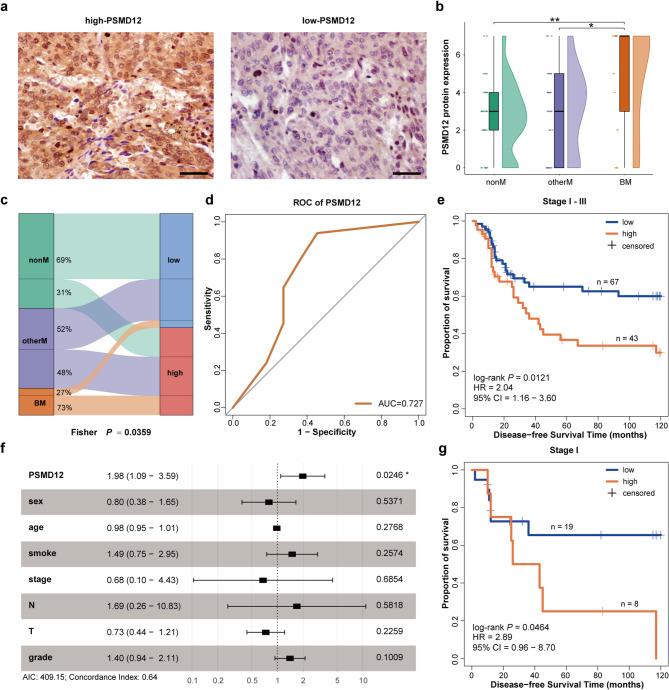
Through integrated bioinformatics analyses, we identified PSMD12 as a critical gene associated with BM. The associations of PSMD12 with BM and poor survival were validated in multiple public datasets comprising 706 patients. Immunohistochemical results confirmed that patients exhibiting high PSMD12 protein expression had a significantly higher incidence of BM within 5 years and shorter progression-free survival. Functional experiments revealed that PSMD12 overexpression in A549 cells disrupted BBB integrity and enhanced tumor cell invasiveness, whereas PSMD12 knockdown attenuated these effects. Furthermore, upstream regulator network and knockdown experiments indicated that downregulated EOMES expression would contribute to PSMD12 overexpression.
CONCLUSIONS
PSMD12 emerges as a crucial gene in promoting BM, potentially serving as an early warning indicator of BM in early-stage LUAD. The upstream regulatory network of PSMD12 overexpression provides potential mechanisms for BM in LUAD patients.
背景
尽管有综合治疗方法,但脑转移(BM)仍是肺腺癌(LUAD)患者的主要死亡原因。本研究旨在系统地鉴定LUAD患者中与BM相关的关键基因,并开发一种结合信息过滤和多步逐步回归的启发式搜索算法,以构建多层转录因子调控网络。
方法
我们使用来自不同器官转移的LUAD患者的原发性肿瘤和相邻正常组织样本的mRNA表达谱,以鉴定BM特异性的差异表达基因,并在批量、空间和单细胞RNA测序数据中进行验证。此外,我们收集了110例I-III期LUAD标本,以验证高PSMD12(蛋白酶体26S亚基,非ATP酶12)蛋白表达与BM发生率和患者预后的相关性。我们还开发了一种体外血脑屏障(BBB)模型,以研究PSMD12对屏障的破坏作用。从机制上,我们开发了一种算法来构建PSMD12过表达的上游调节网络。
结果
通过综合生物信息学分析,我们鉴定出PSMD12是与BM相关的关键基因。在包含706例患者的多个公共数据集中验证了PSMD12与BM和不良生存的关联。免疫组织化学结果证实,PSMD12蛋白表达高的患者在5年内BM发生率显著更高,无进展生存期更短。功能实验表明A549细胞中PSMD12过表达破坏了BBB完整性并增强了肿瘤细胞侵袭性,而PSMD12敲低减弱了这些作用。此外,上游调节网络和敲低实验表明EOMES表达下调会导致PSMD12过表达。
结论
PSMD12成为促进BM的关键基因,可能作为早期LUAD中BM的预警指标。PSMD12过表达的上游调控网络为LUAD患者的BM提供了潜在机制。


 Zotero 插件