
长期新冠患者神经系统症状的患病率和严重程度以及既往疾病、住院治疗和心理健康的作用。
Prevalence and severity of neurologic symptoms in Long-COVID and the role of pre-existing conditions, hospitalization, and mental health.
作者信息
Huff Hanalise V, Roberts Henry, Bartrum Elizabeth, Norato Gina, Grayson Nicholas, Fleig Katherine, Wilkerson Miciah J, Stussman Barbara J, Nath Avindra, Walitt Brian
机构信息
National Institutes of Health, National Institute of Neurological Diseases and Stroke, Bethesda, MD, United States.
出版信息
Front Neurol. 2025 Jun 25;16:1562084. doi: 10.3389/fneur.2025.1562084. eCollection 2025.
BACKGROUND
Long-COVID refers to ongoing, relapsing, or new symptoms present 30 or more days after Severe Acute Respiratory Syndrome Coronavirus 2 (SARS-CoV-2) infection. This study examined the prevalence and severity of neurologic symptoms at greater than 1 month following acute SARS-CoV-2 infection and the influence of pre-existing neurologic and psychiatric conditions, current depression and anxiety status, and hospitalization on the presence and severity of these symptoms.
METHODS
This prospective cohort study recruited primarily self-referred Long-COVID participants with confirmed SARS-CoV-2 infection. Online questionnaires inquiring about pre-existing conditions, neurologic symptoms and their severity pre, during and post COVID-19, and current anxiety and depression screening were completed by 213 participants at a median time of 8 months after infection. Descriptive analyses and prevalence modeling were performed.
RESULTS
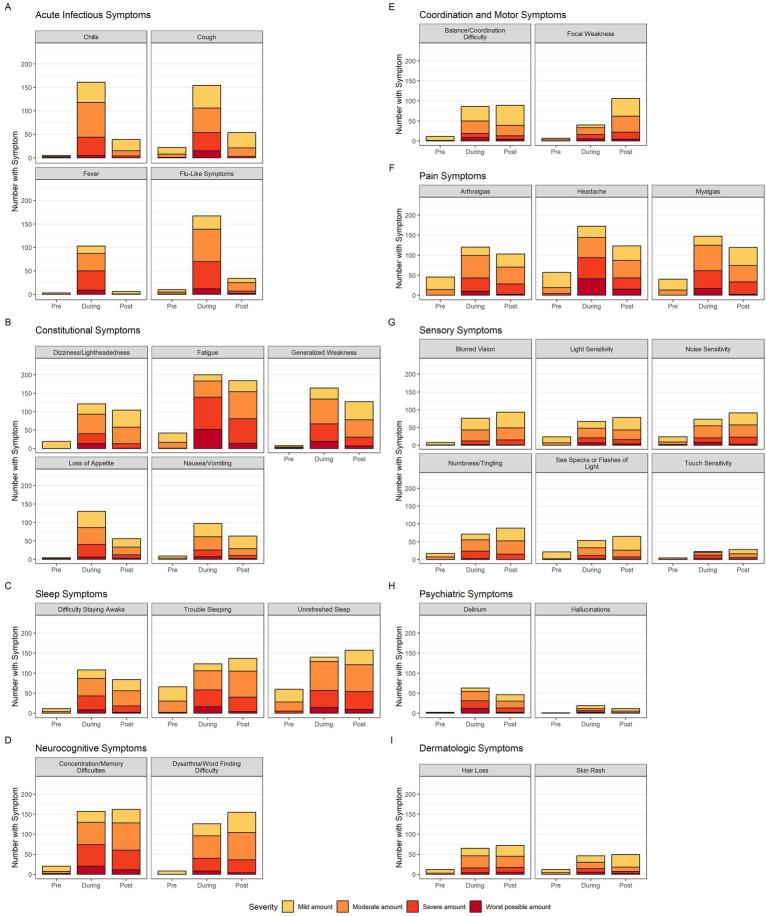
The most frequent neurologic symptoms post COVID-19 were fatigue, concentration/memory difficulties, unrefreshed sleep, and dysarthria/word finding difficulties (73.2-86.4%). Neurologic symptoms were highly prevalent with significantly greater odds post COVID-19 compared to pre for all symptoms and higher prevalence at time periods farther from infection, including those implicit in fibromyalgia and myalgic encephalomyelitis/chronic fatigue syndrome. Several severe neurologic symptoms were significantly more prevalent post COVID-19. Moderate to severe anxiety (34%) and depression (27%) were observed post COVID-19. Preexisting neurologic or psychiatric conditions did not demonstrate any significant difference in neurologic symptom prevalence post COVID-19. Those who met criteria for moderate or severe anxiety post COVID-19 had a significant difference in prevalence of fatigue, sensitivity to touch and unrefreshed sleep. Similarly, fatigue, concentration/memory difficulty and unrefreshed sleep were more prevalent in moderate to severe depression. There were no significant differences in neurologic symptom prevalence in a hospitalized group when compared to non- hospitalized.
CONCLUSION
Long-COVID has a high burden of long lasting and severe neurological sequelae. These sequelae are independent of pre-existing self-reported neurologic and psychiatric conditions, as well as previous hospitalization. Current moderate to severe anxiety and depression status can impact fatigue, cognition, and sleep post COVID-19. Focus on the biological impact of SARS-CoV-2 on the nervous system will be essential in ameliorating the tremendous symptom burden left in the wake of the COVID-19 pandemic.
CLINICAL TRIAL REGISTRATION
http://clinicaltrials.gov, identifier: NCT04573062.
背景
新冠后长期症状(Long-COVID)是指严重急性呼吸综合征冠状病毒2(SARS-CoV-2)感染30天或更长时间后出现的持续、复发或新的症状。本研究调查了急性SARS-CoV-2感染1个月后神经症状的患病率和严重程度,以及既往神经和精神疾病、当前抑郁和焦虑状态以及住院治疗对这些症状的存在和严重程度的影响。
方法
这项前瞻性队列研究主要招募了自我推荐的确诊SARS-CoV-2感染的新冠后长期症状参与者。213名参与者在感染后中位时间8个月完成了在线问卷,询问既往疾病、新冠疫情前、期间和后的神经症状及其严重程度,以及当前的焦虑和抑郁筛查。进行了描述性分析和患病率建模。
结果
新冠后最常见的神经症状是疲劳、注意力/记忆力困难、睡眠未恢复、构音障碍/找词困难(73.2-86.4%)。与新冠疫情前相比,所有症状在新冠后神经症状的患病率都很高,且在离感染时间更远的时期患病率更高,包括纤维肌痛和肌痛性脑脊髓炎/慢性疲劳综合征中隐含的症状。几种严重的神经症状在新冠后明显更普遍。新冠后观察到中度至重度焦虑(34%)和抑郁(27%)。既往神经或精神疾病在新冠后神经症状患病率上没有显示出任何显著差异。新冠后符合中度或重度焦虑标准的人在疲劳、触觉敏感度和睡眠未恢复的患病率上有显著差异。同样,疲劳、注意力/记忆力困难和睡眠未恢复在中度至重度抑郁中更普遍。与非住院组相比,住院组的神经症状患病率没有显著差异。
结论
新冠后长期症状有长期持续且严重的神经后遗症负担。这些后遗症与既往自我报告的神经和精神疾病以及既往住院无关。当前中度至重度焦虑和抑郁状态会影响新冠后的疲劳、认知和睡眠。关注SARS-CoV-2对神经系统的生物学影响对于减轻新冠疫情后留下的巨大症状负担至关重要。
临床试验注册

 Zotero 插件