
化学发光免疫分析法与酶联免疫吸附测定法检测1型糖尿病胰岛自身抗体的比较评估
A Comparative Evaluation of the Chemiluminescence Immunoassay and ELISA for the Detection of Islet Autoantibodies in Type 1 Diabetes.
作者信息
Danese Elisa, Piona Claudia, Rizza Mariateresa, Tiziani Elena, Pighi Laura, Morotti Elisa, Salvagno Gian Luca, Mattiuzzi Camilla, Maffeis Claudio, Lippi Giuseppe
机构信息
Clinical Biochemistry Section, Department of Engineering for Innovation Medicine, University of Verona, Strada le Grazie 15, 37134 Verona, Italy.
Section of Pediatric Diabetes and Metabolism, Department of Surgery, Dentistry, Pediatrics, and Gynecology, University of Verona, Piazzale L.A Scuro 10, 37126 Verona, Italy.
出版信息
Diagnostics (Basel). 2025 Jul 3;15(13):1695. doi: 10.3390/diagnostics15131695.
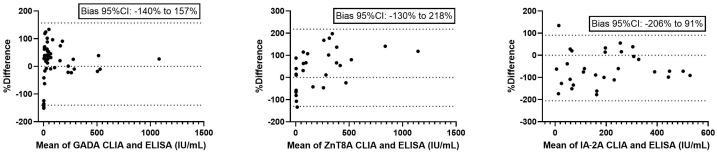
The early detection of type 1 diabetes (T1D) through screening for major islet autoantibodies is receiving increasing attention as a public health strategy, exemplified by the recent implementation of a pilot pediatric screening program in Italy. The transition from research-based screening to large-scale population initiatives needs automated and standardized assays that are capable of processing extensive sample volumes. Hence, this study aimed to evaluate the analytical performance and comparability of a fully automated chemiluminescence immunoassay (CLIA) compared to a conventional enzyme-linked immunosorbent assay (ELISA) for the detection of three classes of major islet antibodies-anti-GAD (GADA), anti-IA-2 (IA-2A), and anti-ZnT8 (ZnT8A). A total of 104 serum specimens were analyzed for each autoantibody using both ELISA (RSR and Medyzim, DYNES, DSX) and CLIA (MAGLUMI 800). Assay precision and linearity were assessed through intra-assay variability studies and dilution protocols. Methods agreement was evaluated with Passing-Bablok regression, Spearman's correlation, Bland-Altman analysis, and Cohen's kappa statistics. The CLIA showed good precision and excellent linearity across clinically relevant concentration ranges of all islet antibodies. Correlation coefficients and categorical agreement between CLIA and ELISA were high (r > 0.96 and Cohen's kappa >0.8 for all), with ZnT8A exhibiting the highest concordance. However, proportional biases were found, as CLIA systematically underestimated GADA and ZnT8A levels, while overestimated IA-2A compared to the ELISA. The CLIA displayed satisfactory precision and agreement with ELISA for GADA, IA-2A, and ZnT8A detection. Our findings support the use of these automated immunoassays in large-scale population initiatives for diagnosing T1D, but we also highlight the need for further efforts to achieve better inter-assay harmonization.
通过筛查主要胰岛自身抗体来早期检测1型糖尿病(T1D)作为一项公共卫生策略正受到越来越多的关注,意大利近期实施的一项儿科筛查试点项目就是例证。从基于研究的筛查向大规模人群计划的转变需要能够处理大量样本的自动化和标准化检测方法。因此,本研究旨在评估一种全自动化学发光免疫分析(CLIA)与传统酶联免疫吸附测定(ELISA)在检测三类主要胰岛抗体——抗谷氨酸脱羧酶抗体(GADA)、抗胰岛细胞抗原2抗体(IA-2A)和抗锌转运体8抗体(ZnT8A)方面的分析性能和可比性。使用ELISA(RSR和Medyzim、DYNES、DSX)和CLIA(MAGLUMI 800)对总共104份血清标本中的每种自身抗体进行分析。通过批内变异研究和稀释方案评估检测的精密度和线性。采用Passing-Bablok回归、Spearman相关性分析、Bland-Altman分析和Cohen's kappa统计量评估方法的一致性。CLIA在所有胰岛抗体的临床相关浓度范围内显示出良好的精密度和出色的线性。CLIA与ELISA之间的相关系数和分类一致性较高(所有抗体的r>0.96且Cohen's kappa>0.8),其中ZnT8A的一致性最高。然而,发现存在比例偏差,与ELISA相比,CLIA系统性地低估了GADA和ZnT8A水平,同时高估了IA-2A水平。CLIA在检测GADA、IA-2A和ZnT8A方面显示出令人满意的精密度和与ELISA的一致性。我们的研究结果支持在大规模人群计划中使用这些自动化免疫分析来诊断T1D,但我们也强调需要进一步努力以实现更好地检测方法间的一致性。

 Zotero 插件