
多尺度分析与机器学习相结合揭示细胞外基质相关癌相关成纤维细胞在肺腺癌中的预后作用。
Integration of Multi-Scale Profiling and Machine Learning Reveals the Prognostic Role of Extracellular Matrix-Related Cancer-Associated Fibroblasts in Lung Adenocarcinoma.
作者信息
Chen Ziyi, Chen Mengyuan, Yang Changqing, Wang Jiajing, Gao Yuan, Feng Yuanying, Yuan Dongqi, Chen Peng
机构信息
Tianjin Medical University Cancer Institute and Hospital, National Clinical Research Center for Cancer, Key Laboratory of Cancer Prevention and Therapy, Tianjin, 300060, China.
Tianjin's Clinical Research Center for Cancer, Department of Thoracic Oncology, Tianjin Lung Cancer Center, Tianjin Cancer Institute & Hospital, Tianjin Medical University, Tianjin, 300060, China.
出版信息
Int J Med Sci. 2025 Jun 12;22(12):2956-2972. doi: 10.7150/ijms.113580. eCollection 2025.
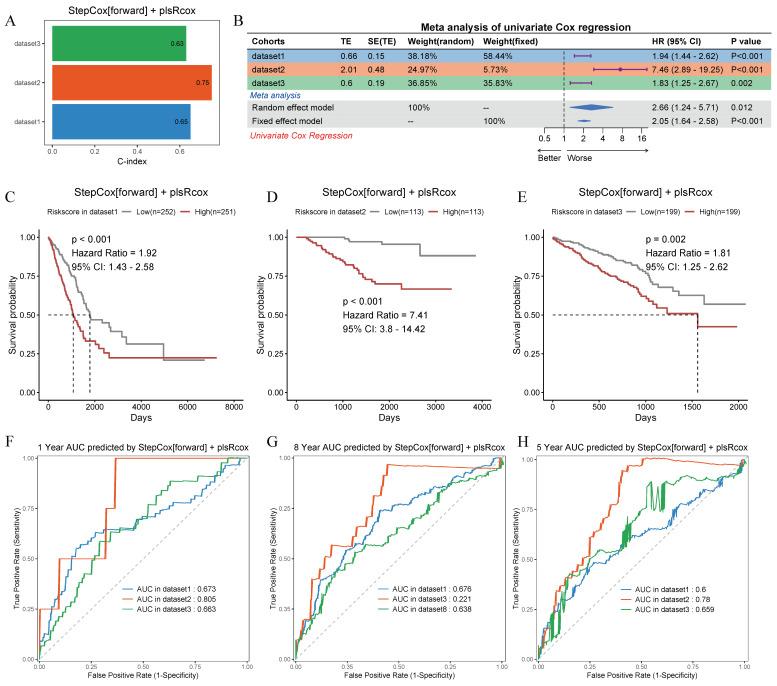
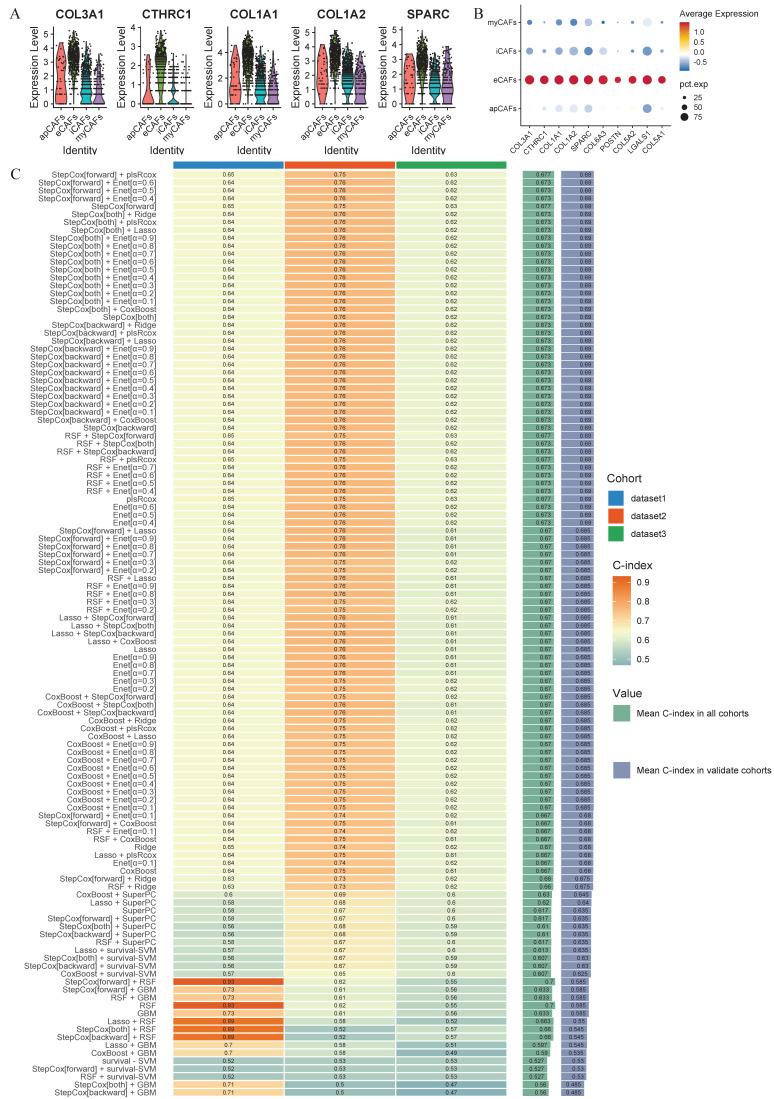
Lung adenocarcinoma (LUAD) remains a leading cause of cancer mortality, necessitating novel therapeutic targets and prognostic strategies. This study investigates the role of extracellular matrix cancer-associated fibroblasts (eCAFs) and their interaction with SPP1+ macrophages in LUAD progression and prognosis. Utilizing single-cell RNA sequencing from 15 LUAD tumors and integrating multi-cohort transcriptomic data (TCGA, GSE31210, GSE72094), we identified eCAFs as a dominant CAF subtype in advanced-stage tumors and high-grade pathological subtypes, correlating with poor patient survival. Similarly, SPP1+ macrophages exhibited increased abundance in advanced tumors and adverse prognosis. Pseudotime trajectory analysis revealed eCAFs as an evolutionary endpoint in CAF differentiation, associated with extracellular matrix remodeling pathways (COLLAGEN, FN1). Cell-cell communication analysis highlighted eCAFs-SPP1+ macrophage interactions via COL1A1-CD44 and COL1A2-CD44 ligand-receptor pairs, suggesting a mechanism for immune-excluded microenvironments. A prognostic model incorporating 28 eCAFs-related genes, validated through 101-machine learning algorithms, effectively stratified patients into high- and low-risk groups across cohorts. This study underscores eCAFs as key drivers of LUAD progression and proposes their interplay with SPP1+ macrophages as a therapeutic target. The developed prognostic signature offers clinical utility for risk stratification, though further experimental validation is warranted. These findings advance understanding of stromal-immune crosstalk in LUAD and highlight ECM remodeling as a critical pathway in tumor evolution.
肺腺癌(LUAD)仍然是癌症死亡的主要原因,因此需要新的治疗靶点和预后策略。本研究调查了细胞外基质癌症相关成纤维细胞(eCAF)的作用及其与SPP1+巨噬细胞在LUAD进展和预后中的相互作用。利用来自15个LUAD肿瘤的单细胞RNA测序并整合多队列转录组数据(TCGA、GSE31210、GSE72094),我们确定eCAF是晚期肿瘤和高病理分级亚型中的主要CAF亚型,与患者生存率低相关。同样,SPP1+巨噬细胞在晚期肿瘤中的丰度增加且预后不良。伪时间轨迹分析显示eCAF是CAF分化的进化终点,与细胞外基质重塑途径(胶原蛋白、纤连蛋白1)相关。细胞间通讯分析突出了eCAF与SPP1+巨噬细胞通过COL1A1-CD44和COL1A2-CD44配体-受体对的相互作用,提示了免疫排斥微环境的一种机制。一个包含28个与eCAF相关基因的预后模型,通过101种机器学习算法进行验证,有效地将各队列中的患者分为高风险和低风险组。本研究强调eCAF是LUAD进展的关键驱动因素,并提出它们与SPP1+巨噬细胞的相互作用作为治疗靶点。所开发的预后特征为风险分层提供了临床实用性,不过仍需进一步的实验验证。这些发现推进了对LUAD中基质-免疫串扰的理解,并突出了细胞外基质重塑作为肿瘤进化中的关键途径。


 Zotero 插件