
感觉神经元表达的FGF13在糖尿病性神经病变模型中控制伤害性信号传导。
Sensory neuron-expressed FGF13 controls nociceptive signaling in diabetic neuropathy models.
作者信息
Singh Aditya K, Bernabucci Matteo, Dvorak Nolan M, Haghighijoo Zahra, Di Re Jessica, Goode Nana A, Kadakia Feni K, Maile Laura A, Folorunso Olumarotimi O, Wadsworth Paul A, Tapia Cynthia M, Wang Pingyuan, Wang Jigong, Chen Haiying, Xue Yu, Singh Jully, Hankerd Kali, Gamez Isaac J, Kager Makenna, Truong Vincent, Walsh Patrick, Shiers Stephanie I, Kuttanna Nishka, Liao Hanyue, Marchi Margherita, Salvi Erika, D'Amato Ilaria, D'Amico Daniela, Arman Parsa, Faber Catharina G, Malik Rayaz A, de Tommaso Marina, Ziegler Dan, Rajarathnam Krishna, Green Thomas A, Grace Peter M, Sapio Matthew R, Iadarola Michael J, Cuny Gregory D, Chow Diana S, Lauria Pinter Giuseppe, Davidson Steve, Green Dustin P, La Jun-Ho, Chung Jin Mo, Zhou Jia, Price Theodore J, Salisbury Elizabeth, Yuan Subo, Laezza Fernanda
机构信息
Department of Pharmacology and Toxicology, The University of Texas Medical Branch, Galveston, Texas, USA.
Department of Anesthesiology, University of Cincinnati, College of Medicine, Cincinnati, Ohio, USA.
出版信息
J Clin Invest. 2025 Jul 15;135(14). doi: 10.1172/JCI183749.
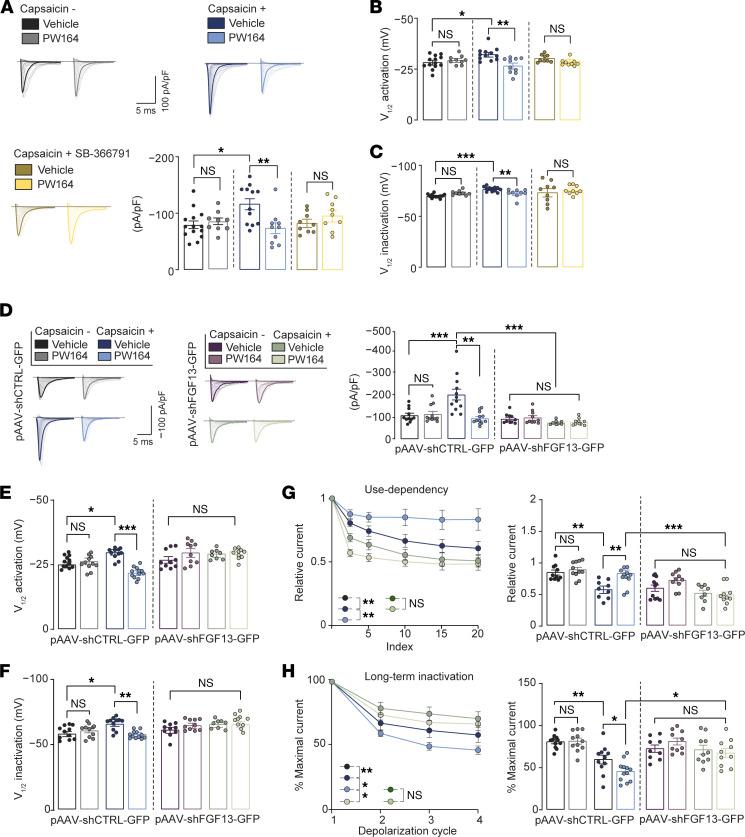
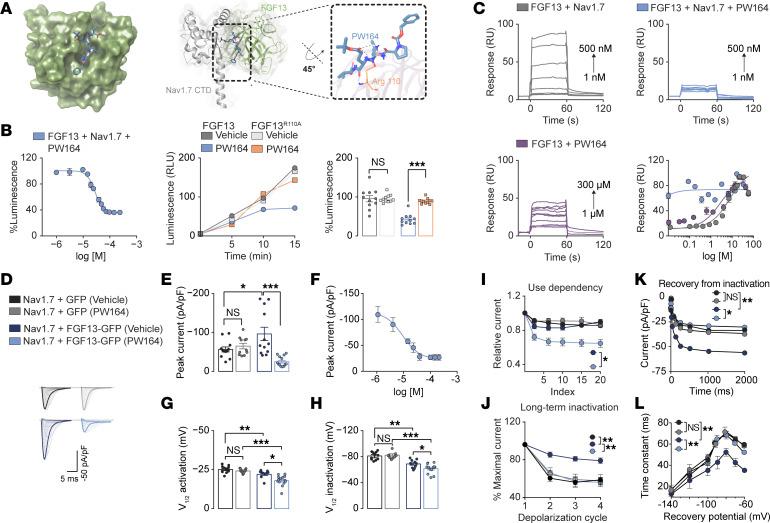
Nociception involves complex signaling, yet intrinsic mechanisms bidirectionally regulating this process remain unexplored. Here, we show that the fibroblast growth factor 13 (FGF13)/Nav1.7 protein-protein interaction (PPI) complex bidirectionally modulates nociception, and that the FGF13/Nav1.7 ratio is upregulated in type 2 diabetic neuropathy (T2DN). PW164, an FGF13/Nav1.7 channel C-terminal tail domain (CTD) PPI interface inhibitor, which reduces complex assembly, selectively suppressed Na+ currents sensitized by capsaicin-induced activation of TRPV1 channels in human induced pluripotent stem cell-derived (hIPSC-derived) sensory neurons and inhibited mechanical and thermal hyperalgesia in mice. FGF13 silencing mimics PW164 activity in culture and in vivo. Conversely, ZL192, an FGF13 ligand that stabilizes FGF13/Nav1.7 CTD assembly, sensitized Na+ currents in hIPSC-derived sensory neurons and exerted pronociceptive behavioral responses in mice. ZL192's effects were abrogated by FGF13 silencing in culture and in vivo and recapitulated by FGF13 overexpression. In a model of T2DN, PW164 injection reduced mechanical hyperalgesia locally and contralaterally without systemic side effects. In donor-derived dorsal root ganglia neurons, FGF13 and Nav1.7 proteins colocalized, and the FGF13/Nav1.7 protein ratio was upregulated in patients with T2DN. Lastly, we found that SCN9A variant V1831F, associated with painless diabetic neuropathy, abolished PW164-directed modulation of the FGF13/Nav1.7 PPI interface. Thus, FGF13 is a rheostat of nociception and promising therapeutic target for diabetic neuropathy pain.
伤害感受涉及复杂的信号传导,但双向调节这一过程的内在机制仍未得到探索。在此,我们表明成纤维细胞生长因子13(FGF13)/Nav1.7蛋白-蛋白相互作用(PPI)复合物双向调节伤害感受,且在2型糖尿病性神经病变(T2DN)中FGF13/Nav1.7比率上调。PW164是一种FGF13/Nav1.7通道C末端尾域(CTD)PPI界面抑制剂,可减少复合物组装,在人诱导多能干细胞衍生(hIPSC衍生)的感觉神经元中选择性抑制辣椒素诱导的TRPV1通道激活所致敏的Na+电流,并抑制小鼠的机械性和热性痛觉过敏。FGF13沉默在培养物中和体内模拟了PW164活性。相反,ZL192是一种稳定FGF13/Nav1.7 CTD组装的FGF13配体,可使hIPSC衍生的感觉神经元中的Na+电流致敏,并在小鼠中产生伤害性感受行为反应。在培养物中和体内,FGF13沉默消除了ZL192的作用,而FGF13过表达则重现了该作用。在T2DN模型中,注射PW164可局部和对侧减轻机械性痛觉过敏,且无全身副作用。在供体来源的背根神经节神经元中,FGF13和Nav1.7蛋白共定位,且T2DN患者的FGF13/Nav1.7蛋白比率上调。最后,我们发现与无痛性糖尿病性神经病变相关的SCN9A变体V1831F消除了PW164对FGF13/Nav1.7 PPI界面的调节作用。因此,FGF13是伤害感受的一个调节器,也是糖尿病性神经病变疼痛有前景的治疗靶点。
 Zotero 插件