
自我报告的长睡眠时间、短睡眠时间和失眠与认知功能的孟德尔随机化研究。
Mendelian randomization study of self-reported long sleep duration, short sleep duration, and insomnia and cognitive function.
作者信息
Guo Yunyun
机构信息
Ageing Epidemiology Research Unit, School of Public Health, Imperial College London, London, United Kingdom.
出版信息
PLoS One. 2025 Aug 20;20(8):e0330782. doi: 10.1371/journal.pone.0330782. eCollection 2025.
BACKGROUND AND AIMS
Causal relationship between sleep duration and cognitive function remains unclear. This study used a two-sample Mendelian randomization (MR) analysis to assess the causal relationship between self-reported short sleep duration, insomnia and long sleep duration and cognitive function.
METHODS
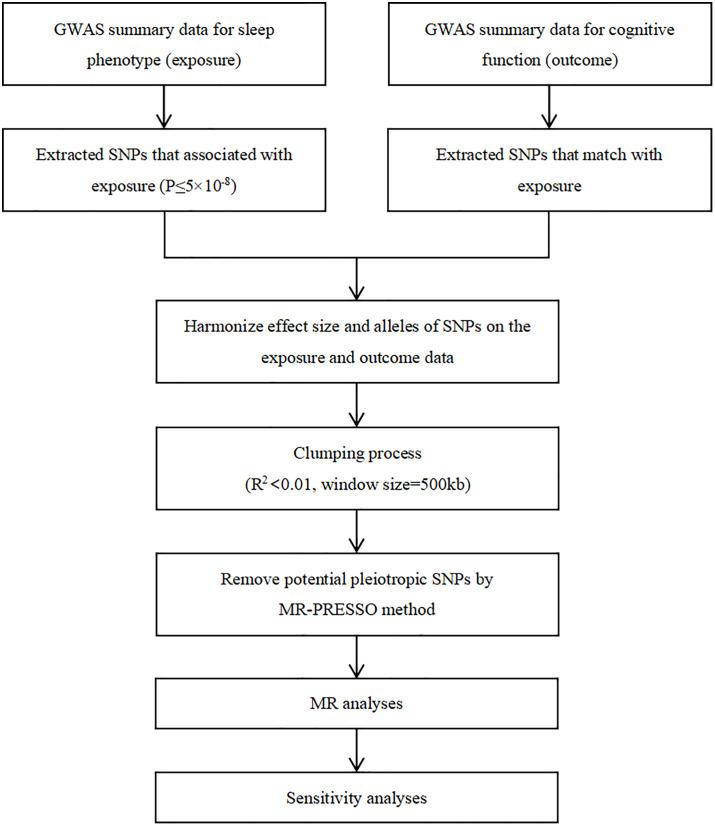
A total of 26 single nucleotide polymorphisms (SNPs) associated with short sleep duration, 240 associated with insomnia, and 7 associated with long sleep duration were extracted from a genome-wide association study primarily based on European ancestry, to be used as instrumental variables. Summary-level statistics were obtained from the Dementia genome-wide association studies database. MR estimation was performed using the inverse variance weighted (IVW) method as the primary method, supplemented by MR-Egger regression and weighted median estimator methods. Finally, multiple sensitivity analyses were performed to obtain robust and valid estimates.
RESULTS
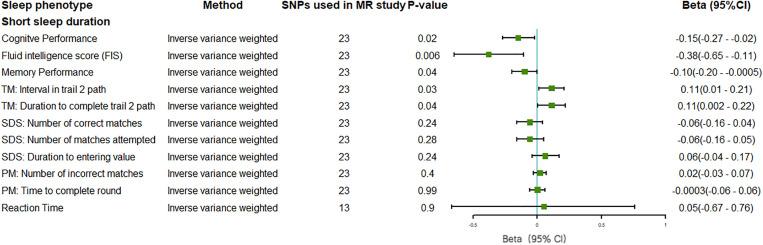
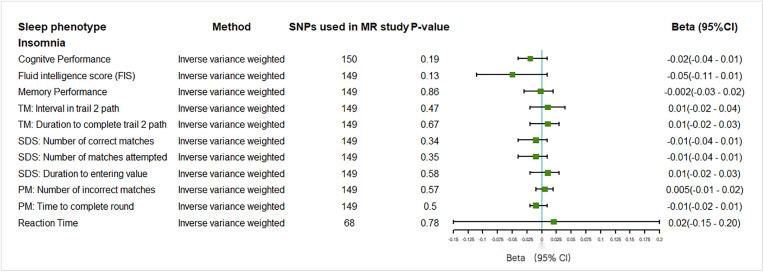
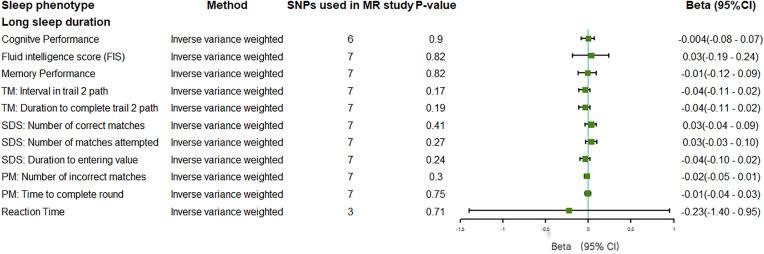
Based on IVW methods, short sleep duration showed a harmful impact on cognitive performance score (beta = -0.15, 95% CI: -0.27 to -0.02, P = 0.02, IVW), fluid intelligence score (beta = -0.38; 95% CI: -0.65 to -0.11; P = 0.006, IVW), memory performance (beta = -0.10, 95% CI: -0.20 to -0.0005; P = 0.04, IVW) and Trail Making (TM) test (TM: interval in trail 2 path, beta = 0.11, 95% CI: 0.01 to 0.21; P = 0.03, IVW; TM: duration to complete trail 2 path, beta = 0.11, 95% CI: 0.002 to 0.22; P = 0.04, IVW). In addition, insomnia was causally associated with Alzheimer's disease (OR = 1.13, 95% CI = 1.02-1.24, p = 0.02, IVW). However, due to the limited number of SNPs (n = 7) available as instruments for long sleep duration, there was no strong evidence to support a causal effect of long sleep duration on cognitive outcomes.
CONCLUSIONS
This study suggests self-reported short sleep duration was causally associated with cognitive decline and self-reported insomnia was causally associated with increased risk of Alzheimer's disease in individuals of European ancestry. The evidence of causality between long sleep duration and cognitive function requires further investigation. These results may have implications for public health interventions aimed at reducing the risk of cognitive decline.
背景与目的
睡眠时间与认知功能之间的因果关系尚不清楚。本研究采用两样本孟德尔随机化(MR)分析,以评估自我报告的短睡眠时间、失眠和长睡眠时间与认知功能之间的因果关系。
方法
从一项主要基于欧洲血统的全基因组关联研究中提取了总共26个与短睡眠时间相关的单核苷酸多态性(SNP)、240个与失眠相关的SNP和7个与长睡眠时间相关的SNP,用作工具变量。汇总统计数据来自痴呆症全基因组关联研究数据库。采用逆方差加权(IVW)法作为主要方法进行MR估计,并辅以MR-Egger回归和加权中位数估计法。最后,进行了多项敏感性分析以获得稳健有效的估计值。
结果
基于IVW方法,短睡眠时间对认知表现评分有有害影响(β=-0.15,95%CI:-0.27至-0.02,P=0.02,IVW)、流体智力评分(β=-0.38;95%CI:-0.65至-0.11;P=0.00�,IVW)、记忆表现(β=-0.10,95%CI:-0.20至-0.0005;P=0.04,IVW)和连线测验(TM)(TM:路径2间隔,β=0.11,95%CI:0.01至0.21;P=0.03,IVW;TM:完成路径2的持续时间,β=0.11,95%CI:0.002至0.22;P=0.04,IVW)。此外,失眠与阿尔茨海默病存在因果关联(OR=1.1璢,95%CI=1.02-1.24,p=0.02,IVW)。然而,由于可作为长睡眠时间工具的SNP数量有限(n=7),没有强有力的证据支持长睡眠时间对认知结果有因果效应。
结论
本研究表明,在欧洲血统个体中,自我报告的短睡眠时间与认知能力下降存在因果关联,自我报告的失眠与阿尔茨海默病风险增加存在因果关联。长睡眠时间与认知功能之间因果关系的证据需要进一步研究。这些结果可能对旨在降低认知能力下降风险的公共卫生干预措施具有启示意义。


 Zotero 插件