
紫杉烷类通过NKG2D介导的自然杀伤细胞识别作用增强曲妥珠单抗介导的对肿瘤细胞的抗体依赖的细胞介导的细胞毒性作用。
Taxanes enhance trastuzumab-mediated ADCC on tumor cells through NKG2D-mediated NK cell recognition.
作者信息
Di Modica Martina, Sfondrini Lucia, Regondi Viola, Varchetta Stefania, Oliviero Barbara, Mariani Gabriella, Bianchi Giulia Valeria, Generali Daniele, Balsari Andrea, Triulzi Tiziana, Tagliabue Elda
机构信息
Molecular Targeting Unit, Department of Experimental Oncology and Molecular Medicine, Fondazione IRCCS Istituto Nazionale dei Tumori, Milan, Italy.
Dipartimento di Scienze Biomediche per la Salute, Università degli Studi di Milano, Milan, Italy.
出版信息
Oncotarget. 2016 Jan 5;7(1):255-65. doi: 10.18632/oncotarget.6353.
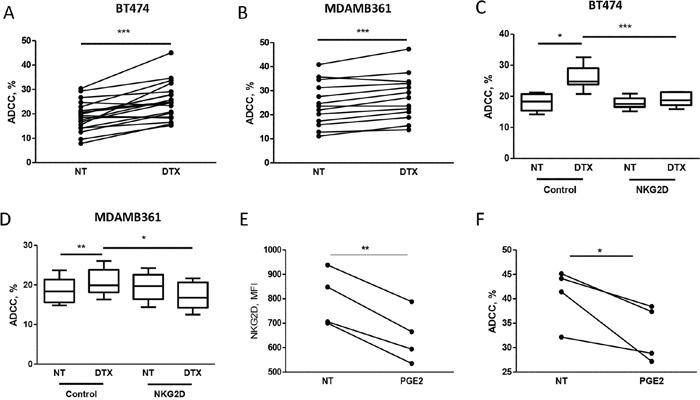
Recent clinical data indicate a synergistic therapeutic effect between trastuzumab and taxanes in neoadjuvantly treated HER2-positive breast cancer (BC) patients. In HER2+ BC experimental models and patients, we investigated whether this synergy depends on the ability of drug-induced stress to improve NK cell effectiveness and thus trastuzumab-mediated ADCC. HER2+ BC cell lines BT474 and MDAMB361 treated with docetaxel showed up-modulation of NK activator ligands both in vitro and in vivo, accompanied by a 15-40% increase in in vitro trastuzumab-mediated ADCC; antibodies blocking the NKG2D receptor significantly reduced this enhancement. NKG2D receptor expression was increased by docetaxel treatment in circulating and splenic NK cells from mice xenografted with tumor cells, an increase related to expansion of the CD11b+Ly6G+ cell population. Accordingly, NK cells derived from HER2+ BC patients after treatment with taxane-containing therapy expressed higher levels of NKG2D receptor than before treatment. Moreover, plasma obtained from these patients recapitulated the modulation of NKG2D on healthy donors' NK cells, improving their trastuzumab-mediated activity in vitro. This enhancement occurred mainly using plasma from patients with low NKG2D basal expression. Our results indicate that taxanes increase tumor susceptibility to ADCC by acting on tumor and NK cells, and suggest that taxanes concomitantly administered with trastuzumab could maximize the antibody effect, especially in patients with low basal immune effector cytotoxic activity.
近期临床数据表明,在新辅助治疗的HER2阳性乳腺癌(BC)患者中,曲妥珠单抗与紫杉烷类药物具有协同治疗效果。在HER2+ BC实验模型和患者中,我们研究了这种协同作用是否取决于药物诱导应激提高NK细胞效能从而增强曲妥珠单抗介导的抗体依赖细胞介导的细胞毒性作用(ADCC)的能力。用多西他赛处理的HER2+ BC细胞系BT474和MDAMB361在体外和体内均出现NK激活配体上调,同时体外曲妥珠单抗介导的ADCC增加15%-40%;阻断NKG2D受体的抗体显著降低了这种增强作用。多西他赛处理使荷瘤小鼠循环和脾脏NK细胞中的NKG2D受体表达增加,这种增加与CD11b+Ly6G+细胞群体的扩增有关。相应地,接受含紫杉烷类治疗后的HER2+ BC患者来源NK细胞表达的NKG2D受体水平高于治疗前。此外,这些患者的血浆可重现健康供体NK细胞上NKG2D的调节作用,提高其体外曲妥珠单抗介导的活性。这种增强主要发生在使用NKG2D基础表达水平低的患者血浆时。我们的结果表明,紫杉烷类药物通过作用于肿瘤细胞和NK细胞增加肿瘤对ADCC的敏感性,并提示紫杉烷类药物与曲妥珠单抗联合使用可使抗体效应最大化,尤其是在基础免疫效应细胞细胞毒性活性较低的患者中。




 Zotero 插件