
从中国南方分离出的一种新型传染性支气管炎病毒的基因组特征、抗原性及致病性
Genome characterization, antigenicity and pathogenicity of a novel infectious bronchitis virus type isolated from south China.
作者信息
Jiang Lei, Zhao Wenjun, Han Zongxi, Chen Yuqiu, Zhao Yan, Sun Junfeng, Li Huixin, Shao Yuhao, Liu Liangliang, Liu Shengwang
机构信息
Division of Avian Infectious Diseases, State Key Laboratory of Veterinary Biotechnology, Harbin Veterinary Research Institute, Chinese Academy of Agricultural Sciences, Harbin 150001, People's Republic of China.
Division of Avian Infectious Diseases, State Key Laboratory of Veterinary Biotechnology, Harbin Veterinary Research Institute, Chinese Academy of Agricultural Sciences, Harbin 150001, People's Republic of China.
出版信息
Infect Genet Evol. 2017 Oct;54:437-446. doi: 10.1016/j.meegid.2017.08.006. Epub 2017 Aug 8.
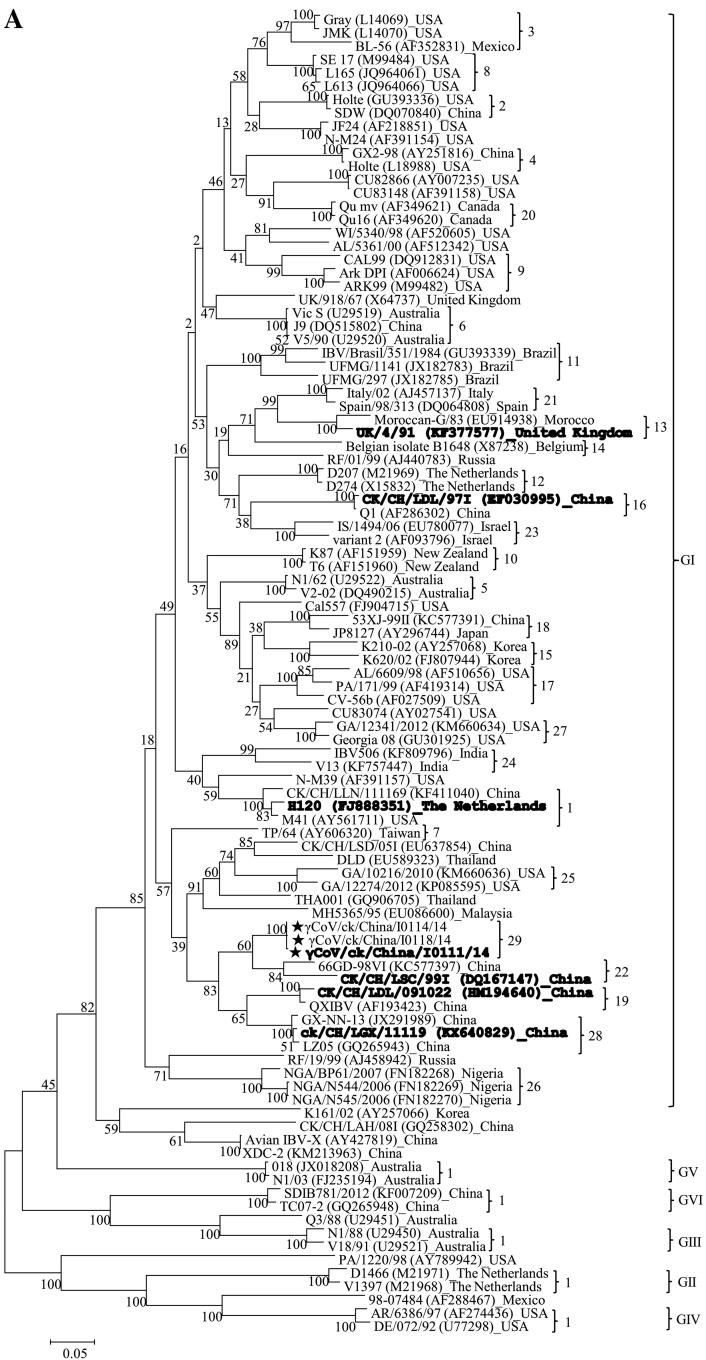
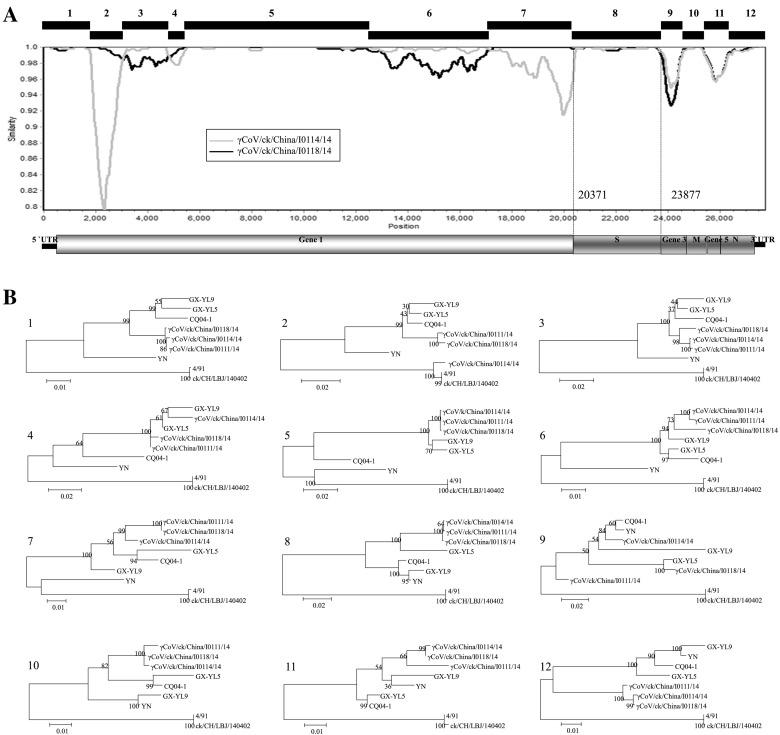
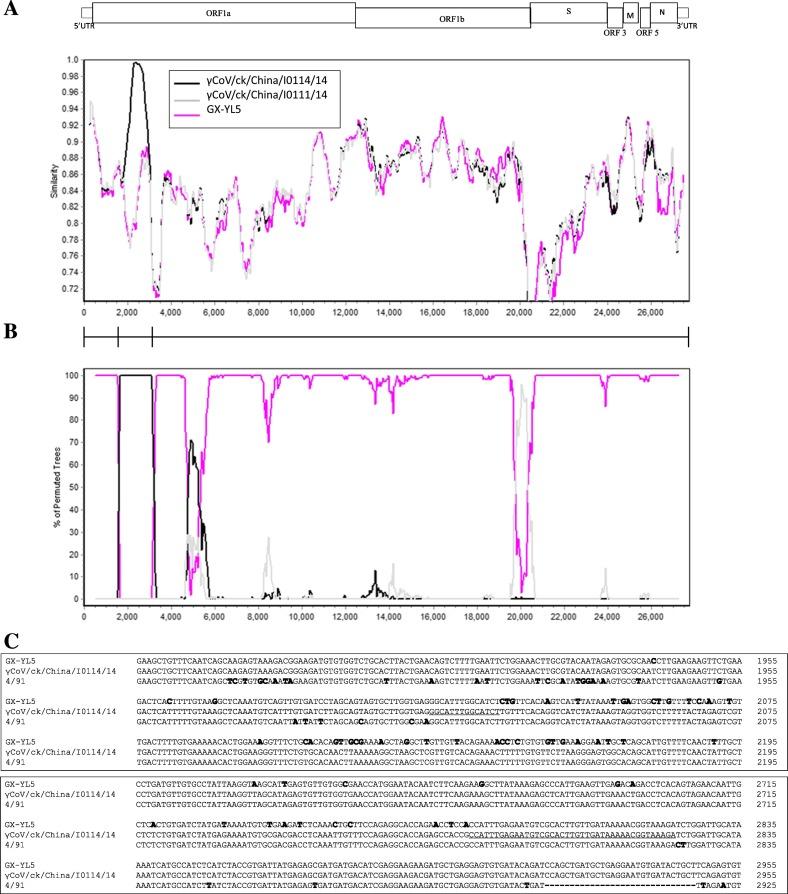
In 2014, three infectious bronchitis virus (IBV) strains, designated as γCoV/ck/China/I0111/14, γCoV/ck/China/I0114/14 and γCoV/ck/China/I0118/14, were isolated and identified from chickens suspected to be infected with IBV in Guangxi province, China. Based upon data arising from S1 sequence and phylogenetic analyses, the three IBV isolates were genetically different from other known IBV types, which represented a novel genotype (GI-29). Virus cross-neutralization tests, using γCoV/ck/China/I0111/14 as a representative, showed that genotype GI-29 was antigenically different from all other known IBV types, thus representing a novel serotype. Complete genomic analysis showed that GI-29 type viruses were closely related to and might originate from a GX-YL5-like virus by accumulation of substitutions in multiple genes. These GI-29 viral genomes are still evolving and diverging, particularly in the 3' region, although we cannot rule out the possibility of recombination events occurring. For isolate γCoV/ck/China/I0114/14, we found that recombination events had occurred between nsps 2 and 3 in gene 1 which led to the introduction of a 4/91 gene fragment into the γCoV/ck/China/I0114/14 viral genome. In addition, we found that the GI-29 type γCoV/ck/China/I0111/14 isolate was a nephropathogenic strain and high pathogenic to 1-day-old specific pathogen-free (SPF) chickens although cystic oviducts were not observed in the surviving layer chickens challenged with γCoV/ck/China/I0111/14 isolate.
2014年,从中国广西疑似感染传染性支气管炎病毒(IBV)的鸡群中分离并鉴定出三株IBV毒株,分别命名为γCoV/ck/China/I0111/14、γCoV/ck/China/I0114/14和γCoV/ck/China/I0118/14。基于S1序列和系统发育分析数据,这三株IBV分离株在基因上与其他已知的IBV类型不同,代表了一种新的基因型(GI-29)。以γCoV/ck/China/I0111/14为代表进行的病毒交叉中和试验表明,GI-29基因型在抗原性上与所有其他已知的IBV类型不同,因此代表一种新的血清型。全基因组分析表明,GI-29型病毒与GX-YL5样病毒密切相关,可能通过多个基因中替换的积累而起源于该病毒。这些GI-29病毒基因组仍在进化和分化,特别是在3'区域,尽管我们不能排除发生重组事件的可能性。对于分离株γCoV/ck/China/I0114/14,我们发现在基因1的nsps 2和3之间发生了重组事件,导致一个4/91基因片段引入γCoV/ck/China/I0114/14病毒基因组。此外,我们发现GI-29型γCoV/ck/China/I0111/14分离株是一种肾致病性毒株,对1日龄无特定病原体(SPF)鸡具有高致病性,尽管在用γCoV/ck/China/I0111/14分离株攻击的存活蛋鸡中未观察到囊性输卵管。


 Zotero 插件