
差异共表达和调控网络分析揭示T细胞急性白血病的复发因素和机制
Differential Co-expression and Regulatory Network Analysis Uncover the Relapse Factor and Mechanism of T Cell Acute Leukemia.
作者信息
Luo Mei, Zhang Qiong, Xia Mengxuan, Hu Feifei, Ma Zhaowu, Chen Zehua, Guo An-Yuan
机构信息
Department of Bioinformatics and Systems Biology, Key Laboratory of Molecular Biophysics of the Ministry of Education, College of Life Science and Technology, Huazhong University of Science and Technology, Wuhan 430074, China.
Laboratory of Neuronal Network and Brain Diseases Modulation, School of Medicine, Yangtze University, Jingzhou, Hubei 434023, China.
出版信息
Mol Ther Nucleic Acids. 2018 Sep 7;12:184-194. doi: 10.1016/j.omtn.2018.05.003. Epub 2018 May 29.
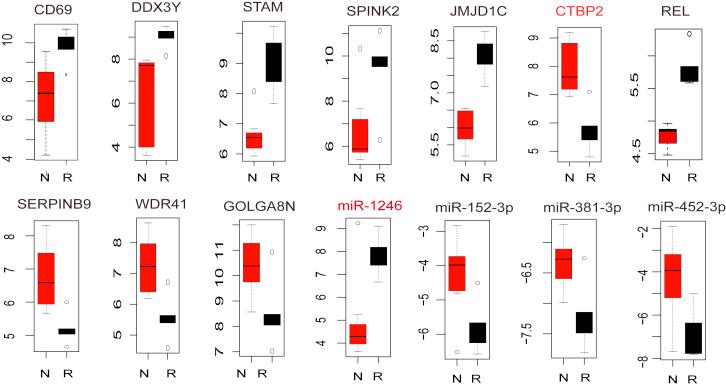
The pediatric T cell acute lymphoblastic leukemia (T-ALL) still remains a cancer with worst prognosis for high recurrence. Massive studies were conducted for the leukemia relapse based on diagnosis and relapse paired samples. However, the initially diagnostic samples may contain the relapse information and mechanism, which were rarely studied. In this study, we collected mRNA and microRNA (miRNA) data from initially diagnosed pediatric T-ALL samples with their relapse or remission status after treatment. Integrated differential co-expression and miRNA-transcription factor (TF)-gene regulatory network analyses were used to reveal the possible relapse mechanisms for pediatric T-ALL. We detected miR-1246/1248 and NOTCH2 served as key nodes in the relapse network, and they combined with TF WT1/SOX4/REL to form regulatory modules that influence the progress of T-ALL. A regulatory loop miR-429-MYCN-MFHAS1 was found potentially associated with the remission of T-ALL. Furthermore, we proved miR-1246/1248 combined with NOTCH2 could promote cell proliferation in the T-ALL cell line by experiments. Meanwhile, analysis based on the miRNA-drug relationships demonstrated that drugs 5-fluorouracil, ascorbate, and trastuzumab targeting miR-1246 could serve as potential supplements for the standard therapy. In conclusion, our findings revealed the potential molecular mechanisms of T-ALL relapse by the combination of co-expression and regulatory network, and they provide preliminary clues for precise treatment of T-ALL patients.
小儿T细胞急性淋巴细胞白血病(T-ALL)仍然是一种复发率高、预后最差的癌症。基于诊断和复发配对样本,针对白血病复发进行了大量研究。然而,最初的诊断样本可能包含复发信息和机制,而对此很少有研究。在本研究中,我们收集了初诊小儿T-ALL样本的mRNA和微小RNA(miRNA)数据,以及其治疗后的复发或缓解状态。采用综合差异共表达和miRNA-转录因子(TF)-基因调控网络分析来揭示小儿T-ALL可能的复发机制。我们检测到miR-1246/1248和NOTCH2作为复发网络中的关键节点,它们与TF WT1/SOX4/REL结合形成调控模块,影响T-ALL的进展。发现一个调控环miR-429-MYCN-MFHAS1可能与T-ALL的缓解相关。此外,我们通过实验证明miR-1246/1248与NOTCH2结合可促进T-ALL细胞系中的细胞增殖。同时,基于miRNA-药物关系的分析表明,靶向miR-1246的药物5-氟尿嘧啶、抗坏血酸和曲妥珠单抗可作为标准治疗的潜在补充。总之,我们的研究结果通过共表达和调控网络的结合揭示了T-ALL复发的潜在分子机制,并为T-ALL患者的精准治疗提供了初步线索。




 Zotero 插件