
上皮相关铜绿假单胞菌生物膜的分散。
Dispersal of Epithelium-Associated Pseudomonas aeruginosa Biofilms.
机构信息
Division of Pulmonary, Allergy and Critical Care Medicine, Department of Medicine, University of Pittsburgh, Pittsburgh, Pennsylvania, USA.
Department of Microbiology and Molecular Genetics, University of Pittsburgh, Pittsburgh, Pennsylvania, USA.
出版信息
mSphere. 2020 Jul 15;5(4):e00630-20. doi: 10.1128/mSphere.00630-20.
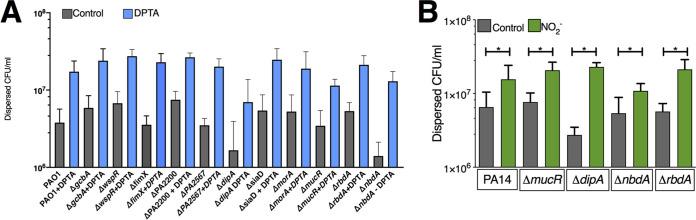
grows in highly antibiotic-tolerant biofilms during chronic airway infections. Dispersal of bacteria from biofilms may restore antibiotic susceptibility or improve host clearance. We describe models to study biofilm dispersal in the nutritionally complex environment of the human airway. was cocultured in the apical surface of airway epithelial cells (AECs) in a perfusion chamber. Dispersal, triggered by sodium nitrite, a nitric oxide (NO) donor, was tracked by live cell microscopy. Next, a static model was developed in which biofilms were grown on polarized AECs without flow. We observed that NO-triggered biofilm dispersal was an energy-dependent process. From the existing literature, NO-mediated biofilm dispersal is regulated by DipA, NbdA, RbdA, and MucR. Interestingly, altered signaling pathways appear to be used in this model, as deletion of these genes failed to block NO-induced biofilm dispersal. Similar results were observed using biofilms grown in an abiotic model on glass with iron-supplemented cell culture medium. In cystic fibrosis, airway mucus contributes to the growth environment, and a wide range of bacterial phenotypes are observed; therefore, we tested biofilm dispersal in a panel of late cystic fibrosis clinical isolates cocultured in the mucus overlying primary human AECs. Finally, we examined dispersal in combination with the clinically used antibiotics ciprofloxacin, aztreonam and tobramycin. In summary, we have validated models to study biofilm dispersal in environments that recapitulate key features of the airway and identified combinations of currently used antibiotics that may enhance the therapeutic effect of biofilm dispersal. During chronic lung infections, grows in highly antibiotic-tolerant communities called biofilms that are difficult for the host to clear. We have developed models for studying biofilm dispersal in environments that replicate key features of the airway. We found that mechanisms of biofilm dispersal in these models may employ alternative or additional signaling mechanisms, highlighting the importance of the growth environment in dispersal events. We have adapted the models to accommodate apical fluid flow, bacterial clinical isolates, antibiotics, and primary human airway epithelial cells, all of which are relevant to understanding bacterial behaviors in the context of human disease. We also examined dispersal agents in combination with commonly used antipseudomonal antibiotics and saw improved clearance when nitrite was combined with the antibiotic aztreonam.
在慢性气道感染期间, 在高度耐受抗生素的生物膜中生长。 生物膜中的细菌分散可能会恢复抗生素敏感性或改善宿主清除率。 我们描述了用于研究人类气道营养复杂环境中生物膜分散的模型。 将 在气道上皮细胞 (AEC) 的顶表面在灌注室中进行共培养。 通过亚硝酸钠触发, 一种一氧化氮 (NO) 供体, 通过活细胞显微镜跟踪分散情况。 接下来, 开发了一种静态模型, 其中在没有流动的情况下在极化的 AEC 上生长生物膜。 我们观察到,NO 触发的生物膜分散是一个能量依赖的过程。 根据现有文献,NO 介导的生物膜分散受 DipA、NbdA、RbdA 和 MucR 调节。 有趣的是, 在这个模型中似乎使用了改变的信号通路, 因为这些基因的缺失未能阻止 NO 诱导的生物膜分散。 使用在含有铁的细胞培养基上的玻璃上生长的非生物模型观察到类似的结果。 在囊性纤维化中, 气道粘液有助于生长环境, 并且观察到广泛的细菌表型; 因此, 我们在覆盖原发性人 AEC 的粘液上共培养的一组晚期囊性纤维化临床分离株中测试了生物膜分散。 最后, 我们检查了与临床使用的抗生素环丙沙星、氨曲南和妥布霉素联合使用的分散情况。 总之, 我们已经验证了用于研究在模拟气道关键特征的环境中生物膜分散的模型,并确定了目前使用的抗生素组合,这些抗生素组合可能增强生物膜分散的治疗效果。 在慢性肺部感染期间, 在称为生物膜的高度耐受抗生素的群落中生长, 宿主难以清除。 我们已经为研究在模拟气道关键特征的环境中的 生物膜分散开发了模型。 我们发现,这些模型中生物膜分散的机制可能采用替代或额外的信号机制,突出了生长环境在分散事件中的重要性。 我们已经使这些模型适应了包括顶部分泌液流动、细菌临床分离株、抗生素和原代人呼吸道上皮细胞在内的适应,所有这些都与理解细菌在人类疾病背景下的行为有关。 我们还研究了分散剂与常用抗假单胞菌抗生素联合使用的情况,并发现当亚硝酸钠与抗生素氨曲南联合使用时,清除率得到提高。




 Zotero 插件