
比较 COVID-19 控制的分子检测策略:一项数学建模研究。
Comparison of molecular testing strategies for COVID-19 control: a mathematical modelling study.
机构信息
MRC Centre for Global Infectious Disease Analysis, Department of Infectious Disease Epidemiology, Imperial College London, London, UK.
MRC Centre for Global Infectious Disease Analysis, Department of Infectious Disease Epidemiology, Imperial College London, London, UK.
出版信息
Lancet Infect Dis. 2020 Dec;20(12):1381-1389. doi: 10.1016/S1473-3099(20)30630-7. Epub 2020 Aug 18.
BACKGROUND
WHO has called for increased testing in response to the COVID-19 pandemic, but countries have taken different approaches and the effectiveness of alternative strategies is unknown. We aimed to investigate the potential impact of different testing and isolation strategies on transmission of severe acute respiratory syndrome coronavirus 2 (SARS-CoV-2).
METHODS
We developed a mathematical model of SARS-CoV-2 transmission based on infectiousness and PCR test sensitivity over time since infection. We estimated the reduction in the effective reproduction number (R) achieved by testing and isolating symptomatic individuals, regular screening of high-risk groups irrespective of symptoms, and quarantine of contacts of laboratory-confirmed cases identified through test-and-trace protocols. The expected effectiveness of different testing strategies was defined as the percentage reduction in R. We reviewed data on the performance of antibody tests reported by the Foundation for Innovative New Diagnostics and examined their implications for the use of so-called immunity passports.
FINDINGS
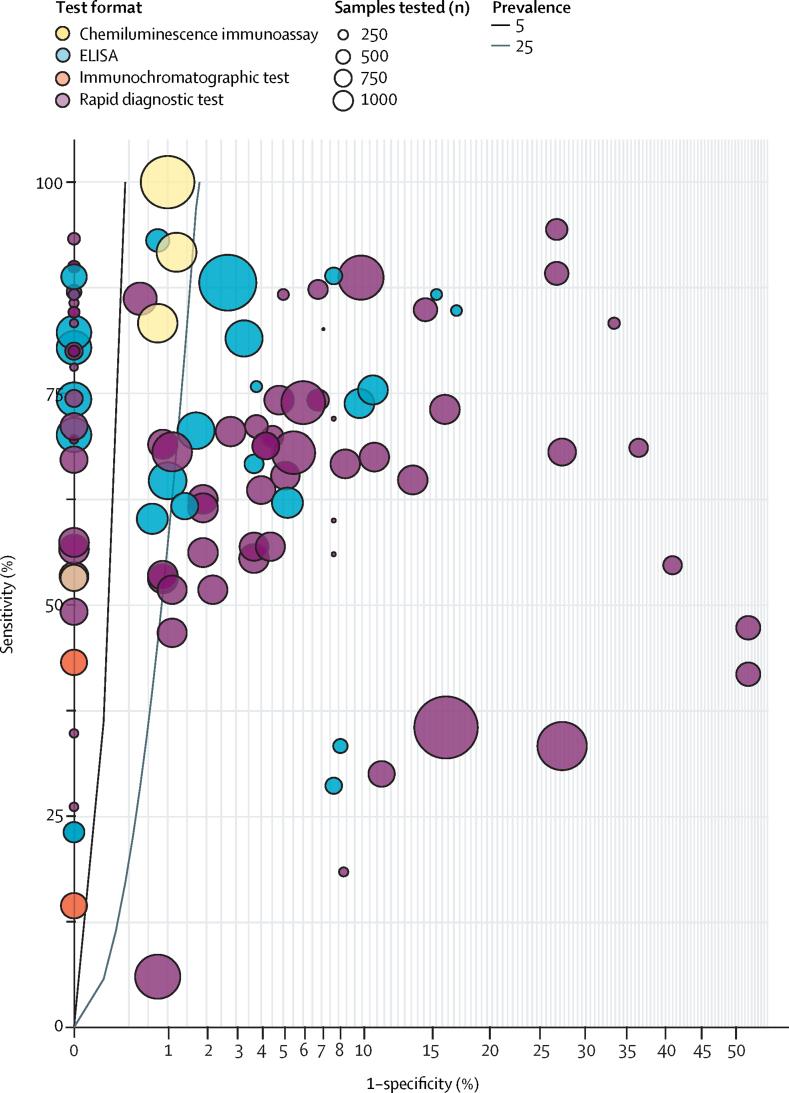
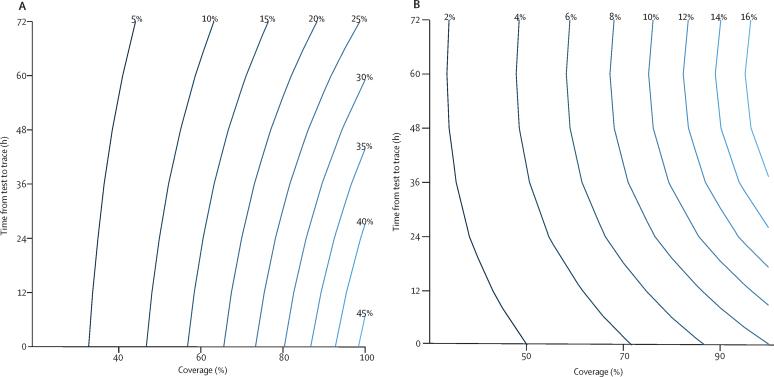
If all individuals with symptoms compatible with COVID-19 self-isolated and self-isolation was 100% effective in reducing onwards transmission, self-isolation of symptomatic individuals would result in a reduction in R of 47% (95% uncertainty interval [UI] 32-55). PCR testing to identify SARS-CoV-2 infection soon after symptom onset could reduce the number of individuals needing to self-isolate, but would also reduce the effectiveness of self-isolation (around 10% would be false negatives). Weekly screening of health-care workers and other high-risk groups irrespective of symptoms by use of PCR testing is estimated to reduce their contribution to SARS-CoV-2 transmission by 23% (95% UI 16-40), on top of reductions achieved by self-isolation following symptoms, assuming results are available at 24 h. The effectiveness of test and trace depends strongly on coverage and the timeliness of contact tracing, potentially reducing R by 26% (95% UI 14-35) on top of reductions achieved by self-isolation following symptoms, if 80% of cases and contacts are identified and there is immediate testing following symptom onset and quarantine of contacts within 24 h. Among currently available antibody tests, performance has been highly variable, with specificity around 90% or lower for rapid diagnostic tests and 95-99% for laboratory-based ELISA and chemiluminescent assays.
INTERPRETATION
Molecular testing can play an important role in prevention of SARS-CoV-2 transmission, especially among health-care workers and other high-risk groups, but no single strategy will reduce R below 1 at current levels of population immunity. Immunity passports based on antibody tests or tests for infection face substantial technical, legal, and ethical challenges.
FUNDING
UK Medical Research Council.
背景
世界卫生组织呼吁加大检测力度以应对 COVID-19 大流行,但各国采取了不同的方法,替代策略的有效性尚不清楚。我们旨在研究不同的检测和隔离策略对严重急性呼吸综合征冠状病毒 2 (SARS-CoV-2) 传播的潜在影响。
方法
我们根据感染后时间的传染性和 PCR 检测灵敏度,开发了 SARS-CoV-2 传播的数学模型。我们估计通过检测和隔离有症状的个体、定期筛查有症状的高危人群、以及对通过检测和追踪协议确定的确诊病例的接触者进行隔离,有效繁殖数 (R) 的减少。不同检测策略的预期效果被定义为 R 的降低百分比。我们审查了创新新诊断基金会报告的抗体检测性能数据,并研究了它们对所谓免疫护照使用的影响。
发现
如果所有有 COVID-19 症状的人都自我隔离,自我隔离能 100%有效减少传播,那么自我隔离有症状的个体将使 R 减少 47%(95%置信区间 [32-55])。PCR 检测可在症状出现后不久识别 SARS-CoV-2 感染,这可以减少需要自我隔离的人数,但也会降低自我隔离的效果(约 10% 为假阴性)。通过使用 PCR 检测,每周对医护人员和其他高危人群进行筛查,不论症状如何,估计可以将他们对 SARS-CoV-2 传播的贡献降低 23%(95%置信区间 [16-40]),假设结果在 24 小时内获得。检测和追踪的效果在很大程度上取决于覆盖率和接触者追踪的及时性,因此,如果 80%的病例和接触者被发现,并且在症状出现后立即进行检测,并在 24 小时内对接触者进行隔离,那么在自我隔离后,R 可能会降低 26%(95%置信区间 [14-35])。目前可用的抗体检测中,性能差异很大,快速诊断检测的特异性约为 90%或更低,而基于实验室的 ELISA 和化学发光检测的特异性为 95-99%。
解释
分子检测在预防 SARS-CoV-2 传播方面可以发挥重要作用,尤其是在医护人员和其他高危人群中,但在当前人群免疫力水平下,没有单一策略可以将 R 降低到 1 以下。基于抗体检测或感染检测的免疫护照面临着重大的技术、法律和伦理挑战。
资助
英国医学研究理事会。

 Zotero 插件