
对与脑动静脉畸形和海绵状畸形相关的微小RNA的深入研究。
An Insight into the microRNAs Associated with Arteriovenous and Cavernous Malformations of the Brain.
作者信息
Florian Ioan Alexandru, Buruiana Andrei, Timis Teodora Larisa, Susman Sergiu, Florian Ioan Stefan, Balasa Adrian, Berindan-Neagoe Ioana
机构信息
Clinic of Neurosurgery, Cluj County Emergency Clinical Hospital, 400012 Cluj-Napoca, Romania.
Department of Neurosurgery, Iuliu Hatieganu University of Medicine and Pharmacy, 400012 Cluj-Napoca, Romania.
出版信息
Cells. 2021 Jun 2;10(6):1373. doi: 10.3390/cells10061373.
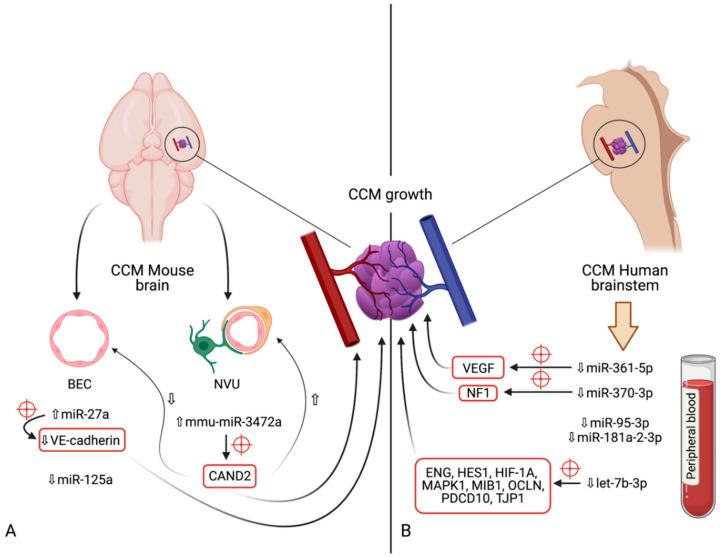
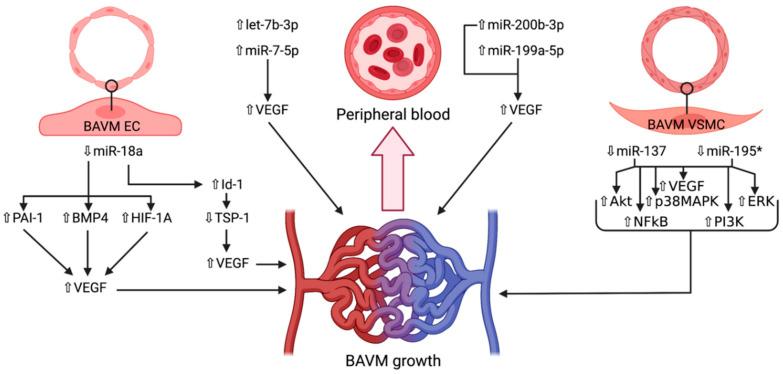
: Brain arteriovenous malformations (BAVMs) and cerebral cavernous malformations (CCMs) are rare developmental anomalies of the intracranial vasculature, with an irregular tendency to rupture, and as of yet incompletely deciphered pathophysiology. Because of their variety in location, morphology, and size, as well as unpredictable natural history, they represent a management challenge. MicroRNAs (miRNAs) are strands of non-coding RNA of around 20 nucleotides that are able to modulate the expression of target genes by binding completely or partially to their respective complementary sequences. Recent breakthroughs have been made on elucidating their contribution to BAVM and CCM occurrence, growth, and evolution; however, there are still countless gaps in our understanding of the mechanisms involved. : We have searched the Medline (PubMed; PubMed Central) database for pertinent articles on miRNAs and their putative implications in BAVMs and CCMs. To this purpose, we employed various permutations of the terms and idioms: 'arteriovenous malformation', 'AVM', and 'BAVM', or 'cavernous malformation', 'cavernoma', and 'cavernous angioma' on the one hand; and 'microRNA', 'miRNA', and 'miR' on the other. Using cross-reference search; we then investigated additional articles concerning the individual miRNAs identified in other cerebral diseases. : Seven miRNAs were discovered to play a role in BAVMs, three of which were downregulated (miR-18a, miR-137, and miR-195*) and four upregulated (miR-7-5p, miR-199a-5p, miR-200b-3p, and let-7b-3p). Similarly, eight miRNAs were identified in CCM in humans and experimental animal models, two being upregulated (miR-27a and mmu-miR-3472a), and six downregulated (miR-125a, miR-361-5p, miR-370-3p, miR-181a-2-3p, miR-95-3p, and let-7b-3p). : The following literature review endeavored to address the recent discoveries related to the various implications of miRNAs in the formation and growth of BAVMs and CCMs. Additionally, by presenting other cerebral pathologies correlated with these miRNAs, it aimed to emphasize the potential directions of upcoming research and biological therapies.
脑动静脉畸形(BAVMs)和脑海绵状畸形(CCMs)是颅内血管罕见的发育异常,具有不规则的破裂倾向,且其病理生理学尚未完全阐明。由于它们在位置、形态和大小上的多样性,以及不可预测的自然病史,它们构成了治疗上的挑战。微小RNA(miRNAs)是约20个核苷酸的非编码RNA链,能够通过与各自的互补序列完全或部分结合来调节靶基因的表达。最近在阐明它们对BAVM和CCM的发生、生长和演变的作用方面取得了突破;然而,我们对其中涉及的机制的理解仍存在无数空白。
我们在Medline(PubMed;PubMed Central)数据库中搜索了有关miRNAs及其在BAVMs和CCMs中可能影响的相关文章。为此,我们一方面使用了术语和习语的各种排列组合:“动静脉畸形”、“AVM”和“BAVM”,或“海绵状畸形”、“海绵状瘤”和“海绵状血管瘤”;另一方面使用了“微小RNA”、“miRNA”和“miR”。通过交叉引用搜索,我们随后研究了其他与在其他脑部疾病中鉴定出的单个miRNAs相关的文章。
发现七种miRNAs在BAVMs中起作用,其中三种下调(miR-18a、miR-137和miR-195*),四种上调(miR-7-5p、miR-199a-5p、miR-200b-3p和let-7b-3p)。同样,在人类和实验动物模型的CCM中鉴定出八种miRNAs,两种上调(miR-27a和mmu-miR-3472a),六种下调(miR-125a、miR-361-5p、miR-370-3p、miR-181a-2-3p、miR-95-3p和let-7b-3p)。
以下文献综述致力于探讨与miRNAs在BAVMs和CCMs的形成和生长中的各种影响相关的最新发现。此外,通过介绍与这些miRNAs相关的其他脑部病理,旨在强调未来研究和生物治疗的潜在方向。

 Zotero 插件