
在完成 2 年免疫检查点抑制剂治疗或在疾病无进展停药后获得持久缓解的晚期和/或转移性非小细胞肺癌患者中的长期结局:多中心真实世界数据(KCSG LU20-11)。
Long-term outcomes in patients with advanced and/or metastatic non-small cell lung cancer who completed 2 years of immune checkpoint inhibitors or achieved a durable response after discontinuation without disease progression: Multicenter, real-world data (KCSG LU20-11).
机构信息
Division of Hematology-Oncology, Department of Internal Medicine, Samsung Medical Center, Sungkyunkwan University School of Medicine, Seoul, Republic of Korea.
Department of Internal Medicine, Seoul National University College of Medicine and Seoul National University Hospital, Seoul, Republic of Korea.
出版信息
Cancer. 2022 Feb 15;128(4):778-787. doi: 10.1002/cncr.33984. Epub 2021 Oct 27.
BACKGROUND
Immune checkpoint inhibitors (ICIs) have shown significant improvements in patients with advanced non-small cell lung cancer (NSCLC). One of the major issues with ICIs is determining the optimal treatment duration.
METHODS
This multicenter, retrospective study analyzed clinical outcomes in patients with NSCLC who completed 2 years of ICI therapy or were treated for more than 6 months and then discontinued ICIs without disease progression at 11 medical centers in Korea between August 2017 and December 2020.
RESULTS
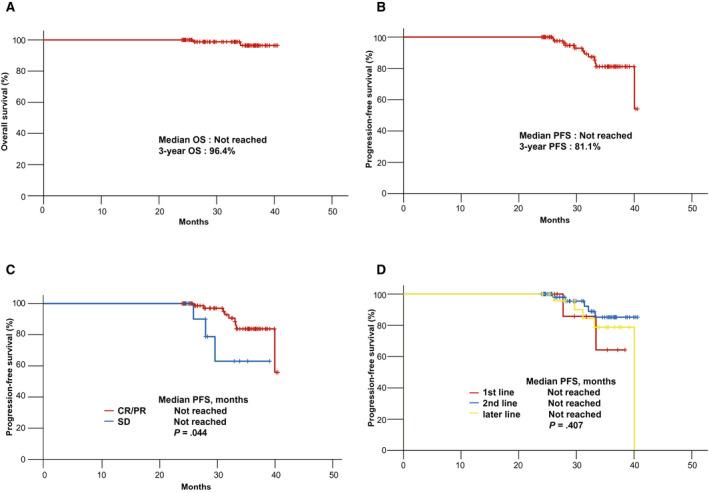
Ninety-six patients who completed 2 years of ICIs were reviewed. The median durations of treatment and follow-up were 24.0 and 33.9 months, respectively. The objective response rate (ORR) was 85.4%. The median progression-free survival (PFS) and overall survival (OS) periods were not reached. After completion, the PFS and OS rates were 81.1% and 96.4%, respectively, at 12 months. Forty-three patients were identified who discontinued ICIs without disease progression: 26 (60.5%) for adverse events and 17 (39.5%) for other causes. The median durations of treatment and follow-up were 10.5 and 21.2 months, respectively. The ORR was 90.7%. The median PFS and OS periods were not reached. After discontinuation, the PFS and OS rates were 71.0% and 90.0%, respectively, at 12 months.
CONCLUSIONS
A significantly high proportion of patients who completed 2 years of ICI therapy continued to experience long-term PFS. Even if ICIs are discontinued after 6 months in patients without disease progression, they may achieve a durable response and facilitate long-term survival.
LAY SUMMARY
The optimal treatment duration for immune checkpoint inhibitors (ICIs) remains to be determined. This study reports the long-term outcomes of patients with non-small cell lung cancer who completed 2 years of ICI therapy or achieved a durable response after the discontinuation of ICIs without disease progression in real-world practice. A significantly high proportion of patients who completed 2 years of ICIs continued to experience long-term progression-free survival. In addition, even if ICIs are discontinued after 6 months in patients without disease progression, they may achieve a durable response and facilitate long-term survival.
背景
免疫检查点抑制剂 (ICI) 在晚期非小细胞肺癌 (NSCLC) 患者中显示出显著的改善。ICI 的主要问题之一是确定最佳的治疗持续时间。
方法
这项多中心、回顾性研究分析了 2017 年 8 月至 2020 年 12 月期间韩国 11 家医疗中心的 NSCLC 患者的临床结果,这些患者完成了 2 年的 ICI 治疗或接受了超过 6 个月的治疗,然后在疾病未进展的情况下停用 ICI。
结果
共纳入 96 例完成 2 年 ICI 治疗的患者。治疗和随访的中位时间分别为 24.0 个月和 33.9 个月。客观缓解率 (ORR) 为 85.4%。中位无进展生存期 (PFS) 和总生存期 (OS) 未达到。完成治疗后,12 个月时 PFS 和 OS 率分别为 81.1%和 96.4%。43 例患者因不良事件 (26 例,60.5%) 和其他原因 (17 例,39.5%) 无疾病进展停用 ICI。治疗和随访的中位时间分别为 10.5 个月和 21.2 个月。ORR 为 90.7%。中位 PFS 和 OS 未达到。停用后,12 个月时 PFS 和 OS 率分别为 71.0%和 90.0%。
结论
在真实世界实践中,完成 2 年 ICI 治疗的患者中有很大比例继续经历长期 PFS。即使在疾病未进展的情况下,6 个月后停用 ICI,患者也可能获得持久的缓解并实现长期生存。
白话摘要
免疫检查点抑制剂 (ICI) 的最佳治疗持续时间仍有待确定。本研究报告了在真实世界实践中,完成 2 年 ICI 治疗或在疾病未进展的情况下停用 ICI 后获得持久缓解的非小细胞肺癌患者的长期结局。在完成 2 年 ICI 治疗的患者中,很大比例的患者继续经历长期无进展生存期。此外,即使在疾病未进展的情况下,6 个月后停用 ICI,患者也可能获得持久的缓解并实现长期生存。



 Zotero 插件