
SARS-CoV-2 的逃逸进化导致高度进化的德尔塔变异株。
The Runaway Evolution of SARS-CoV-2 Leading to the Highly Evolved Delta Strain.
机构信息
State Key Laboratory of Biocontrol, School of Life Sciences, Southern Marine Science and Engineering Guangdong Laboratory (Zhuhai), Sun Yat-sen University, Guangzhou, China.
State Key Laboratory of Protein and Plant Gene Research, Center for Bioinformatics, School of Life Sciences, Peking University, Beijing, China.
出版信息
Mol Biol Evol. 2022 Mar 2;39(3). doi: 10.1093/molbev/msac046.
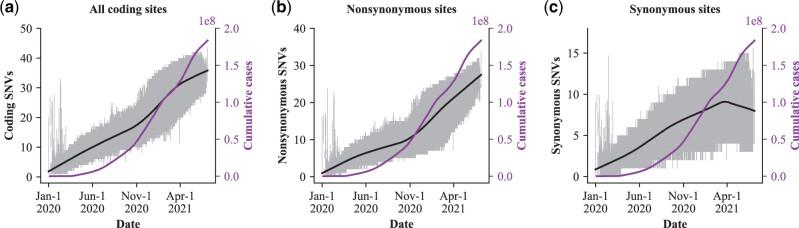
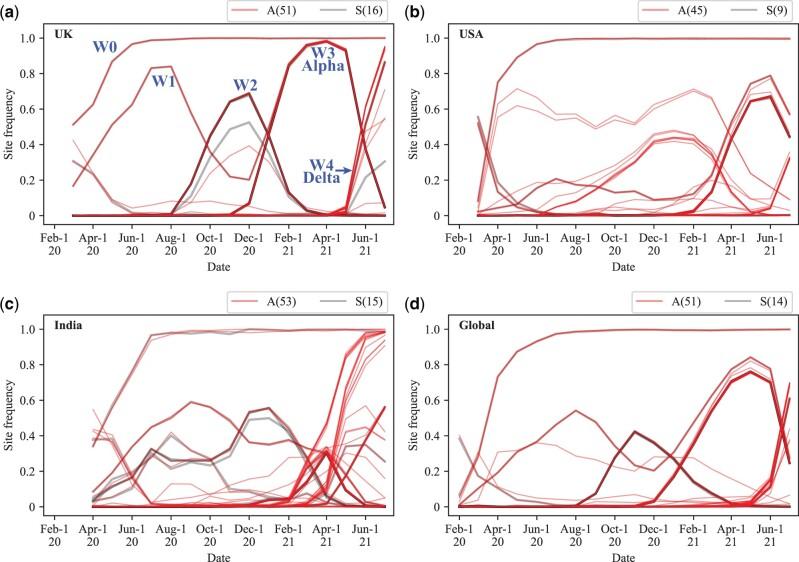
In new epidemics after the host shift, the pathogens may experience accelerated evolution driven by novel selective pressures. When the accelerated evolution enters a positive feedback loop with the expanding epidemics, the pathogen's runaway evolution may be triggered. To test this possibility in coronavirus disease 2019 (COVID-19), we analyze the extensive databases and identify five major waves of strains, one replacing the previous one in 2020-2021. The mutations differ entirely between waves and the number of mutations continues to increase, from 3-4 to 21-31. The latest wave in the fall of 2021 is the Delta strain which accrues 31 new mutations to become highly prevalent. Interestingly, these new mutations in Delta strain emerge in multiple stages with each stage driven by 6-12 coding mutations that form a fitness group. In short, the evolution of severe acute respiratory syndrome coronavirus 2 (SARS-CoV-2) from the oldest to the youngest wave, and from the earlier to the later stages of the Delta wave, is a process of acceleration with more and more mutations. The global increase in the viral population size (M(t), at time t) and the mutation accumulation (R(t)) may have indeed triggered the runaway evolution in late 2020, leading to the highly evolved Alpha and then Delta strain. To suppress the pandemic, it is crucial to break the positive feedback loop between M(t) and R(t), neither of which has yet to be effectively dampened by late 2021. New waves after Delta, hence, should not be surprising.
在宿主转移后的新疫情中,病原体可能会经历由新的选择压力驱动的加速进化。当加速进化与不断扩大的疫情进入正反馈循环时,病原体的失控进化可能会被触发。为了在 2019 年冠状病毒病(COVID-19)中检验这种可能性,我们分析了广泛的数据库,确定了五个主要的毒株波,一个在 2020-2021 年期间取代了前一个。波与波之间的突变完全不同,突变数量不断增加,从 3-4 个增加到 21-31 个。2021 年秋季的最新一波是 Delta 株,它积累了 31 个新突变,变得高度流行。有趣的是,Delta 株中的这些新突变出现在多个阶段,每个阶段都由 6-12 个编码突变驱动,形成一个适应度群。简而言之,从最古老到最新的波,从 SARS-CoV-2 的 Delta 波的早期到后期,严重急性呼吸综合征冠状病毒 2 (SARS-CoV-2) 的进化是一个加速的过程,突变越来越多。病毒群体大小(M(t),在时间 t)和突变积累(R(t))的全球增加确实可能在 2020 年底引发了失控进化,导致高度进化的 Alpha 株和随后的 Delta 株。为了抑制大流行,打破 M(t)和 R(t)之间的正反馈循环至关重要,而到 2021 年底,这两者都尚未得到有效抑制。因此,Delta 之后出现新的波不应感到意外。


 Zotero 插件