
1990年至2019年感染性心内膜炎的全球、地区和国家负担及趋势:全球疾病负担研究2019结果
The Global, Regional, and National Burden and Trends of Infective Endocarditis From 1990 to 2019: Results From the Global Burden of Disease Study 2019.
作者信息
Chen Huilong, Zhan Yuan, Zhang Kaimin, Gao Yiping, Chen Liyuan, Zhan Juan, Chen Zirui, Zeng Zhilin
机构信息
Department and Institute of Infectious Diseases, Tongji Medical College, Tongji Hospital, Huazhong University of Science and Technology, Wuhan, China.
Department of Respiratory and Critical Care Medicine, National Clinical Research Center of Respiratory Disease, Tongji Medical College, Tongji Hospital, Huazhong University of Science and Technology, Wuhan, China.
出版信息
Front Med (Lausanne). 2022 Mar 9;9:774224. doi: 10.3389/fmed.2022.774224. eCollection 2022.
INTRODUCTION
Infective endocarditis (IE) presents with increasing incidence and mortality in some regions and countries, as well as serious socioeconomic burden. The current study aims to compare and interpret the IE burden and temporal trends globally and in different regions from 1990 to 2019.
METHODS
Data on the incidence, deaths and disability-adjusted life years (DALYs) caused by IE were extracted and analyzed from the Global Burden of Disease Study 2019. Estimated annual percentage changes (EAPC) were adopted to quantify the change trends of age-standardized rates (ASRs). Besides, potential contributors of serious IE burden were also evaluated including age, gender, social-demographic index (SDI), and age-standardized incident rate (ASIR) in 1990.
RESULTS
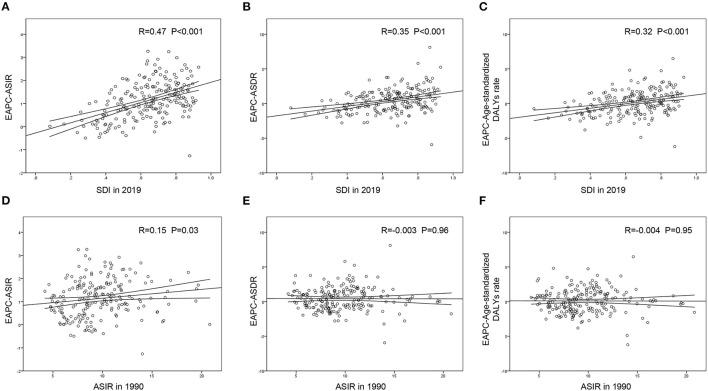
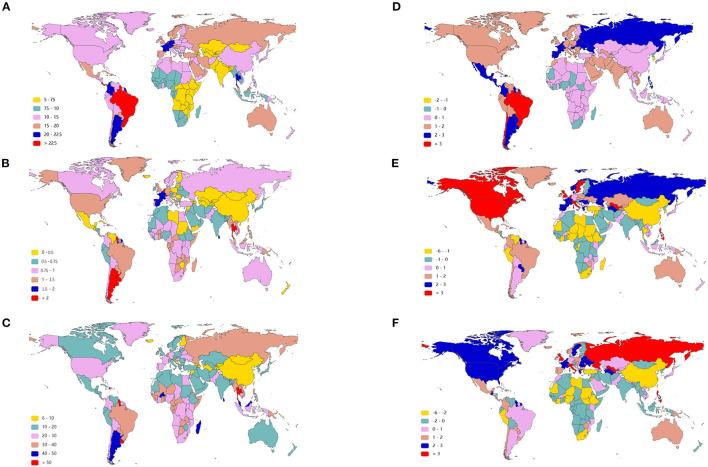
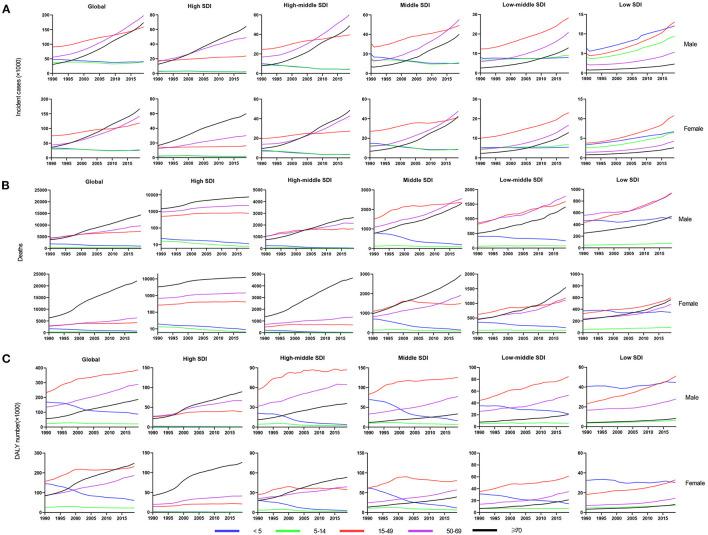
Globally, the number of IE cases and deaths has increased sharply during the past 30 years from 478,000 in 1990 to 1,090,530 in 2019 and from 28,750 in 1990 to 66,320 in 2019, and both presented an upward temporal trend annually (EAPC:1.2 for incidence and 0.71 for death). However, the EAPC of age-standardized DALYs demonstrated a negative temporal trend despite increasing DALYs from 1,118,120 in 1990 to 1,723,590 in 2019. Moreover, older patients and men were more severely affected. Meanwhile, different SDI regions had different disease burdens, and correlation analyses indicated that SDI presented a positive association with ASIR (R = 0.58, < 0.0001), no association with age-standardized death rate (R = -0.06, = 0.10), and a negative association with age-standardized DALYs (R = -0.40, < 0.0001). In addition, the incidence of IE increased in most countries during the past 30 years (190 out of 204 countries). However, the change trends of deaths and DALYs were heterogeneous across regions and countries. Finally, we discovered positive associations of the EAPC of ASRs with the SDI in 2019 among 204 countries and territories but few associations with the ASIR in 1990.
CONCLUSION
Generally, the global burden of IE is increasing, and there is substantial heterogeneity in different genders, ages and regions, which may help policy-makers and medical staff respond to IE and formulate cost-effective interventional measures.
引言
感染性心内膜炎(IE)在一些地区和国家的发病率和死亡率不断上升,同时带来了严重的社会经济负担。本研究旨在比较和解读1990年至2019年全球及不同地区IE的负担和时间趋势。
方法
从《2019年全球疾病负担研究》中提取并分析了由IE导致的发病率、死亡人数和伤残调整生命年(DALYs)的数据。采用估计年度百分比变化(EAPC)来量化年龄标准化率(ASRs)的变化趋势。此外,还评估了严重IE负担的潜在影响因素,包括年龄、性别、社会人口指数(SDI)以及1990年的年龄标准化发病率(ASIR)。
结果
在全球范围内,过去30年中IE病例数和死亡人数急剧增加,从1990年的478,000例增至2019年的1,090,530例,死亡人数从1990年的28,750例增至2019年的66,320例,且两者均呈现逐年上升的时间趋势(EAPC:发病率为1.2,死亡率为0.71)。然而,尽管年龄标准化DALYs从1990年的1,118,120增至2019年的1,723,590,但年龄标准化DALYs的EAPC呈现负时间趋势。此外,老年患者和男性受影响更为严重。同时,不同SDI地区的疾病负担不同,相关性分析表明SDI与ASIR呈正相关(R = 0.58,P < 0.0001),与年龄标准化死亡率无关联(R = -0.06,P = 0.10),与年龄标准化DALYs呈负相关(R = -0.40,P < 0.


 Zotero 插件