
鼻腔递送广谱中和抗体可保护小鼠免受 SARS-CoV-2 德尔塔和奥密克戎变异株的致死性攻击。
Nasal delivery of broadly neutralizing antibodies protects mice from lethal challenge with SARS-CoV-2 delta and omicron variants.
机构信息
National Engineering Technology Research Center for Combined Vaccines, Wuhan Institute of Biological Products Co. Ltd., Wuhan, 430070, China.
State Key Laboratory for Molecular Virology and Genetic Engineering, National Institute for Viral Disease Control and Prevention, Chinese Center for Disease Control and Prevention, Beijing, 102206, China.
出版信息
Virol Sin. 2022 Apr;37(2):238-247. doi: 10.1016/j.virs.2022.02.005. Epub 2022 Feb 18.
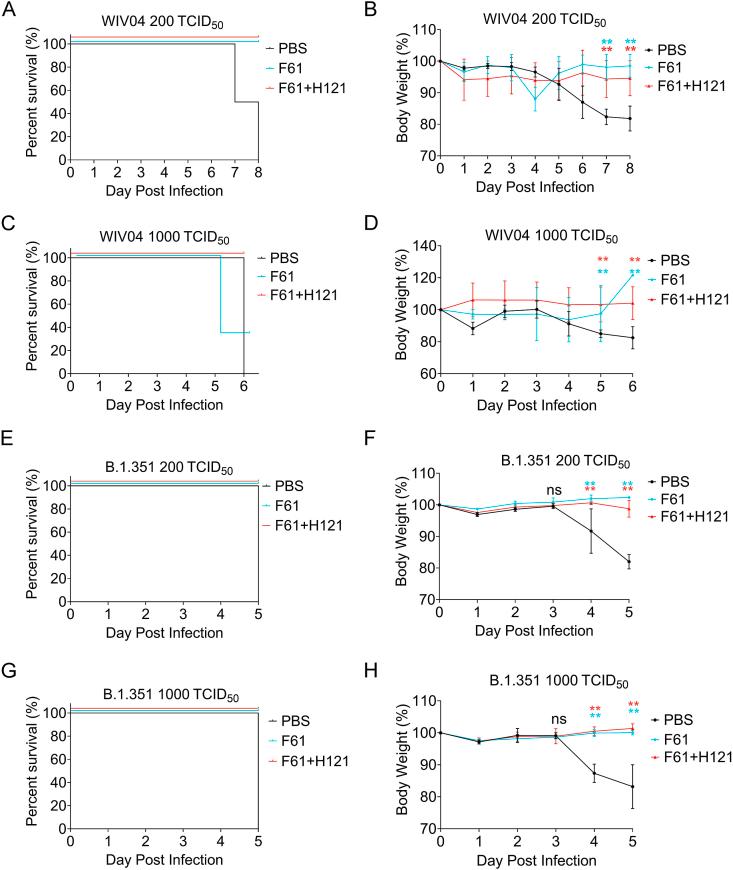
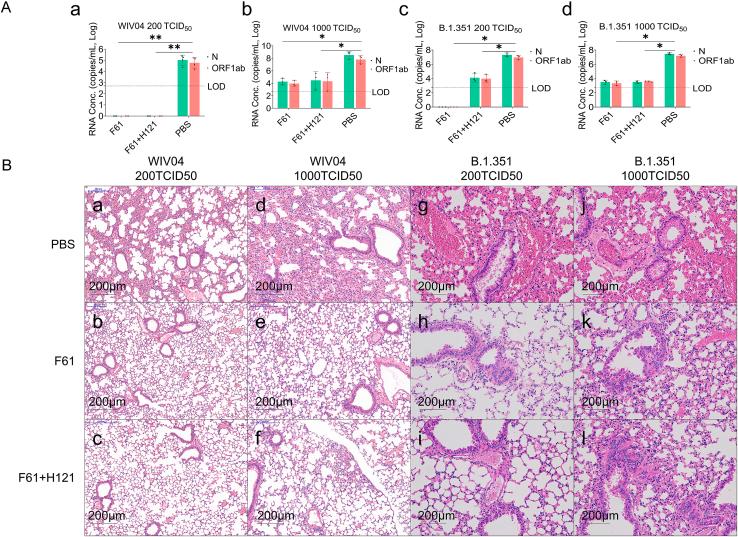
Multiple new variants of severe acute respiratory syndrome coronavirus 2 (SARS-CoV-2) have constantly emerged, as the delta and omicron variants, which have developed resistance to currently gained neutralizing antibodies. This highlights a critical need to discover new therapeutic agents to overcome the variants mutations. Despite the availability of vaccines against coronavirus disease 2019 (COVID-19), the use of broadly neutralizing antibodies has been considered as an alternative way for the prevention or treatment of SARS-CoV-2 variants infection. Here, we show that the nasal delivery of two previously characterized broadly neutralizing antibodies (F61 and H121) protected K18-hACE2 mice against lethal challenge with SARS-CoV-2 variants. The broadly protective efficacy of the F61 or F61/F121 cocktail antibodies was evaluated by lethal challenge with the wild strain (WIV04) and multiple variants, including beta (B.1.351), delta (B.1.617.2), and omicron (B.1.1.529) at 200 or 1000 TCID, and the minimum antibody administration doses (5-1.25 mg/kg body weight) were also evaluated with delta and omicron challenge. Fully prophylactic protections were found in all challenged groups with both F61 and F61/H121 combination at the administration dose of 20 mg/kg body weight, and corresponding mice lung viral RNA showed negative, with almost all alveolar septa and cavities remaining normal. Furthermore, low-dose antibody treatment induced significant prophylactic protection against lethal challenge with delta and omicron variants, whereas the F61/H121 combination showed excellent results against omicron infection. Our findings indicated the potential use of broadly neutralizing monoclonal antibodies as prophylactic and therapeutic agent for protection of current emerged SARS-CoV-2 variants infection.
多种严重急性呼吸综合征冠状病毒 2(SARS-CoV-2)的新变体不断出现,如德尔塔和奥密克戎变体,它们对目前获得的中和抗体产生了耐药性。这凸显了发现新的治疗药物以克服变体突变的迫切需要。尽管有针对 2019 年冠状病毒病(COVID-19)的疫苗,但广泛中和抗体的使用已被视为预防或治疗 SARS-CoV-2 变体感染的替代方法。在这里,我们展示了两种先前表征的广泛中和抗体(F61 和 H121)通过鼻腔给药可保护 K18-hACE2 小鼠免受 SARS-CoV-2 变体的致死性挑战。通过用野生株(WIV04)和多种变体(包括β(B.1.351)、德尔塔(B.1.617.2)和奥密克戎(B.1.1.529))进行致死性挑战(200 或 1000 TCID),评估了 F61 或 F61/F121 鸡尾酒抗体的广泛保护效力,并评估了用德尔塔和奥密克戎挑战时的最小抗体给药剂量(5-1.25 mg/kg 体重)。在给予 20 mg/kg 体重的剂量时,F61 和 F61/F121 联合使用在所有受挑战的组中均发现完全预防性保护,并且相应的小鼠肺病毒 RNA 呈阴性,几乎所有肺泡隔和腔都保持正常。此外,低剂量抗体治疗可显著预防德尔塔和奥密克戎变体的致死性挑战,而 F61/F121 联合使用对奥密克戎感染显示出极佳的效果。我们的研究结果表明,广泛中和单克隆抗体作为预防和治疗药物,具有保护当前出现的 SARS-CoV-2 变体感染的潜力。



 Zotero 插件