
接受免疫检查点抑制剂治疗患者的免疫细胞分数变化
Changes of Immune Cell Fractions in Patients Treated with Immune Checkpoint Inhibitors.
作者信息
Kim Hye Ryeon, Kang Jung Hun, Kim Sung Hyun, Kim Seung Tae, Kim Ilhwan, Min Young Joo, Shin Seong Hoon, Oh Sung Yong, Lee Gyeong-Won, Lee Ji Hyun, Ji Jun Ho, Huh Seok Jae, Lee Suee
机构信息
Department of Internal Medicine, Dong-A University College of Medicine, Busan 49201, Korea.
Division of Hematology-Oncology, Department of Internal Medicine, Gyeongsang National University Hospital, Gyeongsang National University College of Medicine, Jinju 52727, Korea.
出版信息
Cancers (Basel). 2022 Jul 15;14(14):3440. doi: 10.3390/cancers14143440.
BACKGROUND
With the development of immunology, immune checkpoint inhibitors (ICIs) have been widely used in various cancer treatments. Although some patients can benefit from ICIs, other patients have no response to ICIs or suffer from hyperprogression. There has been no biomarker for predicting the efficacy of ICIs. Thus, the objective of this study was to find biomarkers for predicting the efficacy of ICIs using peripheral blood.
METHODS
Adults patients planned to be treated with ICIs were enrolled in this study. Blood sampling was carried out before and after administration of ICIs. Changes of immune cell fraction were analyzed for each patient.
RESULTS
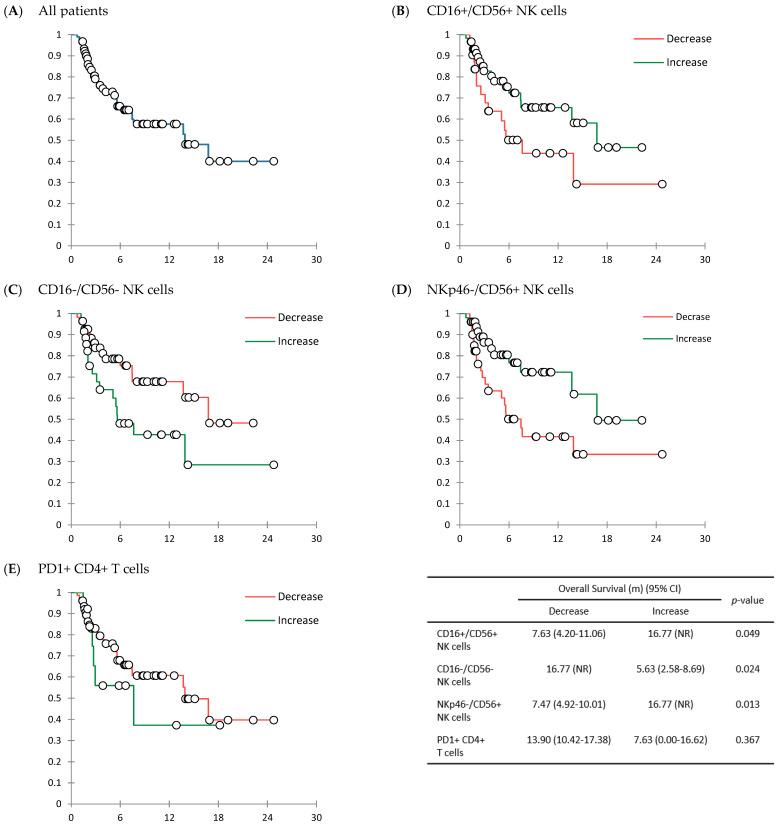
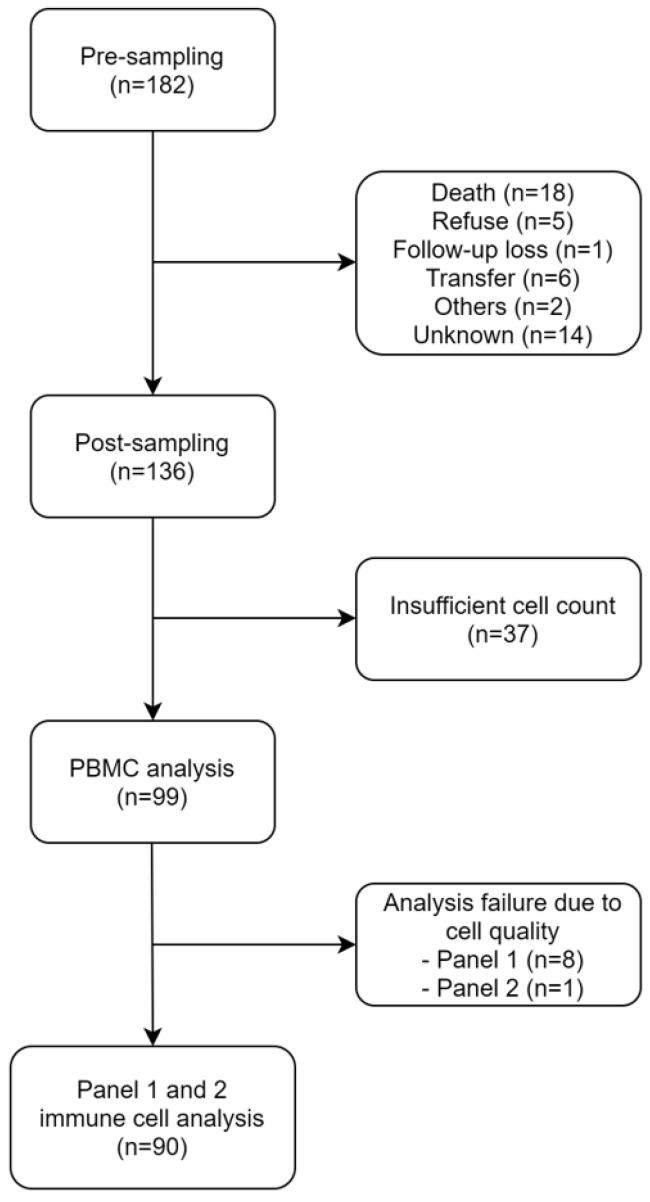
Among 182 patients enrolled, immune cell analysis was performed for 90 patients. The objective response rate was 14.4% ( = 13/90). The median progression-free survival (PFS) was 6.0 months (95% CI: 3.1-8.9 months), and the median overall survival (OS) was 13.9 months (95% CI: 5.6-22.2 months). Significant benefits in ORR and OS were shown for patients with increased NKp46-/CD56+ NK cells ( = 0.033 and = 0.013, respectively). The PFS tended to be longer in these patients, although the difference was not statistically significant ( = 0.050).
CONCLUSION
Changes of immune cell fraction before and after administration of ICIs could be a novel biomarker for predicting the efficacy of immunotherapy.
背景
随着免疫学的发展,免疫检查点抑制剂(ICI)已广泛应用于各种癌症治疗。尽管一些患者可从ICI中获益,但其他患者对ICI无反应或出现疾病快速进展。目前尚无预测ICI疗效的生物标志物。因此,本研究的目的是利用外周血寻找预测ICI疗效的生物标志物。
方法
本研究纳入计划接受ICI治疗的成年患者。在ICI给药前后进行血液采样。分析每位患者免疫细胞比例的变化。
结果
在纳入的182例患者中,对90例患者进行了免疫细胞分析。客观缓解率为14.4%(90例中有13例)。中位无进展生存期(PFS)为6.0个月(95%CI:3.1 - 8.9个月),中位总生存期(OS)为13.9个月(95%CI:5.6 - 22.2个月)。NKp46 - /CD56 + NK细胞增加的患者在ORR和OS方面显示出显著获益(分别为P = 0.033和P = 0.013)。这些患者的PFS有延长趋势,尽管差异无统计学意义(P = 0.050)。
结论
ICI给药前后免疫细胞比例的变化可能是预测免疫治疗疗效的一种新型生物标志物。

 Zotero 插件