
利用机器学习和可解释性预测孕妇次日的感知和生理压力:算法开发和验证。
Predicting the Next-Day Perceived and Physiological Stress of Pregnant Women by Using Machine Learning and Explainability: Algorithm Development and Validation.
机构信息
McCormick School of Engineering, Northwestern University, Evanston, IL, United States.
Northwestern University Feinberg School of Medicine, Chicago, IL, United States.
出版信息
JMIR Mhealth Uhealth. 2022 Aug 2;10(8):e33850. doi: 10.2196/33850.
BACKGROUND
Cognitive behavioral therapy-based interventions are effective in reducing prenatal stress, which can have severe adverse health effects on mothers and newborns if unaddressed. Predicting next-day physiological or perceived stress can help to inform and enable pre-emptive interventions for a likely physiologically and perceptibly stressful day. Machine learning models are useful tools that can be developed to predict next-day physiological and perceived stress by using data collected from the previous day. Such models can improve our understanding of the specific factors that predict physiological and perceived stress and allow researchers to develop systems that collect selected features for assessment in clinical trials to minimize the burden of data collection.
OBJECTIVE
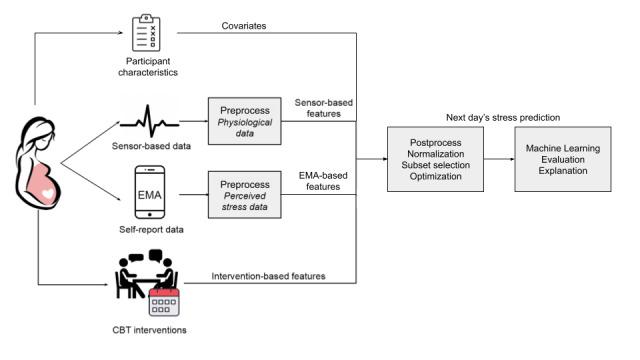
The aim of this study was to build and evaluate a machine-learned model that predicts next-day physiological and perceived stress by using sensor-based, ecological momentary assessment (EMA)-based, and intervention-based features and to explain the prediction results.
METHODS
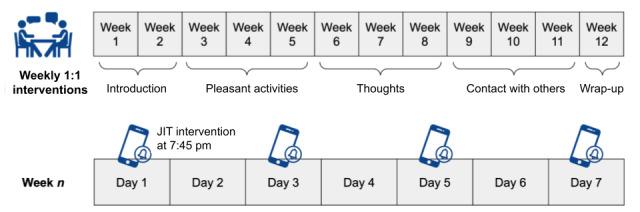
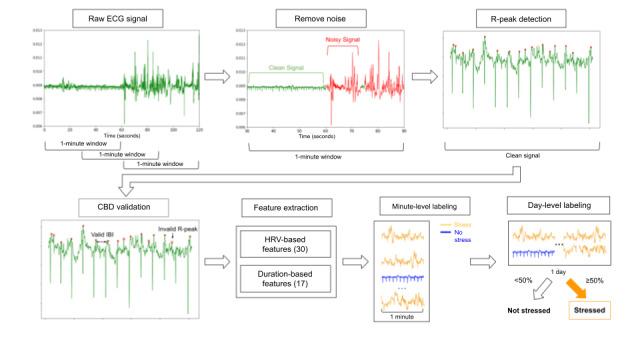
We enrolled pregnant women into a prospective proof-of-concept study and collected electrocardiography, EMA, and cognitive behavioral therapy intervention data over 12 weeks. We used the data to train and evaluate 6 machine learning models to predict next-day physiological and perceived stress. After selecting the best performing model, Shapley Additive Explanations were used to identify the feature importance and explainability of each feature.
RESULTS
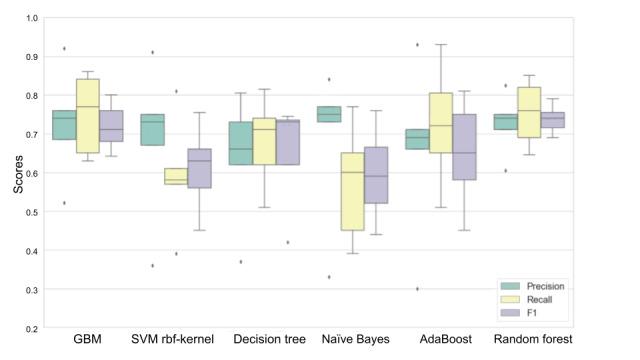
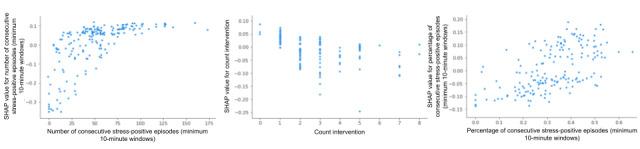
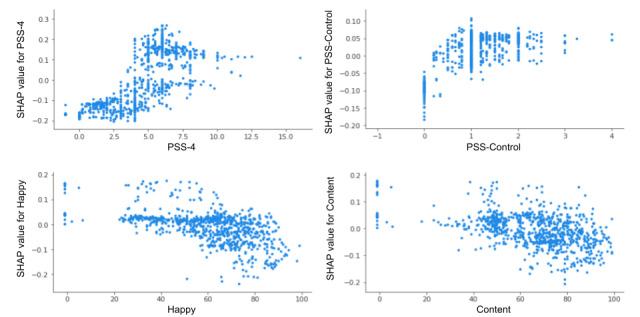
A total of 16 pregnant women enrolled in the study. Overall, 4157.18 hours of data were collected, and participants answered 2838 EMAs. After applying feature selection, 8 and 10 features were found to positively predict next-day physiological and perceived stress, respectively. A random forest classifier performed the best in predicting next-day physiological stress (F1 score of 0.84) and next-day perceived stress (F1 score of 0.74) by using all features. Although any subset of sensor-based, EMA-based, or intervention-based features could reliably predict next-day physiological stress, EMA-based features were necessary to predict next-day perceived stress. The analysis of explainability metrics showed that the prolonged duration of physiological stress was highly predictive of next-day physiological stress and that physiological stress and perceived stress were temporally divergent.
CONCLUSIONS
In this study, we were able to build interpretable machine learning models to predict next-day physiological and perceived stress, and we identified unique features that were highly predictive of next-day stress that can help to reduce the burden of data collection.
背景
基于认知行为疗法的干预措施可有效减轻产前压力,如果不加以处理,这种压力会对母亲和新生儿的健康造成严重不良影响。预测次日的生理或感知压力有助于提供信息并实现对可能产生生理和感知压力的日子的预先干预。机器学习模型是一种有用的工具,可以使用前一天收集的数据来开发预测次日生理和感知压力的模型。此类模型可以帮助我们更好地理解预测生理和感知压力的具体因素,并使研究人员能够开发用于临床试验评估的系统,以最小化数据收集的负担。
目的
本研究旨在构建和评估一种基于机器学习的模型,该模型使用基于传感器的、基于生态瞬时评估(EMA)的和基于干预的特征来预测次日的生理和感知压力,并解释预测结果。
方法
我们将孕妇纳入一项前瞻性概念验证研究,并在 12 周内收集心电图、EMA 和认知行为疗法干预数据。我们使用这些数据训练和评估 6 种机器学习模型以预测次日的生理和感知压力。在选择表现最佳的模型后,我们使用 Shapley 加性解释来确定每个特征的重要性和可解释性。
结果
共有 16 名孕妇参与了这项研究。总共收集了 4157.18 小时的数据,参与者回答了 2838 次 EMA。经过特征选择后,分别发现 8 个和 10 个特征可正向预测次日的生理和感知压力。随机森林分类器在预测次日生理压力(F1 得分为 0.84)和次日感知压力(F1 得分为 0.74)方面表现最佳,使用所有特征。尽管基于传感器的、基于 EMA 的或基于干预的任何特征子集都可以可靠地预测次日生理压力,但基于 EMA 的特征是预测次日感知压力所必需的。可解释性指标的分析表明,生理压力持续时间较长是预测次日生理压力的高度预测因素,并且生理压力和感知压力在时间上是不同的。
结论
在这项研究中,我们能够构建可解释的机器学习模型来预测次日的生理和感知压力,并确定了高度预测次日压力的独特特征,这有助于减轻数据收集的负担。







 Zotero 插件