
基于二吡啶甲胺的荧光探针及其在水溶液中定量测定铁的潜力。
Dipicolylamine-Based Fluorescent Probes and Their Potential for the Quantification of Fe in Aqueous Solutions.
作者信息
Vitharana Nipuni N, Kaushalya Chiranthi, Perera Theshini, Deraniyagala Samitha P, Sameera W M C, Cooray Asitha T
机构信息
Department of Chemistry, Faculty of Applied Sciences, University of Sri Jayewardenepura, Nugegoda 10250, Sri Lanka.
Institute of Low Temperature Science, Hokkaido University, N19-W8, Kita-ku, Sapporo, Hokkaido 060-0819, Japan.
出版信息
ACS Omega. 2022 Aug 1;7(32):28342-28350. doi: 10.1021/acsomega.2c02862. eCollection 2022 Aug 16.
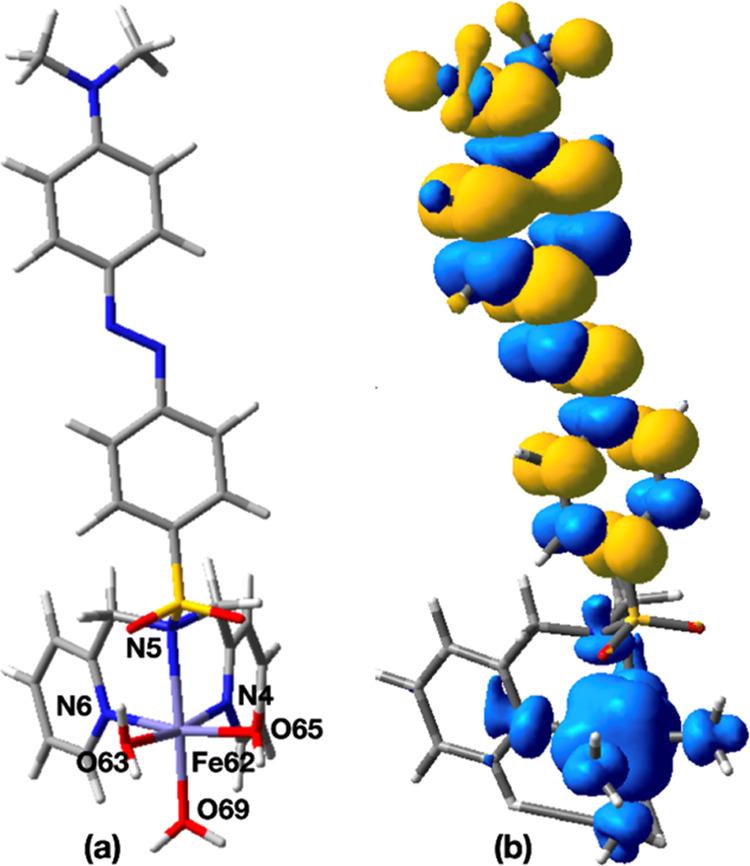
We have synthesized two ligand systems, N(SO)(R)dpa (L1) and N(SO)(R)dpa (L2), where R = biphenyl and R = azobenzene, which are sulfonamide derivatives of the NNN-donor chelating dipicolylamine. Both L1 and L2 can be used as sensors for detecting Fe and are highly sensitive and selective over a wide range of common cations. Time-dependent density functional theory (TDDFT) calculations confirmed that the key excitations of L2 and the [Fe(L2)(HO)] model complex involve -R-unit-based π and π* charge transfer. L2 demonstrates a relatively high photostability, a fluorescence turn-on mechanism, and a detection limit of 0.018 μM with 1.00 μM L2 concentration, whereas L1 has a detection limit of 0.67 μM. Thus, both ligands have the potential to be used as fluorosensors for the detection of Fe in aqueous solutions.
我们合成了两种配体体系,即N(SO)(R)dpa(L1)和N(SO)(R)dpa(L2),其中R = 联苯且R = 偶氮苯,它们是NNN供体螯合二吡啶基胺的磺酰胺衍生物。L1和L2均可作为检测铁的传感器,并且对多种常见阳离子具有高灵敏度和选择性。含时密度泛函理论(TDDFT)计算证实,L2和[Fe(L2)(HO)]模型配合物的关键激发涉及基于-R单元的π和π*电荷转移。L2表现出相对较高的光稳定性、荧光开启机制,在L2浓度为1.00 μM时检测限为0.018 μM,而L1的检测限为0.67 μM。因此,这两种配体都有潜力用作水溶液中铁检测的荧光传感器。


 Zotero 插件