
STAT3 及其靶向抑制剂在口腔鳞状细胞癌中的作用。
STAT3 and Its Targeting Inhibitors in Oral Squamous Cell Carcinoma.
机构信息
Jilin Provincial Key Laboratory of Oral Biomedical Engineering, Department of Oral Anatomy and Physiology, Hospital of Stomatology, Jilin University, Changchun 130021, China.
Liaoning Provincial Key Laboratory of Oral Diseases, Experimental Teaching Center, School and Hospital of Stomatology, China Medical University, Shenyang 110001, China.
出版信息
Cells. 2022 Oct 5;11(19):3131. doi: 10.3390/cells11193131.
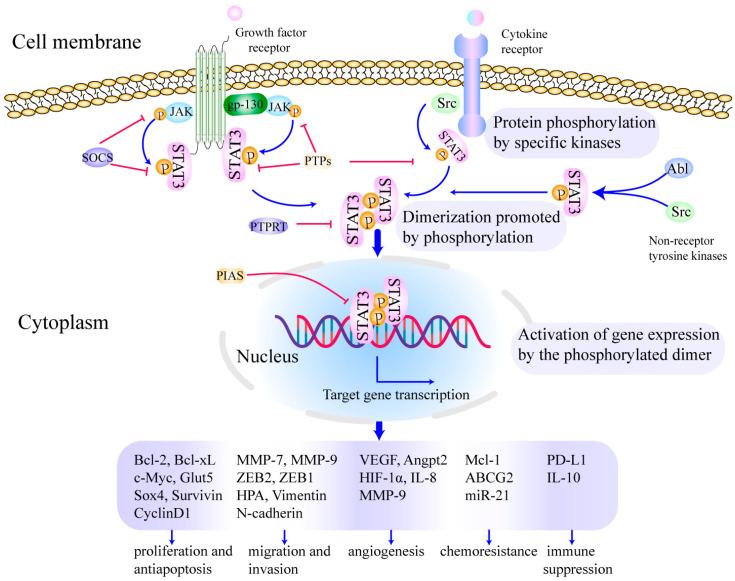
Oral squamous cell carcinoma (OSCC) usually originates from the precancerous lesions of oral mucosa and accounts for approximately 90% of oral cancers. Current therapeutic approaches do not yet meet the needs of patients, and the 5-year survival rate of patients with OSCC is only 50%. Recent studies have revealed that the signal transducer and activator of transcription 3 (STAT3) plays a key role in the development and progression of OSCC. STAT3 is overexpressed and constitutively activated in OSCC cells, and promotes cancer cell proliferation and anti-apoptosis, migration and invasion, angiogenesis, radiotherapy resistance, and immune escape, as well as stem cell self-renewal and differentiation by regulating the transcription of its downstream target genes. Inhibitors of the STAT3 signaling pathway have shown the promising anticancer effects in vitro and in vivo, and STAT3 is expected to be a molecular target for the treatment of OSCC. In this review, we highlight the oncogenic significance of STAT3 in OSCC with an emphasis on the therapeutic approaches and effective small molecule inhibitors targeting STAT3. Finally, we also propose the potential research directions in the expectation of developing more specific STAT3 inhibitors for OSCC treatment.
口腔鳞状细胞癌 (OSCC) 通常起源于口腔黏膜的癌前病变,约占口腔癌的 90%。目前的治疗方法还不能满足患者的需求,OSCC 患者的 5 年生存率仅为 50%。最近的研究表明,信号转导子和转录激活子 3(STAT3)在 OSCC 的发生和发展中起关键作用。STAT3 在 OSCC 细胞中过度表达和持续激活,通过调节其下游靶基因的转录,促进癌细胞增殖和抗凋亡、迁移和侵袭、血管生成、放疗抵抗和免疫逃逸,以及干细胞自我更新和分化。STAT3 信号通路抑制剂在体外和体内均显示出有希望的抗癌作用,STAT3 有望成为治疗 OSCC 的分子靶点。在这篇综述中,我们强调了 STAT3 在 OSCC 中的致癌意义,重点介绍了针对 STAT3 的治疗方法和有效的小分子抑制剂。最后,我们还提出了潜在的研究方向,以期开发出更特异的用于 OSCC 治疗的 STAT3 抑制剂。

 Zotero 插件