
SWI/SNF复合物基因变异与更高的肿瘤突变负荷及对免疫检查点抑制剂治疗的更好反应相关:对4591例病例的下一代测序数据进行的泛癌分析
SWI/SNF complex gene variations are associated with a higher tumor mutational burden and a better response to immune checkpoint inhibitor treatment: a pan-cancer analysis of next-generation sequencing data corresponding to 4591 cases.
作者信息
Li Yue, Yang Xinhua, Zhu Weijie, Xu Yuxia, Ma Jiangjun, He Caiyun, Wang Fang
机构信息
Department of Molecular Diagnostics, State Key Laboratory of Oncology in South China, Collaborative Innovation Center for Cancer Medicine, Sun Yat-Sen University Cancer Center, 651 Dongfeng East Road, Yuexiu District, Guangzhou, 510060, China.
出版信息
Cancer Cell Int. 2022 Nov 12;22(1):347. doi: 10.1186/s12935-022-02757-x.
BACKGROUND
Genes related to the SWItch/sucrose nonfermentable (SWI/SNF) chromatin remodeling complex are frequently mutated across cancers. SWI/SNF-mutant tumors are vulnerable to synthetic lethal inhibitors. However, the landscape of SWI/SNF mutations and their associations with tumor mutational burden (TMB), microsatellite instability (MSI) status, and response to immune checkpoint inhibitors (ICIs) have not been elucidated in large real-world Chinese patient cohorts.
METHODS
The mutational rates and variation types of six SWI/SNF complex genes (ARID1A, ARID1B, ARID2, SMARCA4, SMARCB1, and PBRM1) were analyzed retrospectively by integrating next-generation sequencing data of 4591 cases covering 18 cancer types. Thereafter, characteristics of SWI/SNF mutations were depicted and the TMB and MSI status and therapeutic effects of ICIs in the SWI/SNF-mutant and SWI/SNF-non-mutant groups were compared.
RESULTS
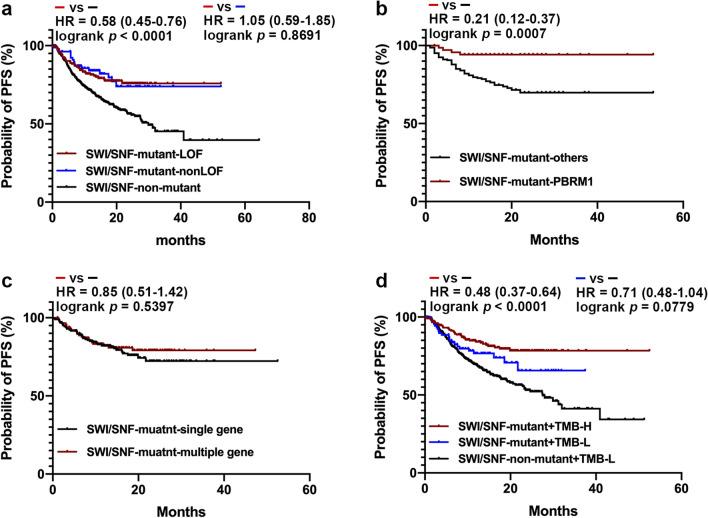
SWI/SNF mutations were observed in 21.8% of tumors. Endometrial (54.1%), gallbladder and biliary tract (43.4%), and gastric (33.9%) cancers exhibited remarkably higher SWI/SNF mutational rates than other malignancies. Further, ARID1A was the most frequently mutated SWI/SNF gene, and ARID1A D1850fs was identified as relatively crucial. The TMB value, TMB-high (TMB-H), and MSI-high (MSI-H) proportions corresponding to SWI/SNF-mutant cancers were significantly higher than those corresponding to SWI/SNF-non-mutant cancers (25.8 vs. 5.6 mutations/Mb, 44.3% vs. 10.3%, and 16.0% vs. 0.9%, respectively; all p < 0.0001). Furthermore, these indices were even higher for tumors with co-mutations of SWI/SNF genes and MLL2/3. Regarding immunotherapeutic effects, patients with SWI/SNF variations showed significantly longer progression-free survival (PFS) rates than their SWI/SNF-non-mutant counterparts (hazard ratio [HR], 0.56 [95% confidence interval {CI} 0.44-0.72]; p < 0.0001), and PBRM1 mutations were associated with relatively better ICI treatment outcomes than the other SWI/SNF gene mutations (HR, 0.21 [95% CI 0.12-0.37]; p = 0.0007). Additionally, patients in the SWI/SNF-mutant + TMB-H (HR, 0.48 [95% CI 0.37-0.54]; p < 0.0001) cohorts had longer PFS rates than those in the SWI/SNF-non-mutant + TMB-low cohort.
CONCLUSIONS
SWI/SNF complex genes are frequently mutated and are closely associated with TMB-H status, MSI-H status, and superior ICI treatment response in several cancers, such as colorectal cancer, gastric cancer, and non-small cell lung cancer. These findings emphasize the necessity and importance of molecular-level detection and interpretation of SWI/SNF complex mutations.
背景
与SWItch/蔗糖非发酵(SWI/SNF)染色质重塑复合体相关的基因在多种癌症中经常发生突变。SWI/SNF突变型肿瘤对合成致死抑制剂敏感。然而,在中国大型真实世界患者队列中,SWI/SNF突变的全貌及其与肿瘤突变负荷(TMB)、微卫星不稳定性(MSI)状态以及对免疫检查点抑制剂(ICI)反应的相关性尚未阐明。
方法
通过整合涵盖18种癌症类型的4591例病例的二代测序数据,回顾性分析6个SWI/SNF复合体基因(ARID1A、ARID1B、ARID2、SMARCA4、SMARCB1和PBRM1)的突变率和变异类型。此后,描述SWI/SNF突变的特征,并比较SWI/SNF突变组和SWI/SNF非突变组的TMB、MSI状态以及ICI的治疗效果。
结果
在21.8%的肿瘤中观察到SWI/SNF突变。子宫内膜癌(54.1%)、胆囊和胆管癌(43.4%)以及胃癌(33.9%)的SWI/SNF突变率显著高于其他恶性肿瘤。此外,ARID1A是最常发生突变的SWI/SNF基因,并且ARID1A D1850fs被确定为相对关键。与SWI/SNF非突变型癌症相比,SWI/SNF突变型癌症对应的TMB值、高肿瘤突变负荷(TMB-H)和高微卫星不稳定性(MSI-H)比例显著更高(分别为25.8对5.6个突变/Mb、44.3%对10.3%、16.0%对0.9%;所有p<0.0001)。此外,对于同时发生SWI/SNF基因和MLL2/3共突变的肿瘤,这些指标甚至更高。关于免疫治疗效果,SWI/SNF变异患者的无进展生存期(PFS)率显著长于SWI/SNF非突变患者(风险比[HR],0.56[95%置信区间{CI}0.44-0.72];p<0.0001),并且与其他SWI/SNF基因突变相比,PBRM1突变与相对更好的ICI治疗结果相关(HR,0.21[95%CI 0.12-0.37];p = 0.0007)。此外,SWI/SNF突变+TMB-H队列中的患者(HR,0.48[95%CI 0.37-0.54];p<0.0001)的PFS率长于SWI/SNF非突变+低TMB队列中的患者。
结论
SWI/SNF复合体基因经常发生突变,并且在几种癌症(如结直肠癌、胃癌和非小细胞肺癌)中与TMB-H状态、MSI-H状态以及优异的ICI治疗反应密切相关。这些发现强调了对SWI/SNF复合体突变进行分子水平检测和解读的必要性和重要性。


 Zotero 插件