
SLAMF7 调节多微生物脓毒症期间巨噬细胞的炎症反应。
SLAMF7 regulates the inflammatory response in macrophages during polymicrobial sepsis.
机构信息
Center for Infection and Immunity and Guangdong Provincial Key Laboratory of Biomedical Imaging, The Fifth Affiliated Hospital of Sun Yat-sen University, Zhuhai, Guangdong Province, China.
Scientific Research Center, The Seventh Affiliated Hospital, Sun Yat-sen University, Shenzhen, Guangdong Province, China.
出版信息
J Clin Invest. 2023 Mar 15;133(6):e150224. doi: 10.1172/JCI150224.
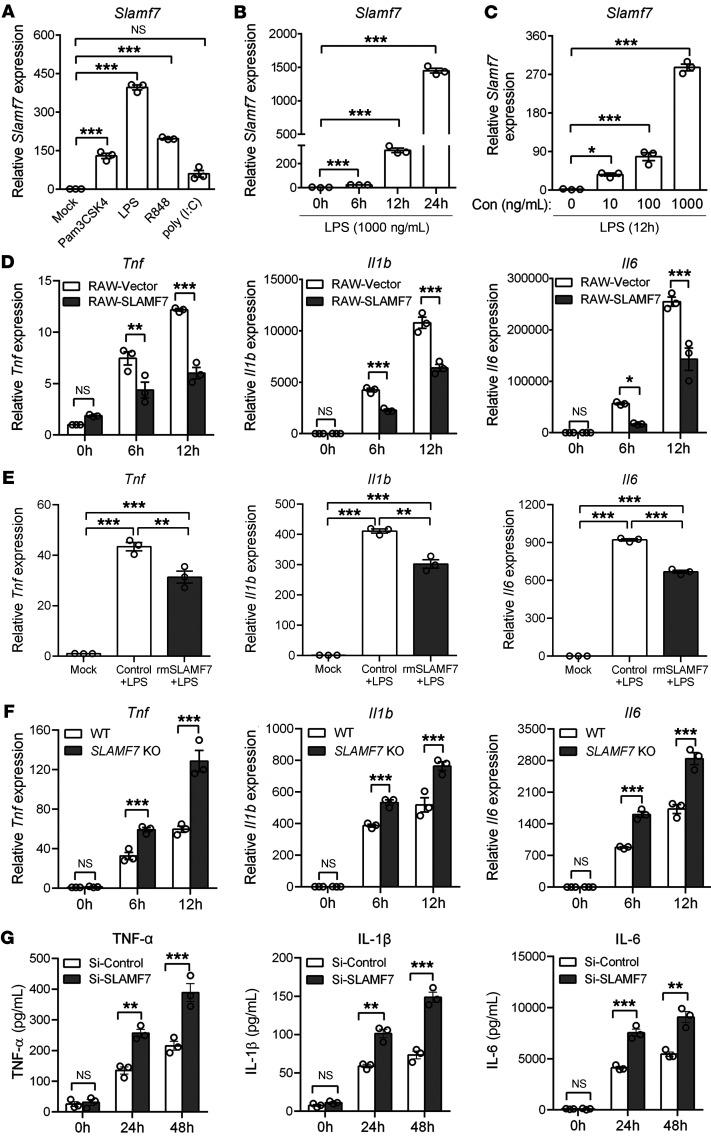
Uncontrolled inflammation occurred in sepsis results in multiple organ injuries and shock, which contributes to the death of patients with sepsis. However, the regulatory mechanisms that restrict excessive inflammation are still elusive. Here, we identified an Ig-like receptor called signaling lymphocyte activation molecular family 7 (SLAMF7) as a key suppressor of inflammation during sepsis. We found that the expression of SLAMF7 on monocytes/macrophages was significantly elevated in patients with sepsis and in septic mice. SLAMF7 attenuated TLR-dependent MAPK and NF-κB signaling activation in macrophages by cooperating with Src homology 2-containing inositol-5'‑phosphatase 1 (SHIP1). Furthermore, SLAMF7 interacted with SHIP1 and TNF receptor-associated factor 6 (TRAF6) to inhibit K63 ubiquitination of TRAF6. In addition, we found that tyrosine phosphorylation sites within the intracellular domain of SLAMF7 and the phosphatase domain of SHIP1 were indispensable for the interaction between SLAMF7, SHIP1, and TRAF6 and SLAMF7-mediated modulation of cytokine production. Finally, we demonstrated that SLAMF7 protected against lethal sepsis and endotoxemia by downregulating macrophage proinflammatory cytokines and suppressing inflammation-induced organ damage. Taken together, our findings reveal a negative regulatory role of SLAMF7 in polymicrobial sepsis, thus providing sights into the treatment of sepsis.
失控的炎症反应发生在脓毒症中会导致多个器官损伤和休克,这导致了脓毒症患者的死亡。然而,限制过度炎症的调节机制仍然难以捉摸。在这里,我们鉴定了一种称为信号淋巴细胞激活分子家族 7(SLAMF7)的免疫球蛋白样受体,它是脓毒症期间炎症的关键抑制物。我们发现,脓毒症患者和脓毒症小鼠的单核细胞/巨噬细胞上 SLAMF7 的表达显著升高。SLAMF7 通过与 Src 同源 2 结构域中的肌醇 5′-磷酸酶 1(SHIP1)合作,减弱了 TLR 依赖性 MAPK 和 NF-κB 信号的激活。此外,SLAMF7 与 SHIP1 和 TNF 受体相关因子 6(TRAF6)相互作用,抑制 TRAF6 的 K63 泛素化。此外,我们发现 SLAMF7 细胞内结构域内的酪氨酸磷酸化位点和 SHIP1 的磷酸酶结构域对于 SLAMF7、SHIP1 和 TRAF6 之间的相互作用以及 SLAMF7 介导的细胞因子产生的调节是必不可少的。最后,我们证明 SLAMF7 通过下调巨噬细胞促炎细胞因子并抑制炎症诱导的器官损伤来抵抗致命性脓毒症和内毒素血症。总之,我们的研究结果揭示了 SLAMF7 在多微生物脓毒症中的负调节作用,为脓毒症的治疗提供了新的思路。




 Zotero 插件