
促结缔组织增生反应和纤维化在胰腺癌进展中的多方面作用:当前认识和未来方向。
Multifaced roles of desmoplastic reaction and fibrosis in pancreatic cancer progression: Current understanding and future directions.
机构信息
Department of Medical Data Science, Center of Medical Innovation and Translational Research, Osaka University Graduate School of Medicine, Osaka, Japan.
Department of Gastrointestinal Surgery, Osaka University Graduate School of Medicine, Osaka, Japan.
出版信息
Cancer Sci. 2023 Sep;114(9):3487-3495. doi: 10.1111/cas.15890. Epub 2023 Jul 21.
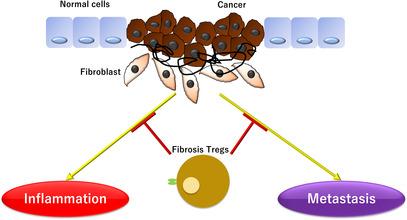
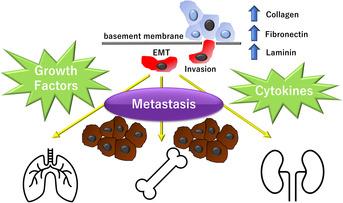
Desmoplastic reaction is a fibrosis reaction that is characterized by a large amount of dense extracellular matrix (ECM) and dense fibrous stroma. Fibrotic stroma around the tumor has several different components, including myofibroblasts, collagen, and other ECM molecules. This stromal reaction is a natural response to the tissue injury process, and fibrosis formation is a key factor in pancreatic cancer development. The fibrotic stroma of pancreatic cancer is associated with tumor progression, metastasis, and poor prognosis. Reportedly, multiple processes are involved in fibrosis, which is largely associated with the upregulation of various cytokines, chemokines, matrix metalloproteinases, and other growth factors that promote tumor growth and metastasis. Fibrosis is also associated with immunosuppressive cell recruitment, such as regulatory T cells (Tregs) with suppressing function to antitumor immunity. Further, dense fibrosis restricts the flow of nutrients and oxygen to the tumor cells, which can contribute to drug resistance. Furthermore, the dense collagen matrix can act as a physical barrier to block the entry of drugs into the tumor, thereby further contributing to drug resistance. Thus, understanding the mechanism of desmoplastic reaction and fibrosis in pancreatic cancer will open an avenue to innovative medicine and improve the prognosis of patients suffering from this disease.
促结缔组织增生反应是一种纤维化反应,其特征是大量致密的细胞外基质 (ECM) 和致密的纤维基质。肿瘤周围的纤维基质有几个不同的组成部分,包括肌成纤维细胞、胶原蛋白和其他 ECM 分子。这种基质反应是对组织损伤过程的自然反应,纤维化的形成是胰腺癌发展的关键因素。胰腺癌的纤维基质与肿瘤的进展、转移和不良预后有关。据报道,纤维化涉及多个过程,主要与各种细胞因子、趋化因子、基质金属蛋白酶和其他促进肿瘤生长和转移的生长因子的上调有关。纤维化还与抑制抗肿瘤免疫的免疫抑制性细胞招募有关,如具有抑制功能的调节性 T 细胞 (Treg)。此外,密集的纤维化限制了营养物质和氧气流向肿瘤细胞,这可能导致耐药性。此外,密集的胶原基质可以作为物理屏障阻止药物进入肿瘤,从而进一步导致耐药性。因此,了解胰腺癌中促结缔组织增生反应和纤维化的机制将为创新药物开辟途径,并改善患有这种疾病的患者的预后。


 Zotero 插件